

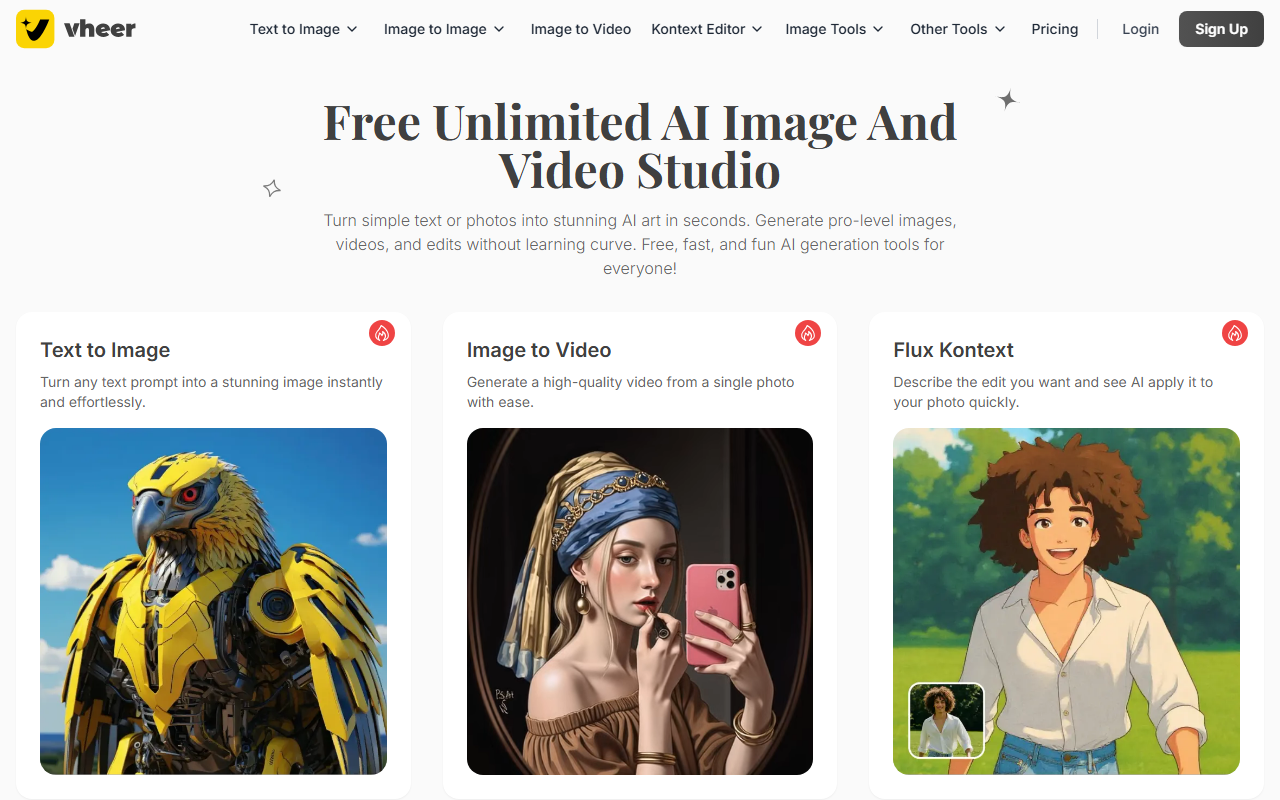
First Impressions and Interface
Upon visiting Vheer (vheer.com), I was greeted by a clean, modern dashboard that immediately invites experimentation. The landing page prominently displays a carousel of model options—Nano Banana Pro, Nano Banana 2, Flux Klein, SeeDream V4, SeeDance V1 Pro Fast, Veo3 Fast, LTX Video 2.3 Fast, Sora 2, MiniMax Image 01, and MiniMax Hailuo 2.3 Fast. The interface is minimal but functional, with a large text input prompt and a "Start Creating Now" call-to-action. I tested the free tier by entering a prompt: "Retro-futuristic portrait of a person with a glowing VR headset." Within seconds, Veo3 Fast generated a 4-second video clip that showed decent motion consistency and a slightly stylized aesthetic. The output was watermarked with a small Vheer logo, which is acceptable for the free tier. The overall onboarding is fast—no email sign-up required to start, which lowers the barrier to entry.
Model Ecosystem and Technical Capabilities
Vheer aggregates multiple AI models under one roof. The list includes well-known names like Sora 2 (OpenAI's advanced video model), Veo3 (Google), and MiniMax's image and video models. This aggregation is a key differentiator: instead of subscribing to individual services, you get a unified workspace. I tried generating an image using MiniMax Image 01 with the prompt "Giant glittering hand in a wildflower meadow." The result was highly detailed, with realistic lighting and texture—impressive for a single-pass generation. For video, I used SeeDance V1 Pro Fast with "Surreal shot of a pink cowboy on a floating horse" and received a short, smooth animation that maintained the surreal color palette. The platform appears to fetch model outputs from remote APIs, so generation speed depends on queue load—sometimes instant, sometimes a 10-second wait.
One notable feature is the absence of watermarks on the paid tier (as claimed). The free tier does include a watermark, but it's subtle. The platform also claims "unlimited" generations, which likely scales with the subscription tier. However, I did not see any explicit mention of API access or batch processing—this seems primarily a web app for individual creators. Integrations with external tools like Photoshop or Final Cut Pro are not mentioned.
Pricing, Market Position, and Alternatives
Pricing is not publicly listed on the website. This is a common tactic to encourage sign-ups, but it adds friction for serious evaluators. A quick search indicates that Vheer likely offers multiple subscription plans—free, pro, and enterprise—but exact numbers are absent. For context, competitors like RunwayML and Pika Labs have transparent pricing (e.g., Runway's Standard plan at $15/month for 625 credits). Vheer's advantage lies in offering premium models like Sora 2 and Veo3, which are typically locked behind expensive partnerships. If Vheer can offer these at a competitive price, it could disrupt the market. However, the lack of pricing transparency is a weakness; users cannot budget without contacting sales.
The tool is best suited for digital artists, social media managers, and content creators who need quick access to diverse generative models without managing multiple accounts. It is less ideal for developers seeking programmatic control or white-label solutions, as there is no obvious API. The user interface is intentionally simple, so it may not satisfy power users who want fine-grained control over parameters like seed, CFG scale, or steps. Overall, Vheer positions itself as a creative studio, not a technical tool.
Verdict and Recommendation
Vheer delivers on its promise of a unified creative studio with top-tier AI models. Its strengths are the breadth of model access—including Sora 2 and MiniMax—and the smooth, watermark-free experience on paid plans. The limitations are the hidden pricing and lack of advanced controls. I recommend Vheer for hobbyists and professionals who want to quickly experiment with many models in one place. However, before committing, contact their sales team for a price quote. If you need transparent billing or API integration, look at alternatives like RunwayML or Leonardo AI. Visit Vheer at https://vheer.com/ to explore it yourself.













Comments