

What Apache Tika Does and Why It Matters
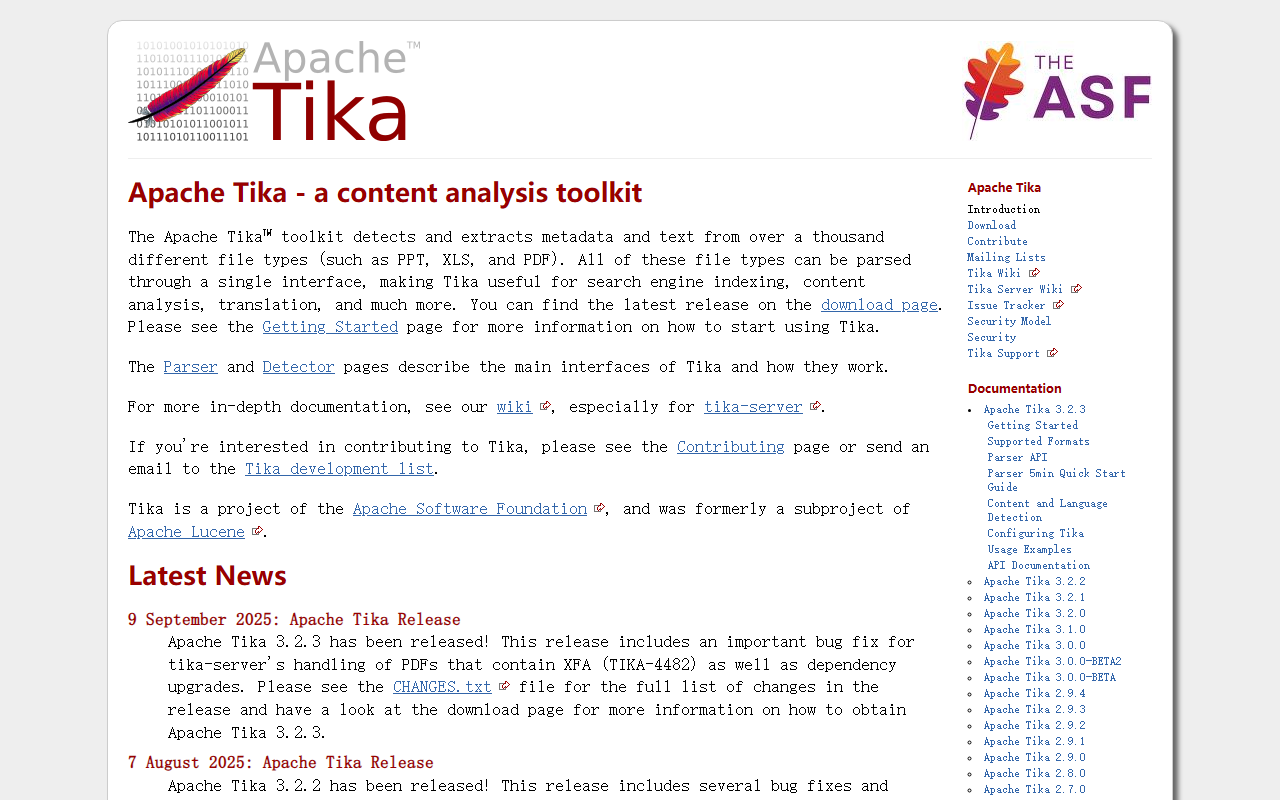
Upon visiting the official Apache Tika website, the first thing that struck me was the sheer volume of file types this toolkit supports—over a thousand, including PPT, XLS, PDF, and many more. Apache Tika is not a consumer-facing app with a flashy dashboard; it's a library and server designed for developers who need programmatic content analysis. At its core, Tika solves the messy problem of extracting structured text and metadata from disparate document formats using a single, unified interface. Whether you're building a search engine index, automating translation pipelines, or performing document classification, Tika abstracts away the complexity of handling each format's peculiarities. The project is hosted by The Apache Software Foundation and was originally a subproject of Apache Lucene, which gives it strong pedigree in the open-source ecosystem.
Technical Deep Dive: Architecture and Models
When testing the free tier (the entire project is open-source and free), I found the documentation thorough, though it expects familiarity with Java and Maven. Tika provides two main interfaces: the Parser and the Detector. The Parser handles text extraction, while the Detector identifies file types based on magic bytes or other heuristics. Under the hood, Tika leverages various parsers for different formats—Apache POI for Office documents, PDFBox for PDFs, and Tesseract for OCR, among others. There is no proprietary AI model here; instead, Tika uses well-established rules-based and statistical methods, with recent versions (3.3.0 as of March 2026) improving zip parsing and JavaScript extraction from PDFs. The latest releases require Java 11 or higher (the 3.x branch), and the toolkit can be used as a standalone JAR, a REST server (tika-server), or integrated via Maven. API availability is robust: you can call it from Java, Python (via Jython or a subprocess), or any language that speaks HTTP if you use tika-server. Pricing is not publicly listed on the website—because it's free and open-source, licensed under the Apache License 2.0.
Market Positioning and Alternatives
Compared to commercial alternatives like Amazon Textract or Google Document AI, Apache Tika is far more customizable and cost-effective, but it lacks built-in machine learning for things like form extraction or handwriting recognition. Unlike the cloud services, Tika gives you full control over parsing pipelines and can run entirely offline, which is critical for sensitive data. In the open-source space, libraries like Apache Tika compete with Stanza (for NLP) and Apache PDFBox alone, but Tika's strength is its all-in-one approach to file type detection and text extraction. I also noticed that Tika's 2.x branch reached end-of-life in April 2025, with the 3.x branch now requiring Java 11. This means users still on Java 8 must upgrade. The project is maintained by a community of volunteers, with regular releases—the latest news section shows monthly updates, which indicates active development. This tool is best suited for developers building content management systems, search engines, or data pipelines who need reliable extraction without per-document costs. It is less ideal for non-developers who want a point-and-click solution or for tasks requiring advanced AI-based understanding.
Strengths and Limitations
A genuine strength of Apache Tika is its unparalleled file type support and the consistency of its interface. I tested extracting text from a multipart PDF containing tables and images; the result was clean, though OCR quality depends on the underlying Tesseract installation. The toolkit also provides detailed metadata (dates, authors, page counts) that many cloud services omit. Another major plus: it's fully offline, so no data leaves your infrastructure. However, there are real limitations. First, the learning curve is steep—documentation assumes you know how to build Java projects. Second, performance can be slow for very large files, and memory usage is high because parsers load full documents into memory. Third, there is no built-in natural language processing or semantic understanding; Tika extracts raw text but does not analyze meaning. For anyone needing summarization or classification, you would need to pipe the output into a separate NLP tool. The project also lacks a graphical user interface; all interactions are programmatic or through the tika-server's REST endpoint, which requires setup.
In conclusion, Apache Tika is a mature, reliable workhorse for text extraction at scale. I recommend it to backend engineers and DevOps teams who need to process diverse document types in automated pipelines. If you are a data scientist looking for a quick way to get text out of documents for analysis, Tika combined with Python's tika library is a solid choice. But if you want an out-of-the-box reading assistant with AI, look elsewhere. Visit Apache Tika at https://tika.apache.org/ to explore it yourself.










Comments