

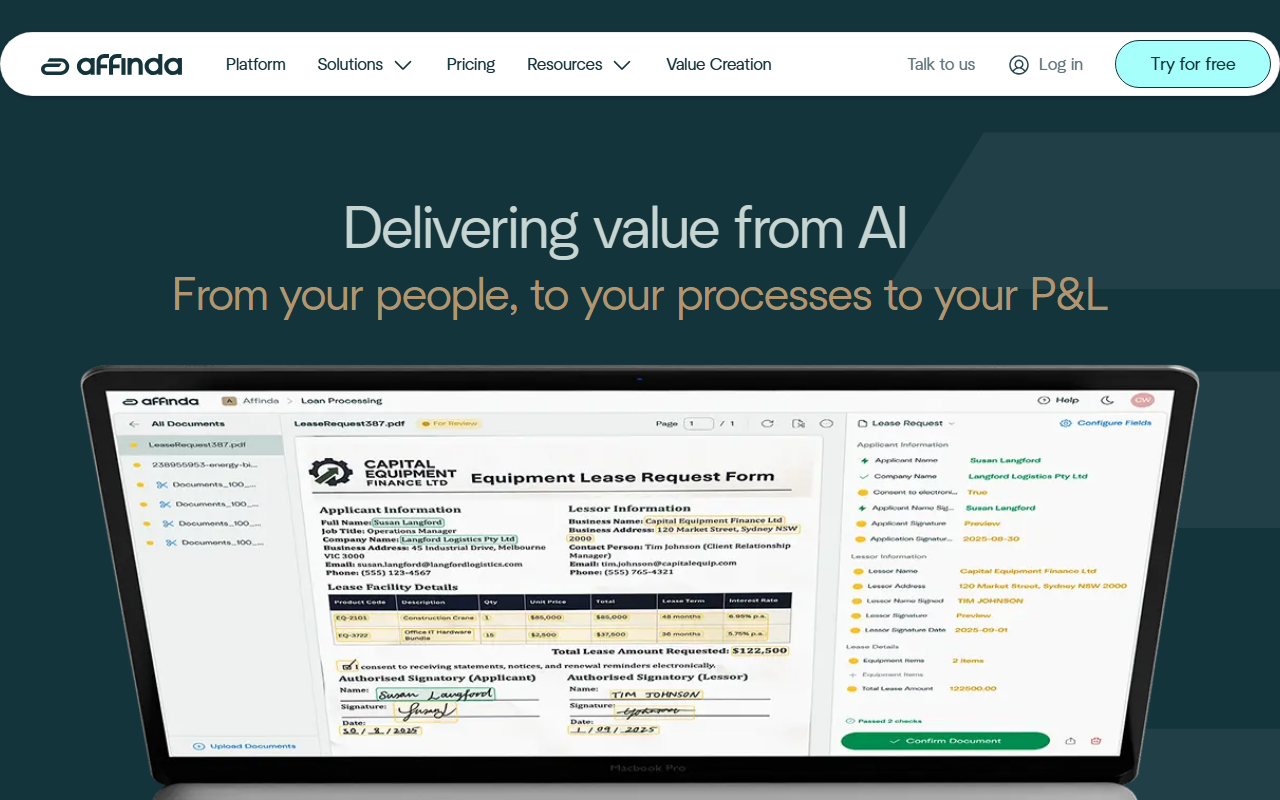
Upon visiting the Affinda website, I was immediately struck by how polished the landing page is. The tagline—“Turn documents into decision-ready data”—appears above a sleek demo interface. The navigation is clean, with clear calls to action like “Try Platform” and “Talk to us.” I could instantly log in via Microsoft, Google, or GitHub, which lowered the barrier to exploration. The site makes a strong first impression: professional, confident, and clearly aimed at enterprise-grade use.
The dashboard itself wasn’t fully accessible on the public site, but the interactive pitch suggests a system that abstracts away complexity. The promise of no “platform to learn, no consultants to hire” is bold, but the detailed feature breakdown that follows makes it believable.
What Affinda Does and How It Works
Affinda is an intelligent document processing (IDP) platform that ingests documents in any format—scanned, digital, templated, handwritten, multi-language—and outputs structured, validated data. The core innovation is the **Affinda Agent**, which you can configure in plain English. Instead of training models or writing complex extraction rules, you describe your workflow conversationally, and the platform sets up the pipeline.
The tool uses frontier AI models but wraps them in production-grade controls: reading order, context selection, grounding, and validation. This means the output isn’t just raw extracted text but data with traceability—every field links back to its exact location in the source document. That’s huge for regulated industries like insurance and finance.
Another standout feature is **continuous learning**. Every time a human validates an extraction, that document becomes a reference for future processing. No more months of training with thousands of labelled examples. The platform adapts as your documents change. I also noticed support for multi-document bundles: loan files, insurance submissions, supplier kits—one messy pack in, structured data out. This is a realistic solution for real-world workflows.
Affinda also includes a human review queue for exceptions. Business rules automatically route documents that pass validation straight through; those that fail go to a review interface with the source document alongside. This balances automation with accountability.
Pricing and Market Position
Affinda does not publicly list pricing on its website. The site offers a free trial (“Try for free”) and a “Talk to us” option, strongly suggesting a **custom enterprise pricing model**. This makes sense given the platform’s focus on large-scale, industry-specific deployments. You will need to contact sales to get a quote.
In the IDP space, Affinda competes with players like **ABBYY**, **UiPath Document Understanding**, and **Amazon Textract**. Unlike ABBYY which often requires more upfront configuration, Affinda emphasizes natural language setup and continuous learning. Compared to UiPath, which integrates tightly with RPA, Affinda is more of a standalone document intelligence layer with API-first architecture and client libraries for Python, JavaScript, .NET, and more. It also has deep vertical specialization—banking, insurance, healthcare, logistics—backed by impressive customer stories (95% reduction in manual work, 300K documents processed annually in one case).
For teams that need a plug-and-play document processing layer without heavy IT involvement, Affinda is a strong candidate. But small businesses or one-off projects might find the lack of transparent pricing a barrier.
Strengths, Limitations, and Verdict
Strengths: The natural language configuration is genuinely innovative—teams can prototype a workflow in minutes. The continuous learning loop reduces model maintenance effort. The traceability feature is a must for compliance-heavy industries. The platform handles messy real-world documents (multi-language, handwritten, varied formats) effectively. The customer validation data is compelling: 95% reduction in manual work, 10x more invoices processed without added staff, and 82% straight-through processing from the first weeks.
Limitations: The lack of public pricing makes it inaccessible for smaller teams or casual users. The free trial likely has limited scope. The tool is clearly built for enterprise-scale document processing; if you only need occasional single-document extraction, simpler solutions like small GPT-powered scripts might suffice. Also, while the website claims “no platform to learn,” the actual setup for complex integrations may require some technical familiarity with APIs.
Recommendation: Affinda is best suited for medium to large enterprises that process high volumes of diverse documents—think insurance claims, loan processing, accounts payable, or compliance workflows. If you need a document intelligence layer that adapts quickly and provides auditable outputs, give Affinda a serious look. Start with the free trial to test against your own documents. Just be prepared to negotiate a custom plan. Visit Affinda at https://affinda.com/ to explore it yourself.










Comments