

First Impressions and Core Functionality
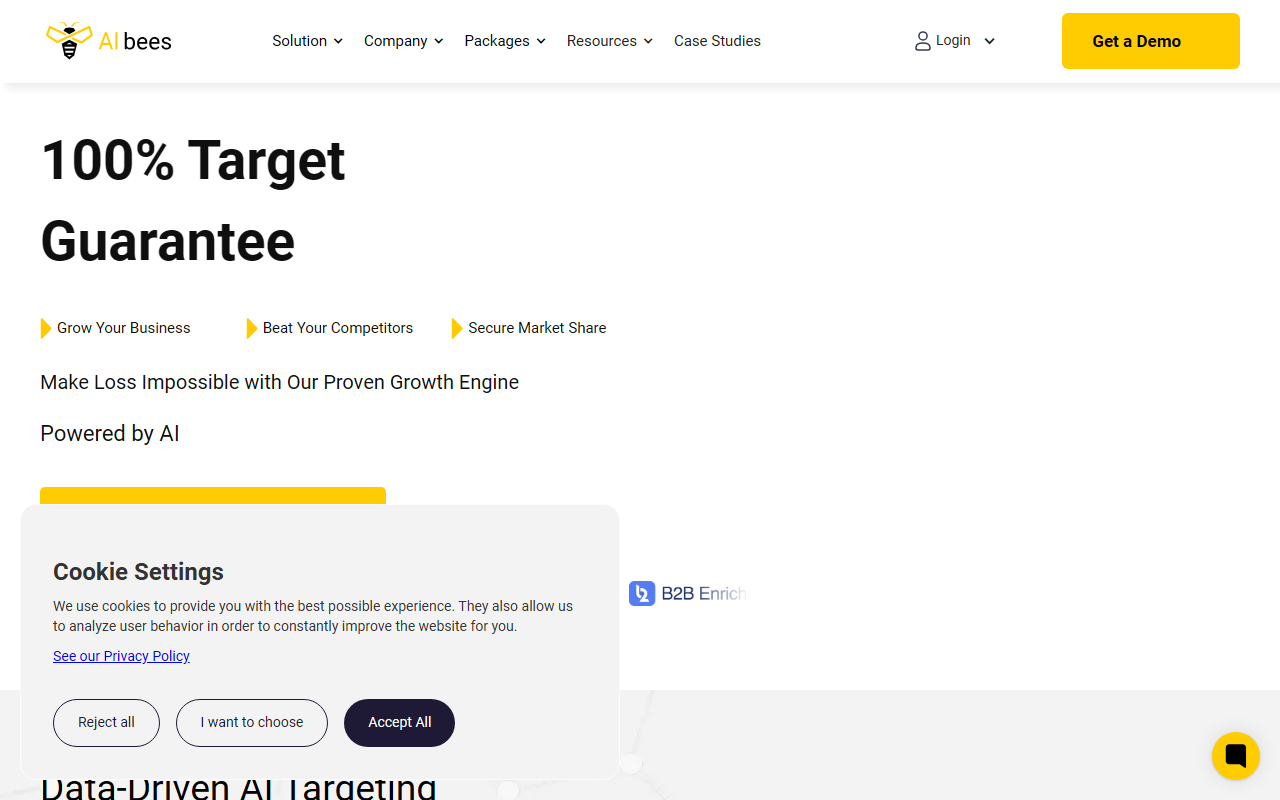
Upon visiting the AI bees website at ai-bees.io, the first thing that struck me was the bold claim: '100% Target Guarantee' and 'Make Loss Impossible.' The homepage wastes no time pitching a performance-based growth engine powered by AI. The navigation is clean, with sections for Company, Packages, Resources, Case Studies, and a prominent 'Get a Demo' button. This is not an AI writing tool in the traditional sense—it is a B2B marketing platform that uses AI to identify prospects, personalize campaigns, and secure meetings.
AI bees positions itself as a complete solution for companies struggling with outbound marketing. The dashboard (though I could not access it without a demo) is advertised as version 2.0. The platform is built around three core modules: AI Nectar, AI Memory, and AI Harvest. AI Nectar helps determine new opportunities by matching them with ideal customers. AI Memory finds companies that look exactly like your ideal customer profile. AI Harvest notifies you when companies need your products or services—essentially intent data. Additionally, the tool layers on behavioral, psychographic, and geo-demographic profiles to refine targeting.
The AI Behind the Targeting
Digging deeper into the technology, AI bees claims to use 'Intelligent Persona-Based AI Targeting' that combines behavioral, psychographic, and geo-demographic profiling. This is more sophisticated than simple firmographic or keyword-based lead generation. The platform also emphasizes 'Weekly Updated Calls and Campaign Analysis From Your Dedicated Account Manager' and 'Multiple Sessions and Workshops with a Team of Growth Hackers.' This suggests AI bees is not a self-serve SaaS tool but rather a managed service with human oversight.
I noticed the website mentions 'Data-Driven AI Targeting' but does not specify which underlying AI models or machine learning algorithms are used. The lack of technical transparency may frustrate prospective buyers who want to evaluate the AI’s accuracy. However, the inclusion of case studies from a Business Consulting Firm, an Enterprise Manager in Dubai, and Hello SciCom (with founder Sarah Rose Siskind) adds some credibility. These case studies imply that AI bees has worked with real clients across different verticals.
One workflow the site highlights is the ability to generate 'highly personalized campaigns with precisely selected prospects.' This is a common pain point for B2B marketers: manual prospecting eats up time, and generic outreach gets ignored. AI bees aims to automate both the targeting and the personalization using the three AI modules. The promise of performance-based contracts—paying only for results like booked meetings—is a strong differentiator.
Pricing and Market Positioning
Pricing is not publicly listed on the website. The 'Packages' dropdown shows three options: 'CPL Scalable Package,' 'SPA,' and 'SAKA Growth Platform.' Without specific dollar figures, potential customers must request a demo to get quotes. This lack of transparency can be a barrier for smaller businesses or those with tight budgets. In comparison, competitors like Apollo.io offer transparent monthly subscriptions (starting at $49 per user per month) for lead database and engagement, while Lusha provides per-contact pricing. AI bees seems to target enterprise accounts willing to invest in a managed service model.
Another competitor is ZoomInfo, which also offers B2B intent data and account-based marketing. Unlike those platforms, AI bees focuses on a performance-based contract where you pay for booked meetings, not for the data itself. That could be appealing if the targeting truly delivers. However, the website does not clarify what constitutes a 'result' or how success is measured.
AI bees claims to be 'Trusted by Top Companies Worldwide,' but the logos or client names beyond those case studies are not displayed. The footer reveals the company is based in the US with a San Francisco phone number (+1 415 801 6494) and an international presence implied by the Dubai client. The platform also emphasizes GDPR compliance and data policy, which is essential for European buyers.
Strengths, Limitations, and Verdict
The strongest aspect of AI bees is its performance-based pricing model. For companies tired of paying for leads that never convert, the 'Pay for Results' approach reduces risk. The combination of AI modules for opportunity matching, look-alike audiences, and intent signals is comprehensive. The dedicated account manager and growth hacking workshops add a human touch that pure software solutions lack.
However, there are real limitations. The lack of publicly available pricing makes it hard to evaluate cost-effectiveness. The technical details of the AI are vague—no mention of model names, accuracy metrics, or third-party evaluations. The website is also light on product screenshots or a live demo, which makes it difficult to assess the user experience. For a tool that promises to 'make loss impossible,' the evidence relies heavily on a few case studies.
Who should try AI bees? This tool is best suited for B2B companies with a clearly defined ideal customer profile and a sales team ready to follow up on pre-qualified meetings. It is not for content writers or general AI writing tasks. If you need an AI assistant for drafting emails or articles, look elsewhere—this is a full-fledged outbound marketing engine.
Who should look elsewhere? Small businesses with limited budgets or those that prefer a self-serve platform may find AI bees too opaque. Similarly, companies that require deep technical integration or API access (not mentioned on the site) may be disappointed.
Overall, AI bees presents an intriguing value proposition for B2B marketers willing to bet on performance-based campaigns. The combination of AI targeting and human-led strategy could be a winning formula, but the lack of transparency in pricing and AI specifics leaves questions unanswered. I recommend requesting a demo to see if the results match the promise.
Visit AI bees at https://ai-bees.io/ to explore it yourself.










Comments