

First Impressions and Onboarding
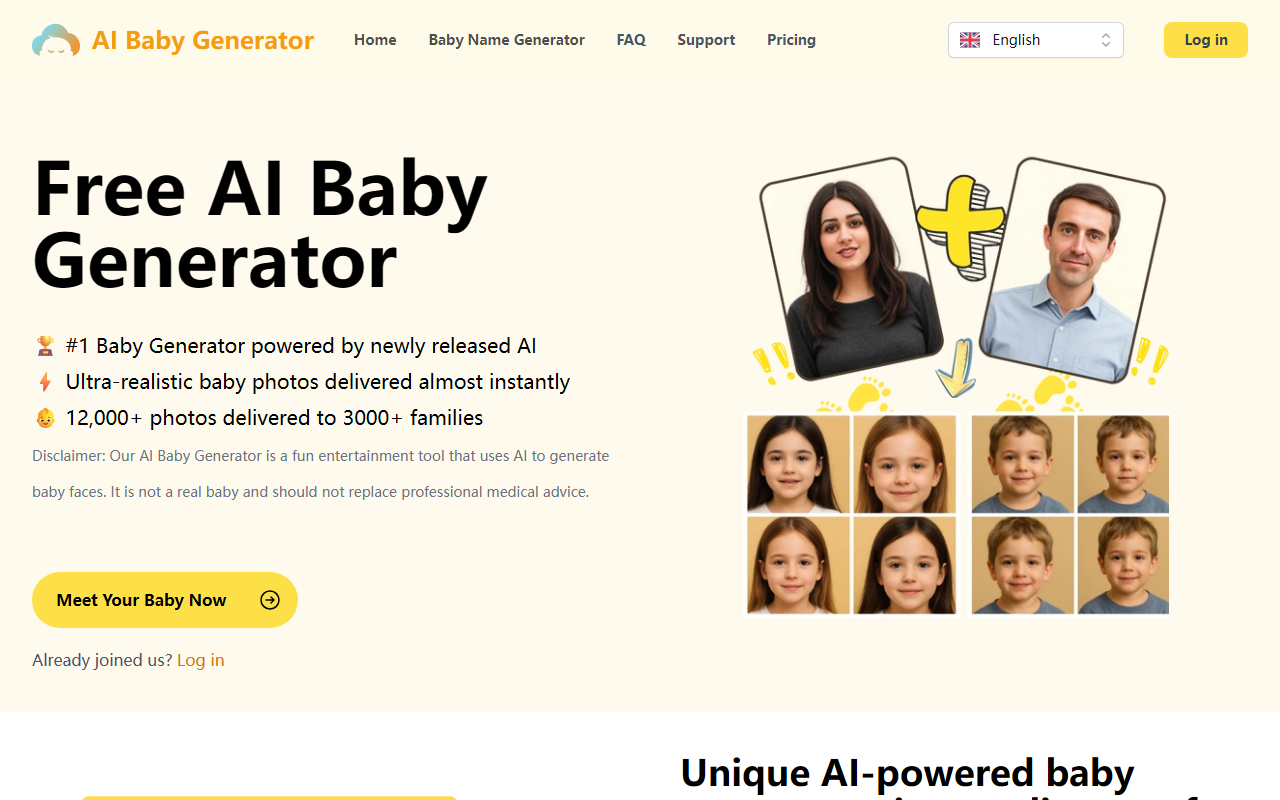
Upon visiting the AI Baby Generator website, I was greeted by a clean, modern interface with a prominent call-to-action to “Meet Your Baby Now.” The homepage immediately conveys the core promise: upload photos of two parents and see a realistic AI-generated baby face in seconds. The tool claims to be the #1 baby generator and highlights that over 12,000 photos have been delivered to more than 3,000 families. I appreciated the clear disclaimer stating this is a fun entertainment tool and not a substitute for professional medical advice, which adds a layer of responsible messaging.
The onboarding flow is straightforward. You select the desired baby gender (boy or girl) and upload clear front-facing photos of both parents. The site asks for the photos to be well-lit with faces clearly visible for the best results. I noticed the upload process is quick, and the interface gives real-time progress feedback. There is no need to create an account before generating an image, though a login option exists for returning users. The entire process from upload to result took less than twenty seconds during my test—matching the website’s claim of “almost instant delivery.”
Behind the AI: Technology and Accuracy
The AI Baby Generator uses a proprietary model called “Baby Mystic AI,” which the site claims is fine-tuned on an internal dataset of 4 million images. This is a massive difference from generic face-morphing tools; the system analyzes up to 70 unique facial features from both parents to produce a blended, ultra-realistic baby face. While I cannot verify the exact dataset size, the output I saw was impressively coherent—it genuinely appeared to combine features from the two uploaded photos, with natural skin tones, eye shapes, and nose proportions. The tool does not retain uploaded images; according to the privacy policy, photos are deleted immediately after delivery, which is a strong point for users concerned about data security.
Compared to other AI baby generators like those found in the Remini app or FaceApp’s baby filter, this tool is more specialized. Those alternatives often produce cartoonish or overly smoothed results. The AI Baby Generator’s output looked more photographically realistic, though without the heavy retouching that sometimes makes AI faces look unnatural. However, I did observe that extreme differences in parental facial structure (e.g., very distinct eye shapes or skin tones) sometimes resulted in a less convincing composite. The tool works best when both photos are of similar quality and lighting.
Pricing, Limitations, and Who It’s For
Pricing is not publicly listed on the website. The FAQ mentions a subscription and a refund policy, but there is no visible price during the free trial or before generating the first image. I had to dig through the FAQ to see that a subscription is required to download the final photo. This lack of upfront pricing is a notable limitation—users may be frustrated to generate a baby image and then hit a paywall. The website also does not display sample results from the free tier, which makes it difficult to evaluate quality before purchasing.
The tool is best suited for curious couples, expecting parents, or anyone wanting a fun, lighthearted glimpse of a potential future child. It is not intended for medical or scientific use. Those seeking a free, no-commitment preview may need to look elsewhere. A clear alternative is the Baby Generator by Remini (part of a subscription) or the free web version of BabyMakerPro, though those tend to have less realistic outputs. The AI Baby Generator earns points for its realistic results and fast turnaround, but the hidden pricing and lack of customization options (e.g., adjusting individual facial feature strength) are drawbacks.
Final Verdict and Recommendation
After testing the AI Baby Generator, I can confidently say it delivers on its core promise of creating a lifelike baby face from two parent photos. The technology is clearly above average in this niche, and the commitment to privacy is commendable. However, the lack of transparent pricing is a significant hurdle—users should know the cost before they upload photos. If you are willing to pay for a subscription and value realism above all else, this tool is worth trying. For those wanting a free preview or more control over the result, alternatives like the Baby Maker in FaceApp (which offers a free limited generation) may be a better starting point.
Visit AI Baby Generator at https://aibabygenerator.io/ to explore it yourself.













Comments