

First Impressions and Onboarding
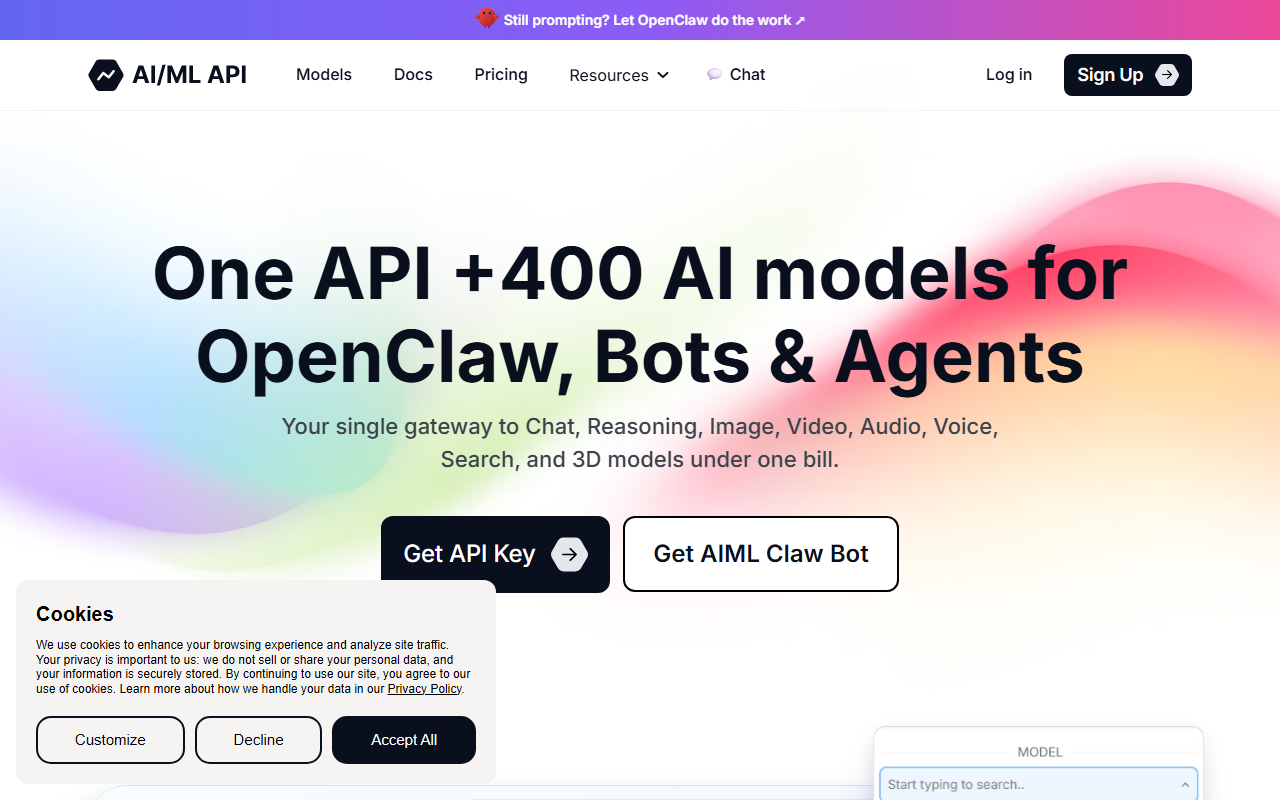
Upon visiting the AIMLAPI site, I was immediately struck by the breadth of models listed on the homepage. The layout is clean, with a prominent hero section featuring a "Get API Key" button and a clear value proposition: one API for over 400 models spanning chat, reasoning, image, video, audio, voice, search, and 3D generation. I signed up in seconds—no credit card required for the free tier. After account creation, I was taken to a dashboard where I could buy credits and generate an API key. The onboarding flow is frictionless, and I appreciated the quick-start code snippet (using OpenAI's Python client) that lets you switch endpoints within minutes.
Model Catalog and Capabilities
The core of AIMLAPI is its enormous model marketplace. During testing, I browsed offerings from MiniMax (including M2.7 and M2.5), OpenAI, Google, Anthropic, Alibaba Cloud, and more. Each model card displays type, price per million tokens, and a concise description. For example, MiniMax M2.7 touts a 204K-token context window and sub-dollar-per-million pricing. I also spotted specialized models for music generation (MiniMax Music 2.6), video synthesis (Wan 2.6), images (GPT Image 1.5), and even OCR and safety moderation. The built-in AI Playground lets you test any model in a sandbox before integrating. I tried a few prompts on GPT-5.2 and DeepSeek R1; responses were fast and coherent, with latency comparable to direct API calls. This breadth of models under one bill is the platform's strongest asset.
Pricing, Integration, and Developer Experience
AIMLAPI uses a credit-based system, with per-token prices listed for each model (e.g., MiniMax M2.7 at 0.351 per 1M input tokens, GPT-5.2 at 2.275 per 1M tokens). There are no fixed subscription tiers publicly listed—pricing is entirely usage-based. This is great for scaling but less predictable for budgeting. Integration is straightforward: the platform provides an OpenAI-compatible endpoint, so switching from OpenAI requires only changing the base URL and API key. The documentation includes Python, Node.js, and curl examples. I also appreciated the 99% uptime SLA and 24/7 support claim, though I didn't test that extensively. Unlike OpenRouter, which focuses on routing, AIMLAPI provides its own infrastructure and a broader range of modalities (including 3D and music). However, models labeled "new" like MiniMax releases may have less community validation than established providers.
Strengths, Limitations, and Verdict
The biggest strength of AIMLAPI is its sheer variety: you get one API key to access 400+ models from multiple vendors, eliminating separate accounts and billing. The sandbox playground and OpenAI compatibility lower the barrier to experimentation. On the downside, pricing is not presented as clear monthly tiers—you have to estimate costs per token, which can feel opaque. Additionally, not all models are equally reliable; I noticed some niche models (e.g., Alibaba's Z-Image Turbo) had limited documentation. This tool is best suited for developers building agents, bots, or apps that need multiple AI capabilities (chat, image, audio, etc.) without managing multiple integrations. It is less ideal for teams that require fixed monthly budgets or deeply specialized models with extensive community support. Overall, AIMLAPI offers a compelling unified API experience. If you value convenience and breadth, it's worth investigating.
Visit AIMLAPI at https://aimlapi.com/ to explore it yourself.










Comments