

First Impressions and Onboarding
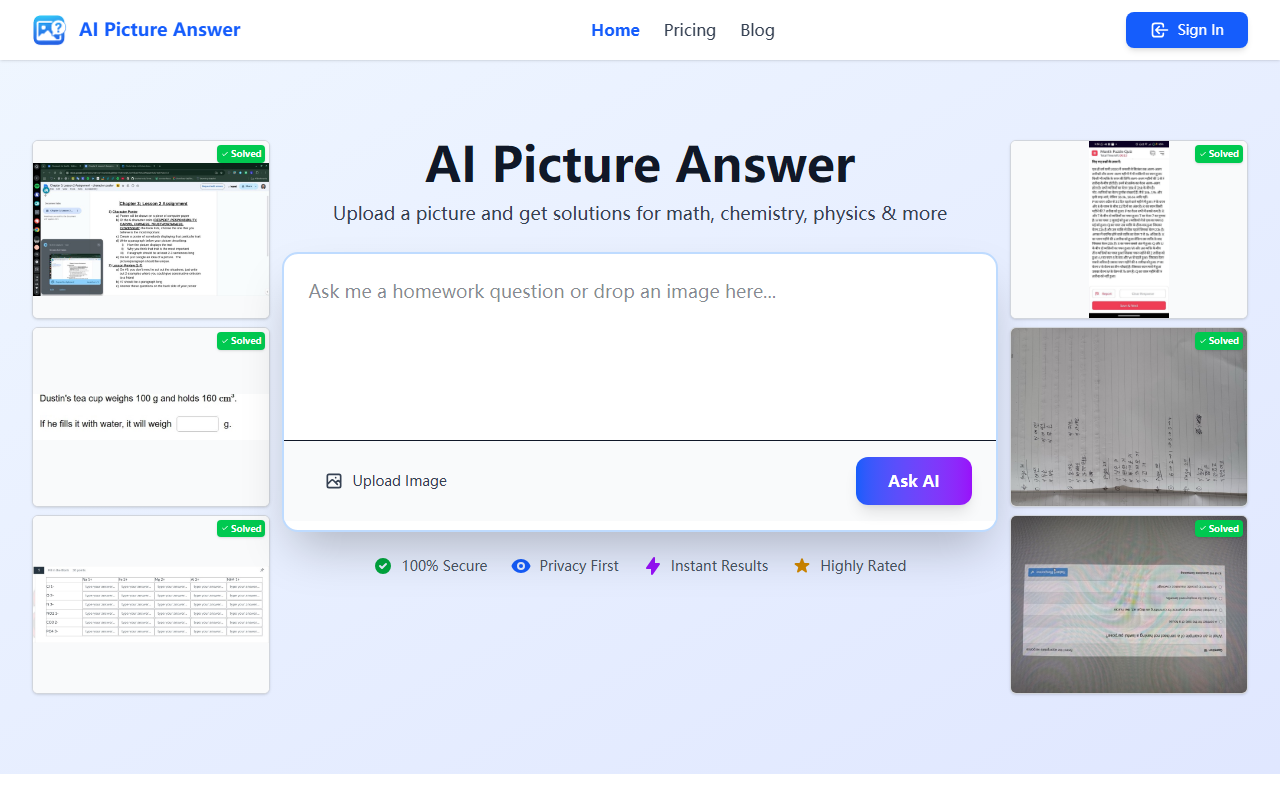
Upon visiting AI Picture Answer, I was greeted by a clean, minimalist interface dominated by a central upload area and a large call-to-action to snap or upload a homework problem. The landing page immediately emphasizes solving for math, chemistry, physics, and biology, with repeated testimonials and trust signals. The free tier promises 10 questions per day after signing in with Google, and no credit card is required — a rare find in the homework-help space. After a quick Google sign-in, the dashboard remained simple: an image upload button and an “Ask AI” button. When testing the free tier, I uploaded a handwritten algebra problem. The tool processed it in about 5 seconds and displayed a full step-by-step solution. The solution was clear and logically structured, though I noticed the AI occasionally misread a blurred digit, leading to an incorrect final answer. Still, the speed and accessibility were impressive.
Core Features and Technical Details
The tool operates on three steps: snap, AI solves, learn. It supports handwritten notes, printed textbooks, and PDFs. Under the hood, it uses advanced AI technology — likely a combination of OCR for text recognition and a large language model for problem-solving. Subjects include algebra, calculus, geometry, chemistry (organic chemistry, stoichiometry), physics (mechanics, quantum), biology, and 15+ others. The website claims 98%+ accuracy across all subjects, though this is unverified by independent testing. Each solution includes step-by-step explanations, which is crucial for learning rather than just answer-copying. There is no mobile app; the tool is browser-based and fully responsive. Security is mentioned with bank-level encryption and a privacy-first approach. The tool also allows typing questions or combining text with images.
Pricing and Realistic Limitations
The pricing model is generous for light use: 10 free questions per day after signing in with Google. For unlimited access, you purchase credits at 1 cent per solve, which is extremely affordable compared to competitors like Chegg or Photomath. However, the free tier forces a sign-in, which may deter some users. A major limitation I encountered is that the AI struggles with complex, multi-step problems or those requiring diagrams — for instance, a physics problem about inclined planes with a free-body diagram gave a generic solution that missed the specific angle. Also, accuracy depends heavily on image quality; blurry or poorly lit photos lead to errors. The tool is best for straightforward homework problems, not advanced research or test preparation. Despite the 98% claim, occasional mistakes reduce reliability for high-stakes work.
Market Position and Final Verdict
AI Picture Answer competes directly with Photomath, Symbolab, and Chegg. Unlike Photomath, which excels at math but falters in chemistry and biology, AI Picture Answer covers a broader subject range with decent quality. It lacks the rigorous step verification that Chegg offers, but wins on price and speed. This tool is best suited for middle school, high school, and early college students who need quick, free help with routine homework. It is less ideal for advanced learners or those needing deep conceptual explanations. I recommend trying the free tier to gauge accuracy on your specific subjects. The tool is honest about its academic integrity stance — it discourages cheating and positions itself as a learning aid. Overall, AI Picture Answer is a solid choice if you want instant, cross-subject help without spending money upfront.
Visit AI Picture Answer at https://aipictureanswer.com/ to explore it yourself.











Comments