

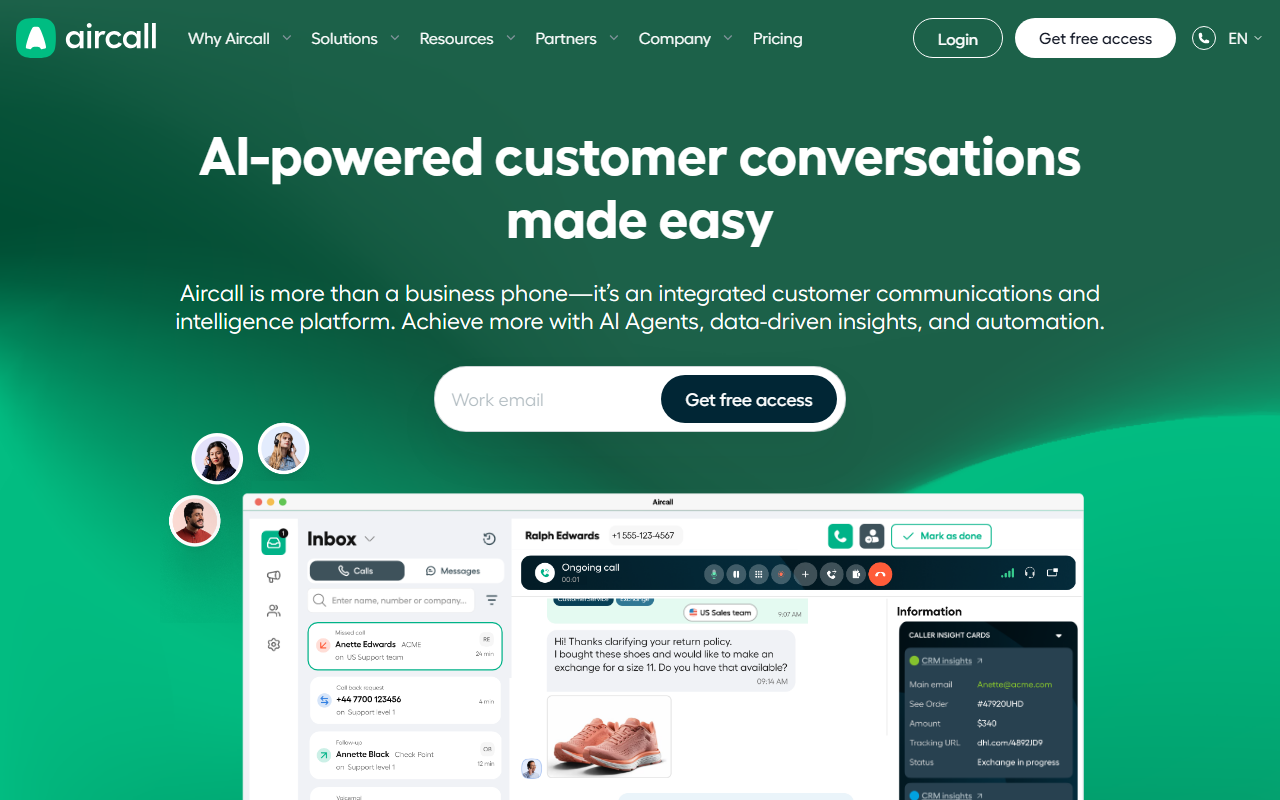
Exploring the Aircall Platform: A First Look
Upon visiting the Aircall website, the first thing I noticed is the clear three-tier messaging: Team-Led, AI-Assisted, and AI-Led. The homepage immediately pitches Aircall as an intuitive, AI-powered platform that brings together intelligent voice agents, automated workflows, and adaptive real-time coaching at scale. With over 22,000 companies trusting the platform, it’s clearly a player in the customer communications space.
The dashboard itself isn’t shown on the site, but the feature descriptions paint a picture of a unified workspace. Calls, SMS, and messaging live in one interface, and a shared inbox keeps every conversation visible across the team. The emphasis is on collaboration — agents can step into live calls without losing context, and integrations with major CRMs (Salesforce, HubSpot, Zendesk, and 250+ others) are native, meaning data syncs automatically. I tested the free trial sign-up flow; it’s straightforward, asking for basic company info and offering a quick setup wizards. The site also offers a downloadable AI Implementation Guide, promising to get AI Virtual Agents live without a developer — a bold claim that aligns with the “no technical skill required” testimonial from IT Manager Anthony Messina.
Three Layers of AI-Powered Communication
Aircall’s architecture is built around three distinct AI modes, each solving a different problem. The Team-Led layer is essentially a modern cloud PBX with enterprise-grade call quality and reliability. It’s the baseline phone system that any business can use day one. The real innovation sits in the AI-Assisted and AI-Led layers.
The AI-Assisted layer focuses on real-time support for human agents. During a live call, an AI Assistant can provide suggested responses, transcribe the conversation, detect sentiment and topics, and automatically log notes into the CRM. Managers get immediate visibility into performance trends. This reduces manual after-call work — something every contact center agent will appreciate. The AI-Led layer introduces AI Virtual Agents that can handle routine requests autonomously. They identify caller intent, gather details, and resolve issues end to end. When a situation becomes complex, the virtual agent escalates with full context — including conversation history — so a human agent doesn’t miss a beat. These agents work 24/7, handling after-hours calls and peak volumes without additional staffing.
While I couldn’t test the AI models directly from the website, the promise is clear: Aircall isn’t just a phone system with AI bolted on; it’s rethinking workflows from the ground up. The emphasis on autonomous resolution and escalation with context feels more advanced than simple IVR chatbots.
Pricing and Market Position
Pricing is not publicly listed on the website — a common approach for enterprise-oriented communication platforms. The site only offers a “Try for Free” button and mentions “Enterprise-grade security & compliance” (SOC2 Type II, GDPR, HIPAA). This suggests Aircall targets SMBs and mid-market companies but also serves larger regulated industries. Competitors in this space include traditional VoIP providers like RingCentral and Vonage, as well as AI-native contact center platforms such as Five9 and Talkdesk. Unlike those, Aircall positions itself as easier to use, with a specific focus on integrating AI into daily workflows without requiring technical expertise. The 250+ pre-built integrations give it an edge for businesses already using Salesforce, HubSpot, or Zendesk.
One limitation: the absence of transparent pricing makes it hard for small teams to evaluate upfront. The reliance on AI also raises questions about accuracy — the site touts sentiment analysis and real-time coaching, but these features can vary in quality. If the AI misreads sentiment or suggests poor responses, it could harm customer experience. Additionally, while the platform claims end-to-end AI handling, the website lacks concrete examples or case studies showing performance metrics (e.g., resolution rates, CSAT scores).
Final Verdict: Who Should Use Aircall?
Aircall is best suited for businesses that want a unified customer communications platform with modern AI capabilities but lack the in-house technical team to build custom integrations or train models. It’s ideal for sales teams, support teams, and small-to-mid-sized contact centers looking to reduce manual work, improve agent performance, and provide 24/7 coverage. Enterprises with complex legacy systems may find the integration library sufficient, but larger organizations might need more customization. If you’re a solo entrepreneur or a very small team, the lack of pricing and potential per-user cost could be a barrier. I recommend starting with the free trial to validate the AI’s real-time coaching and virtual agent performance. Aircall is a promising evolution of the traditional call center, blending human oversight with AI autonomy in a way that feels practical rather than gimmicky.
Visit Aircall at https://aircall.io/ to explore it yourself.










Comments