

First Impressions and Platform Overview
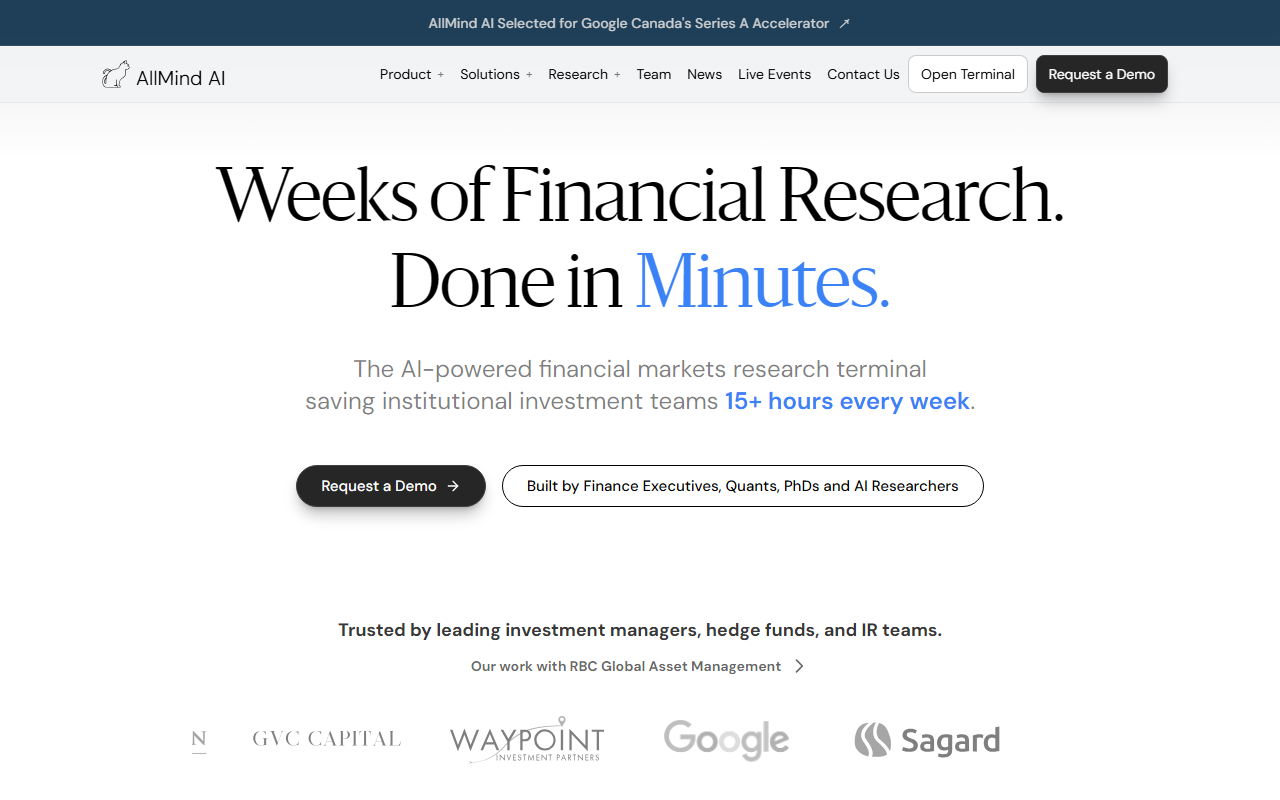
Upon visiting the AllMind AI website, I was immediately struck by its clear focus on institutional finance. The landing page wastes no time stating its value proposition: replacing AlphaSense, S&P Capital IQ, Hebbia, and Boosted AI at leading financial institutions. The dashboard is not publicly accessible, but the product page outlines a single platform that aggregates broker research, financial data from providers, and internal firm documents. The claim of saving 15+ hours per analyst per week is bold, and the mention of a 5-day turnaround compressed to 90 minutes for typical research tasks is the kind of metric that gets attention on the buy side. The site also highlights that AllMind was selected for Google Canada's Series A Accelerator, signaling strong backing and validation.
Core Features and Workflow Capabilities
AllMind AI is built around three pillars: unified data access, AI-powered research at scale, and workflow automation. The platform claims to make over 250 million documents searchable in seconds, including filings, broker research, ESG reports, news, and market data. The AI is described as providing institutional-grade accuracy with cited sources, a critical requirement for compliance-heavy environments. The workflow automation feature allows users to generate investment memos, custom templates, and due diligence reports, then export directly to Microsoft Office, PDF, or email. During my exploration, the site offers a demo request rather than a free tier, so I could not test the terminal hands-on. However, the testimonials and use-case descriptions for public equities, fixed income, wealth management, and private equity suggest a deep understanding of financial workflows. The agentic approach—letting the AI autonomously navigate data and produce deliverables—is a differentiator from simpler chatbot-based tools.
Security, Pricing, and Market Position
Security is clearly a priority for AllMind. The platform holds SOC2 Type I and Type II certifications, encrypts data at rest with AES 256 and in transit with TLS 1.3, and explicitly states that it does not train on user data. This is essential for institutional clients handling sensitive financial information. Pricing is not publicly listed on the website; interested teams must request a demo or contact sales. This is typical for enterprise SaaS tools targeting large asset managers. In the competitive landscape, AllMind directly rivals Hebbia (which also targets finance with AI research), AlphaSense (a popular research aggregator), and traditional terminals like Bloomberg. Unlike those, AllMind emphasizes full workflow automation and a single, unified platform. However, it appears to be exclusively for institutional investors, meaning freelancers or small research firms may find the pricing prohibitive or the features overkill.
Verdict: Who Should Use AllMind AI?
AllMind AI excels in its laser focus on institutional finance. Its genuine strengths include comprehensive data integration, agentic automation that saves significant time, and enterprise-grade security. The platform is clearly built for buy-side and sell-side research teams at banks, asset managers, hedge funds, and private equity firms. If your team currently juggles multiple tools like AlphaSense, Hebbia, and Excel macros, AllMind could replace them and streamline the research-to-deliverable pipeline. However, a real limitation is the opaque pricing and lack of a self-serve trial. Small teams or individual analysts will likely find the product inaccessible without a corporate budget. Additionally, the AI model specifics (e.g., which underlying LLMs are used) are not disclosed, making it hard for tech-savvy users to evaluate accuracy trade-offs. Overall, I recommend AllMind AI to any institutional research team that wants to cut down manual work and centralize their research stack. Others should look elsewhere or wait for a more accessible version. Visit AllMind AI at https://allmindinvestments.com/ to explore it yourself.













Comments