

First Impressions and Onboarding Flow
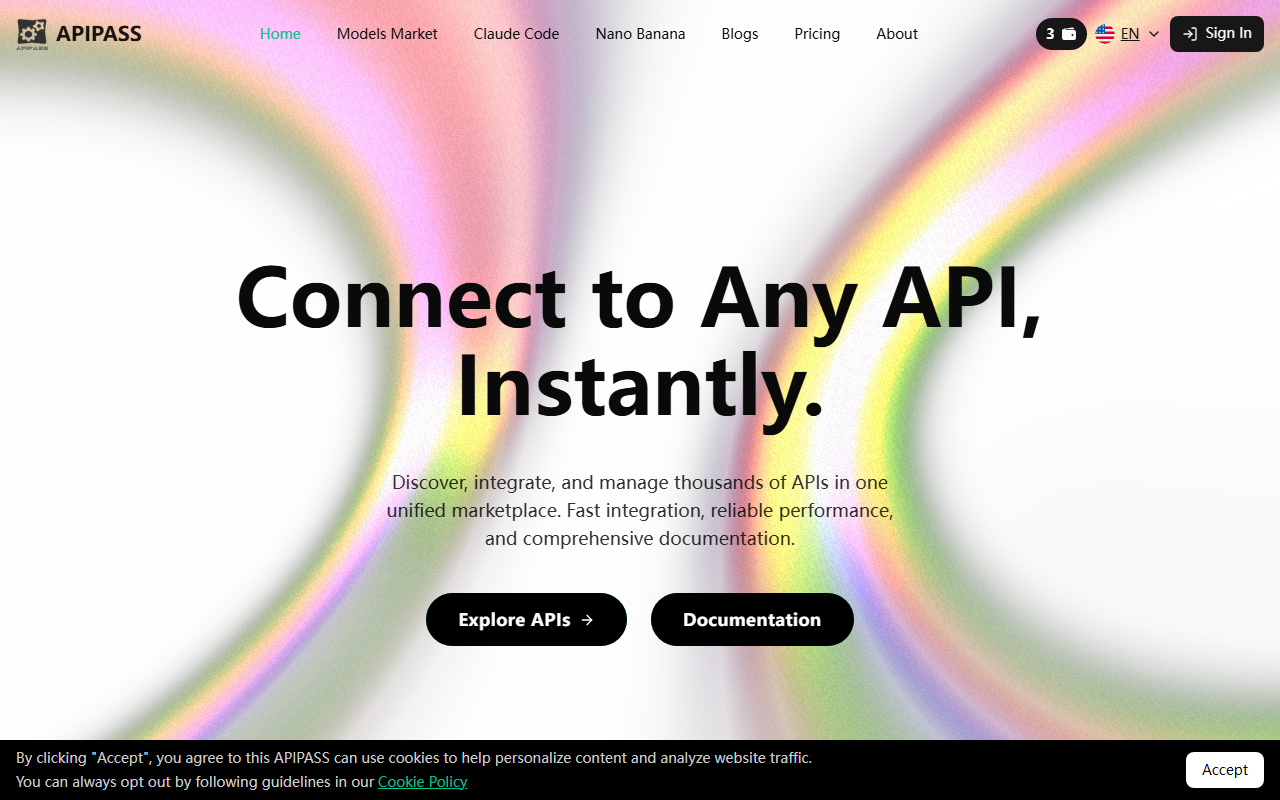
Upon visiting APIPass, I was greeted by a clean, modern landing page that immediately communicates its core proposition: a unified API marketplace for AI models. The homepage features a rotating carousel of model logos — from Kling and Luma to Claude and Gemini. The sign-in button is prominent, and the site offers a free credits registration call-to-action. I tested the free tier sign-up process, which was straightforward: only an email and password are required. After registering, I received 100 free credits, though the exact usage per API request is not clearly displayed during onboarding. The dashboard provides an API key generation section and a list of available models, but the interface feels slightly unfinished — some model cards lack detailed descriptions beyond a sentence. The interactive playground mentioned on the site is accessible, allowing me to test a prompt for image generation with Kling AI. The response took about 15 seconds, which is reasonable.
What APIPass Does and How It Works
APIPass acts as a middleware layer that aggregates dozens of AI APIs — primarily image, video, and text generation models — under one RESTful endpoint. Instead of managing separate API keys for Midjourney, DALL-E 3, Claude, Runway, and others, developers use a single key to call any supported model. The platform supports asynchronous tasks with webhook notifications, which is a thoughtful feature for workflows that don’t need synchronous responses. Under the hood, APIPass routes requests to the original providers (e.g., Anthropic, Google, Stability AI) but handles billing and rate limiting. This solves a real pain point for indie developers and small teams who want to experiment with multiple AI models without juggling multiple accounts and deprecation notices. The site mentions that it uses “optimized infrastructure” for fast response times, but does not specify which cloud provider or caching mechanisms are employed.
Pricing, Positioning, and Alternatives
APIPass does not publicly list its pricing tiers on the website. The only cost information available is that “free credits to start” are offered, and a promotional line says “Access premium AI models at prices lower than competitors.” Without concrete numbers, it’s impossible to assess whether it is truly cheaper than alternatives. For comparison, platforms like RapidAPI and Replicate also provide aggregated AI model access. RapidAPI focuses on a broader range of APIs with transparent pay-as-you-go pricing, while Replicate is more developer-centric with per-run costs and a stronger open-source community. APIPass leans toward an enterprise-friendly “contact us” model – an email is provided for enterprise solutions. The lack of transparent pricing is a limitation for freelancers and hobbyists who need clear budgeting. The website claims “thousands of developers” trust the platform, but there are no case studies or verified user counts. Given the absence of pricing details, I recommend potential users reach out for a quote before committing.
Strengths, Limitations, and Final Recommendation
Strengths: The primary strength of APIPass is its breadth of model access from a single integration. The support for both text-to-text and text-to-image/video models under one API key is genuinely convenient. The webhook support and playground are useful for testing. The free credits allow low-risk experimentation.
Limitations: The lack of public pricing is a significant drawback. The documentation, while claiming to be comprehensive, is not clearly navigated from the homepage — I had to scroll to find a link. Also, some models listed (e.g., Sora) are not yet publicly available via API elsewhere, raising questions about actual availability. Customer support responsiveness is not verifiable, and there is no SLA mentioned. The dashboard could be more polished with usage analytics.
Who should use it: APIPass is best suited for developers and small businesses who want rapid prototyping across multiple AI models without the administrative overhead of individual accounts. It is less ideal for enterprises that require detailed billing breakdowns, SLAs, and self-hosted options.
Who should look elsewhere: If you need specific features like fine-tuning access, model training, or very standardized API contracts, consider Replicate or directly pairing with providers. Also, if transparent per-request pricing is critical, wait for APIPass to publish tiers.
Visit APIPass at https://apipass.dev/ to explore it yourself.










Comments