

First Impressions: More Infrastructure Than Writing Tool
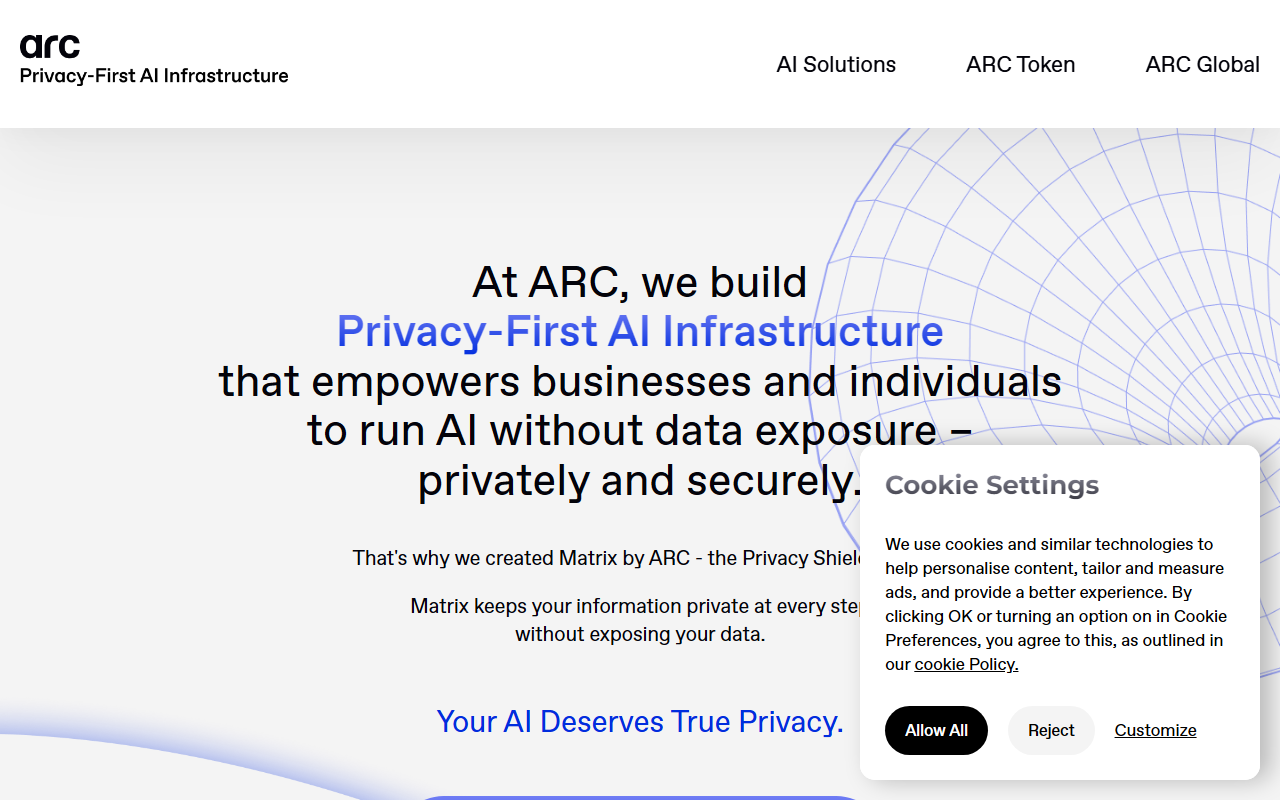
Upon visiting arc.ai, I was greeted not by a text editor or a prompt box, but by a cookie consent banner and a legal disclaimer about a token called $ARC. The site immediately asks you to accept that ARC Tokens and ARC Rewards are not investments—a red flag that this is as much a crypto project as it is an AI one. Navigating the dashboard, I found sections labeled “AI Solutions,” “ARC Token,” and “ARC Global.” There is no obvious “try now” button for AI writing. Instead, the homepage emphasizes “privacy, efficiency, and trust” and directs you toward a roadmap and token utilities. For someone looking for an AI writing assistant like Jasper or Copy.ai, this is confusing—ARC is clearly not a direct competitor.
Understanding ARC's Core Offerings
ARC’s AI Solutions include two named products: Matrix by ARC and Reactor by ARC. Unfortunately, the website provides no detailed descriptions of what these do—no demos, no screenshots, no model information. Based on the context, Matrix likely refers to a decentralized AI compute layer, and Reactor may be an inference or training engine. The site leans heavily on blockchain language: “on-chain infrastructure,” “ecosystem participation,” and “verified smart contracts.” The $ARC token is central, acting as a utility for access and coordination. ARC Global ties the structure together with entities in Switzerland and Samoa. In contrast to typical AI writing tools that plug into GPT or Claude, ARC appears to be building a full-stack, privacy-focused AI platform where the token is required for usage. I could not find any API documentation or integration guides on the site, which makes it difficult to assess its readiness for developers.
Pricing and Accessibility
Pricing is not publicly listed on the website. There are no subscription tiers or pay-per-use rates visible. Instead, ARC relies on the $ARC token economy, which implies that to use any of its AI services, you would need to acquire and hold the token—subject to market fluctuations and regulatory issues. The site includes a “Plans” section but it redirects to the token page. This exclusivity may appeal to crypto-native users but creates a high barrier for mainstream writers or small businesses. Competitors like OpenAI offer clear monthly subscriptions and free tiers; ARC offers none of that transparency. Until a pricing page or a free trial appears, potential users should treat this as an early-stage, token-gated platform rather than a plug-and-play writing tool.
Strengths, Limitations, and Verdict
ARC’s genuine strength is its stated commitment to privacy and decentralization. If they deliver on their roadmap, enterprises handling sensitive data might find value in a self-sovereign AI infrastructure. The integration of a utility token could also incentivize network participation. However, the limitations are significant: the product is essentially vaporware for writing purposes. There is no working demo, no sample output, and no clear timeline for public access. The heavy focus on tokenomics and disclaimers suggests legal and regulatory risks. ARC is best suited for blockchain enthusiasts and privacy-focused organizations that want to follow an evolving project. For anyone needing a reliable AI writing tool today—whether for blog posts, marketing copy, or research—look elsewhere. This is an infrastructure bet, not a writer’s assistant.
Visit ARC at https://arc.ai/ to explore it yourself.










Comments