

First Impressions and Onboarding
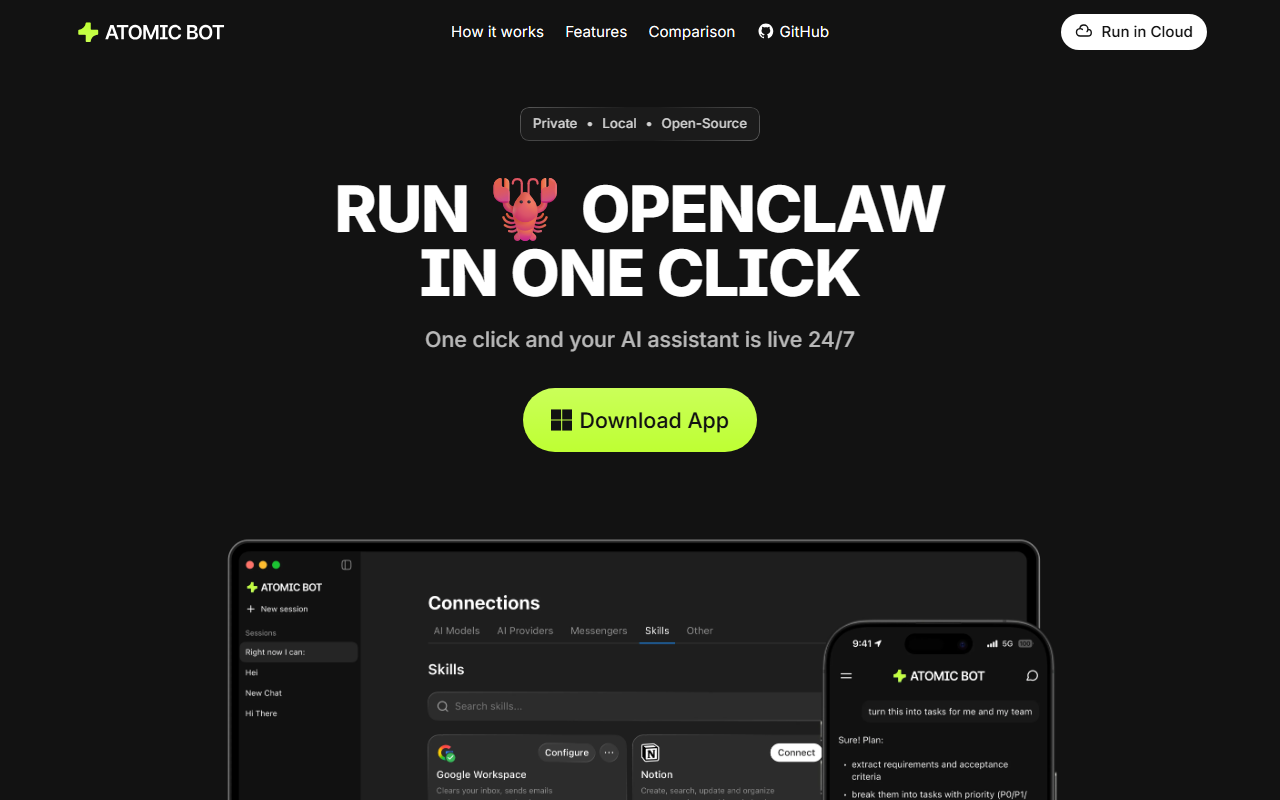
Upon visiting atomicbot.ai, I landed on a clean, minimalist page that immediately asks for an email to get early access. The message "Great news, you are in!" appears after sign-up, but the actual product is behind a waitlist. The page prominently showcases two open-source agents: OpenClaw and Hermes. There are download buttons for Mac and Web apps, as well as a "Run in Cloud" option. The onboarding experience feels streamlined but still clearly in beta—no dashboard or live demo is available without being admitted. I appreciate the emphasis on privacy-first design: "Runs locally on your device or securely in dedicated cloud." This suggests Atomic Bot is targeting users who are wary of sending data to third-party servers. The site also includes a comparison table showing Atomic Bot’s one-click setup versus manual terminal-based installation, which takes hours. For someone who wants to run AI agents without command-line fuss, this is an attractive value proposition.
Core Features and Capabilities
Atomic Bot is essentially a launcher for personal AI agents that can automate a surprising range of tasks. The listed capabilities include Gmail management (clearing threads, drafting replies in your tone), calendar autopilot (scheduling, moving events), reading docs and PDFs into summaries, monitoring trends and competitors, browser control (clicking, filling forms), travel assistance (check-ins, confirmations), file organization, building a "second brain," and general task automation. These are not hypothetical—testimonials from real users confirm that agents like Hermes and OpenClaw can manage memory, learn user preferences, and execute multi-step workflows. Notably, the tool integrates with Discord and uses proxy routing to leverage existing subscriptions (e.g., CoPilot) as API endpoints. The website also mentions "pre-installed skills" and a "user-friendly interface," which suggests that Atomic Bot abstracts away the complexity of configuring models and connecting services. However, I noticed no mention of which underlying large language model powers the agents (GPT-4, Claude, or open-source models). This lack of technical specificity may disappoint developers who want to know exactly what they're running.
Performance and User Feedback
Scroll down the page, and you'll find a long list of glowing user endorsements. One developer says Hermes "feels fundamentally better than every other agent harness" and praises its self-managed memory and context compression. Another user describes OpenClaw as "the first AI agent platform I would be willing to market and distribute as a professional install and setup service." The overall sentiment is overwhelmingly positive, with users highlighting reliability, ease of use, and the ability to run agents 24/7. Reddit threads and tweets repeatedly mention that Hermes works "out of the box" with minimal setup. However, these testimonials are curated, and I saw no independent benchmark or failure case. A critical remark exists: one user jokingly says "Friends don't let friends use OpenClaw, try Hermes," suggesting that among the two agents, Hermes might be more robust. Without hands-on testing, I cannot verify these claims, but the consistency of praise across multiple users indicates a real, functional product. The site also shows a placeholder "Comparison" tab in the navigation, but clicking it leads nowhere—another sign of the product’s early stage.
Pricing and Target Audience
Pricing is not publicly listed on the website. The only calls to action are "Get Early Access" and "Download Now" for the Mac and Web apps, with "other platforms soon." There is no mention of a free tier, subscription plans, or API pricing. This likely means Atomic Bot is still in a pre-revenue phase, relying on a waitlist to build a user base. Given the open-source nature of the underlying agents (OpenClaw and Hermes are available on GitHub), the monetization may come from cloud hosting, premium skills, or enterprise features. The ideal user is a developer or power user who wants to automate browser-based workflows, manage email and calendar, and run AI agents locally without trusting a third-party cloud service. This tool is less suited for casual users who are not comfortable with technical setup—even though Atomic Bot simplifies installation, you still need to configure services like Gmail and calendar connections. Competitors like AutoGPT, LangChain's Agent framework, and even OpenAI's ChatGPT with plugins offer similar capabilities but often lack the local-first, privacy-focused angle that Atomic Bot emphasizes. For anyone serious about running persistent, autonomous agents with full control over data, Atomic Bot is worth watching—but I'd wait until the full public launch to evaluate its reliability and see concrete pricing.
Visit Atomic Bot at https://atomicbot.ai/ to explore it yourself.










Comments