

First Impressions and Onboarding
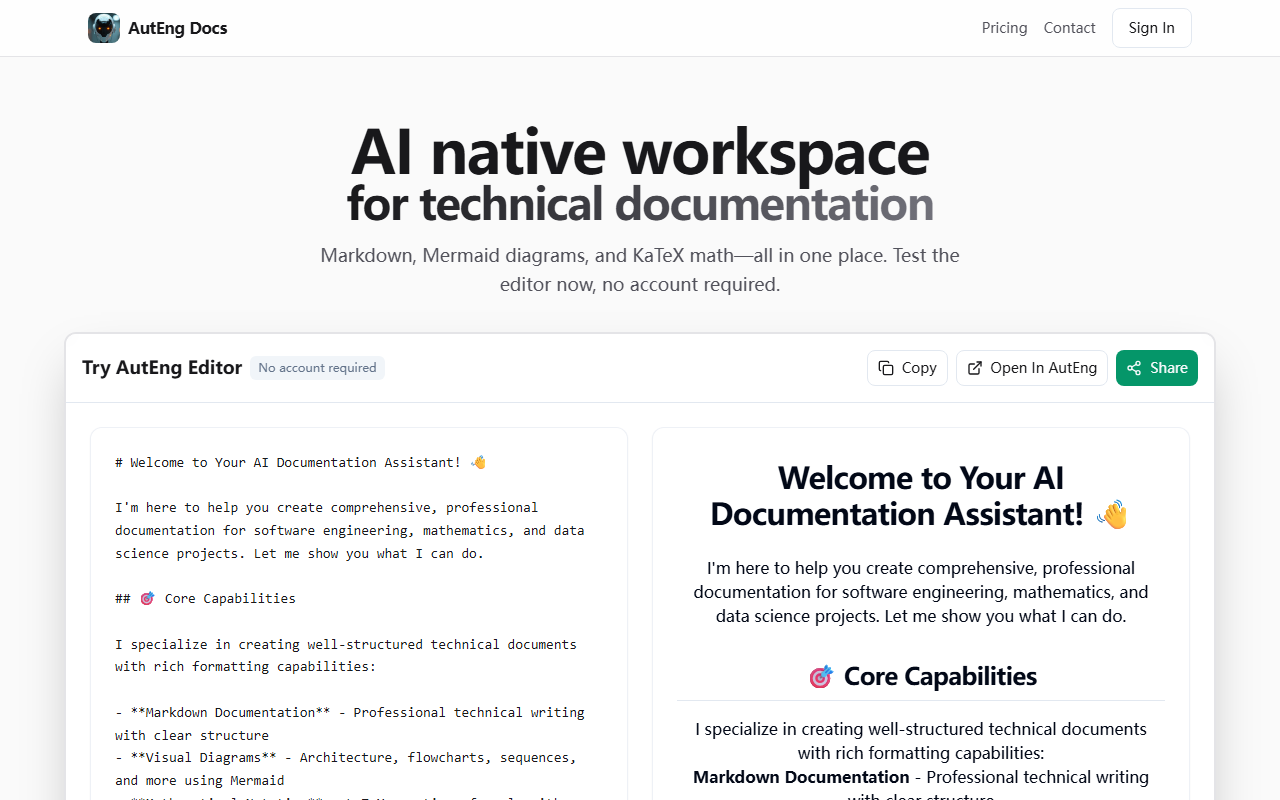
Upon visiting the AutEng website at auteng.ai, I was greeted by a clean, minimal interface that immediately invites exploration. The headline reads "AI-Native Workspace for Technical Documentation," and within seconds I saw a call to action to "Try AutEng Editor — No account required." Clicking that led me directly into an interactive editor preloaded with a rich example document. The onboarding is virtually nonexistent because you can start typing or asking the AI assistant right away. I tested the free tier by pasting a request: “Create a microservices architecture guide with a sequence diagram.” The AI responded within a few seconds, generating a full Markdown file with a Mermaid sequence diagram and explanatory text. The editor itself houses a split view: one side for your Markdown source, the other for a live preview. This real-time rendering is smooth and supports Mermaid diagrams, KaTeX math, and syntax-highlighted code blocks. I didn't need to sign up, which made the initial experience frictionless.
Core Capabilities and Technical Depth
AutEng is built to solve a specific pain point: creating polished, technically accurate documentation that requires visual diagrams, mathematical notation, and code examples—all in one place. The AI assistant is context-aware and can handle requests for architecture diagrams (graph TB, sequence diagrams), inline/display math (LaTeX), and code in multiple languages. I noticed it even fetched web results for a query about current API best practices, which adds a layer of factual grounding. The underlying technology is not explicitly stated on the site, but the AI appears to be a fine-tuned language model with tool-calling capabilities for rendering and web search. The tool integrates deeply with Markdown, Mermaid, and KaTeX—three standards in the technical writing world. For users who need to export, you can copy the Markdown raw or share a link. There is no mention of an API or direct integration with version control systems yet, but the editor is responsive and the output format is portable.
Pricing and Market Position
Pricing is not publicly listed on the website. As of this review, the free tier gives full access to the editor and AI assistant with no account required. There are no upgrade prompts or credit limits visible during my testing, which suggests AutEng may still be in an early-access phase or monetizing through future enterprise features. In the AI documentation space, AutEng competes with tools like Notion AI, which offers similar writing assistant features but lacks native Mermaid and KaTeX support, and Cursor, which is focused more on code generation. Unlike Notion AI, AutEng is purpose-built for technical content with math and diagrams. Another alternative is GitBook AI, which excels in collaborative documentation but doesn't have a dedicated math notation editor. AutEng’s advantage lies in its lightweight, single-purpose design and zero-signup barrier. Its limitation is the lack of collaboration features, version history, or template libraries that teams might expect. The tool feels best for individual developers, researchers, or technical writers who need to quickly produce high-quality docs without a heavy setup.
Strengths and Limitations
AutEng’s greatest strength is its focus. The AI produces genuinely useful technical documentation with diagrams and math that render correctly in the editor. I tested a request for a gradient descent explanation with the update rule: $$\theta_{t+1} = \theta_t - \alpha \nabla J(\theta_t)$$ and it generated the equation, a Mermaid flowchart of the algorithm, and a Python code snippet—all in one coherent document. The speed and accuracy were impressive. However, the tool has real limitations. There is no multi-user collaboration, no import/export integrations with platforms like GitHub or Confluence, and the AI sometimes overcomplicates simple requests. I also noticed that the “Web Research” feature is limited to fetching static pages; it cannot browse dynamic content or verify facts in real-time. For a team working on a large documentation project, AutEng would need more organizational features. But for a solo developer or a technical blogger creating a one-off guide, it is a capable and pleasant tool. I recommend it to anyone who spends time writing math-heavy or diagram-heavy technical content and wants to accelerate the process with AI assistance.
Visit AutEng at https://auteng.ai/ to explore it yourself.













Comments