

First Impressions: A Platform Built for Control
Upon visiting Buzzy's site, I was struck by the clarity of its value proposition. The dashboard—or rather, the pitch—immediately frames the problem: AI code generation accelerates development but creates codebase sprawl, technical debt, and governance gaps. Buzzy's answer is a semantic application definition that separates structure, logic, data, and security from execution. Instead of generating piles of React or Swift code, you get a single definition file that runs on Buzzy's governed core engine. The architecture diagram on the site shows a clear split: one shared engine handles upgrades, security patches, and compliance, while multiple app definitions stay isolated. This is not your typical “prompt-to-code” wrapper; it feels more like a low-code platform with AI as the input method.
How Buzzy Works: From Prompt to Governed App
The core innovation is replacing code generation with application definition. When you type a prompt, upload a Figma design, or connect an API, Buzzy creates a single source of truth covering UI, logic, data models, and security controls. That definition then compiles to web and mobile (iOS and Android) simultaneously. The “AI cookbooks” and “UI toolkit” provide reusable instructions and prebuilt components that guide the AI's output, ensuring consistency and theming. The architecture enforces centralized updates: push a fix to the engine, and every app built on the platform receives it automatically. This directly addresses the 60–70% maintenance cost cited in the site's research.
Buzzy targets CTOs, product teams, and agencies who need to ship quickly but can't afford the security and compliance risks of raw AI-generated code. The site highlights two case studies: Swiftio (a complex healthcare app launched in ~4 days, 100+ screens across platforms, single-tenant deployment) and OneTap (1M+ surveys processed, 20+ major React Native releases absorbed without rebuilds). These numbers suggest real traction, though I'd like to see more third-party validation.
Hands-On Test: The Free Tier and Onboarding Flow
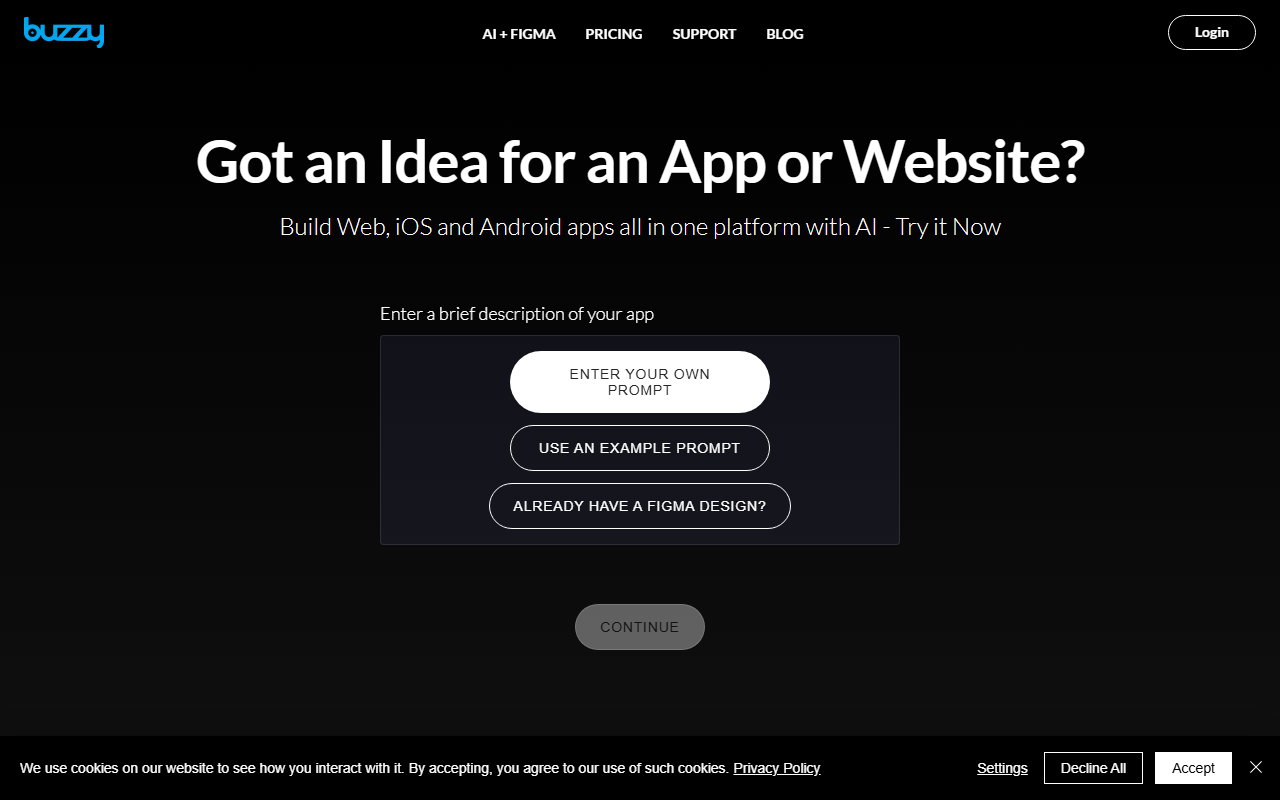
I tested the “Try it now” link, which leads to a prompt-based app builder. The free tier allows you to start from a text description or upload a Figma file. I typed “Build a task manager with team assignment and due dates”. Within seconds, Buzzy generated a multi-screen app with a sidebar, kanban board, and user management. The interface is clean: a left panel shows the app structure, a center preview renders the live app, and a right panel exposes the semantic definition (a JSON-like object). You can edit the definition directly or continue prompting.
What impressed me was the absence of generated code files. Instead, the definition is the artifact. You can export the app as a web URL or both iOS/Android binaries immediately. The preview was responsive and included theming options. However, the free tier limits you to one app and lacks custom domain and advanced governance. The full engine (security controls, cookbooks, multi-app management) is only accessible in the paid plan—which is not publicly priced. Reaching out for a demo is required, which may frustrate some independent developers.
Pricing and Trade-Offs: Strengths, Limitations, and Fit
Pricing is not publicly listed on the website. Buzzy requires booking a demo or contacting sales for custom quotes. This is common for enterprise platforms but limits discoverability for freelancers or small teams. For context, alternatives like Retool (low-code with AI features) and Bubble (no-code) have transparent monthly tiers. Buzzy differentiates by emphasizing governance and central maintenance, making it a stronger fit for regulated industries or agencies worried about technical debt.
Strengths: The semantic definition approach drastically reduces maintenance overhead. Centralized upgrades mean one patch fixes all apps. Multi-platform output from a single source is efficient. The architecture is built for scale and compliance—crucial for healthcare, finance, or government projects.
Limitations: No public pricing is a barrier. The free tier is limited to one app and lacks full governance features. Custom code extensibility is controlled, which may frustrate developers needing deep customization. The platform also requires trust in Buzzy's engine for long-term app viability—a risk if the company pivots or shuts down.
Who should try it: Teams that need to ship multiple apps quickly but cannot accumulate debt. CTOs in regulated environments. Agencies delivering apps for clients with strict maintenance agreements. Who should look elsewhere: Solo developers experimenting with no-code (try Bubble or Glide). Teams needing full source code ownership (Buzzy abstracts the execution layer).
I left the trial genuinely impressed by the reduction in boilerplate and the clarity of the governance model. If you're tired of patching brittle AI-generated code, Buzzy offers a compelling alternative. Visit Buzzy at https://buzzy.buzz/ to explore it yourself.










Comments