

First Impressions and Interface
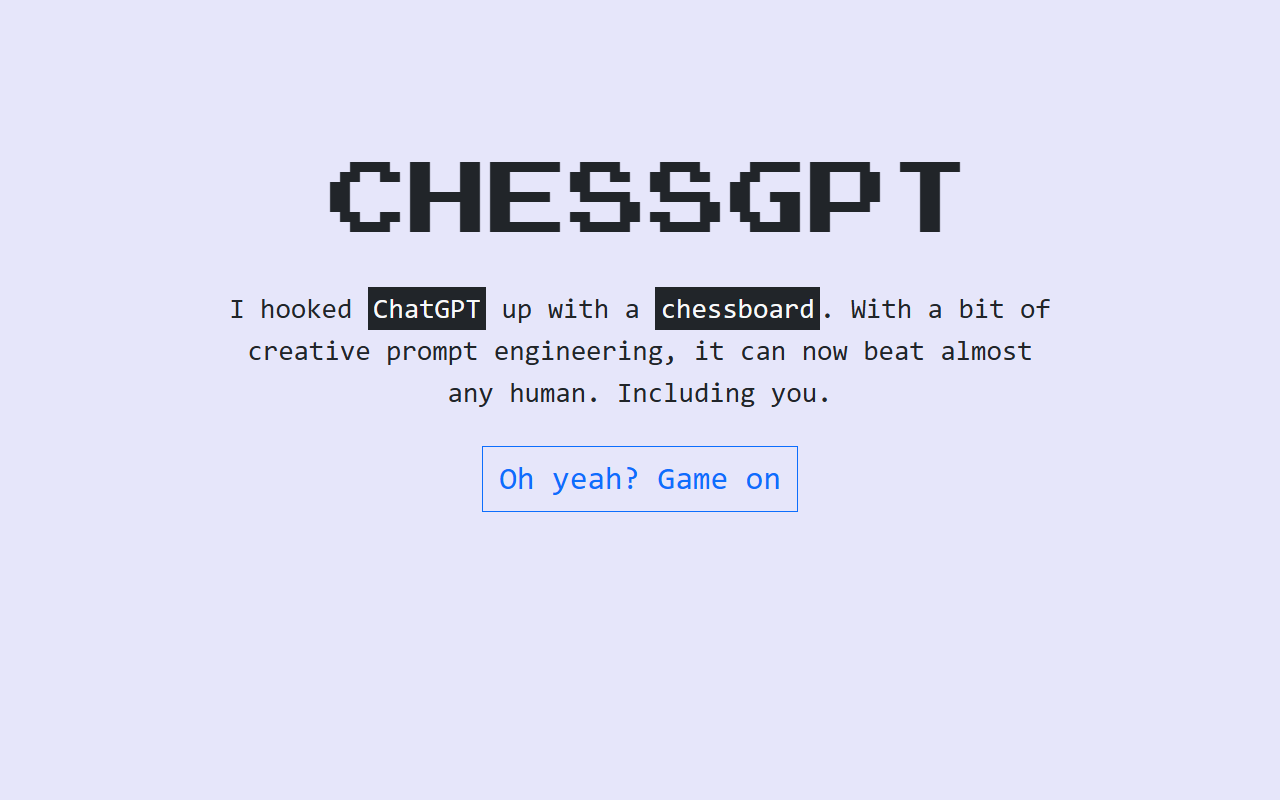
Upon visiting the site at chessgpt.ai, I was greeted with a bold claim: “I hooked ChatGPT up with a chessboard. With a bit of creative prompt engineering, it can now beat almost any human. Including you.” The interface is minimal and playful. A simple chessboard sits in the center, with a toggle to switch between “ChessGPT” mode and “Stockfish” mode. The “ELO: 249” badge for ChessGPT immediately caught my attention—that’s an extremely low rating, suggesting the base ChatGPT model (likely GPT-3.5 or GPT-4) is not a strong chess player without heavy prompt engineering. The site insists on an audio track, which adds a quirky, arcade-like vibe. The leaderboard shows player statistics, but it’s clearly a small community. Overall, the design feels like a proof-of-concept or a hobby project, not a polished product.
Gameplay and AI Behavior
When testing the free tier—there is only one “tier” as the game is completely free to play—I chose to play as Black. ChessGPT moves slowly, suggesting it’s generating moves via ChatGPT’s API in real time. The quality is poor; it missed basic tactics and often played nonsensical moves. After a few moves, I clicked “Evolve” to switch to Stockfish, and suddenly the AI became brutally strong, delivering a checkmate in four moves. The prompt engineering claim seems exaggerated: without evolving, ChessGPT is weaker than most casual human players. The “Show the board” and “Resign” buttons are functional. The game records wins/losses/draws on a leaderboard after entering a name. It’s a fun novelty for a quick game, but there is no tutorial, no analysis, and no educational content. The category “Learning Platform” is misleading—this is pure entertainment.
Pricing and Market Positioning
Pricing is not publicly listed on the website because the tool is entirely free. No API access or integrations are offered. This positions ChessGPT as a low-barrier entertainment experiment rather than a serious chess trainer or learning platform. Competitors like Chess.com and Lichess offer far superior chess engines (including Stockfish) with learning tools, puzzles, and lessons. Unlike those platforms, ChessGPT’s only hook is the ChatGPT integration, which is currently too weak to be useful. The project has no visible backing or funding—it appears to be an indie creation. It might appeal to curious users who want to see ChatGPT play chess, but for anyone wanting to improve their game, it’s a hard pass.
Verdict: Who Should Play?
ChessGPT’s strength is its simplicity and novelty—you can play a quick, free game against an AI that sometimes acts like a human making silly mistakes. The audio track and “evolve” feature add charm. However, its limitations are severe: the ChatGPT mode is too weak for any competitive play, and the Stockfish mode is just a standard engine you can get anywhere for free. There is no learning content, no analysis, and no progress tracking beyond a basic leaderboard. I recommend this tool only to those who want a five-minute laugh or to demonstrate prompt engineering quirks. If you are serious about chess, look elsewhere. Visit ChessGPT at https://chessgpt.ai/ to explore it yourself.











Comments