

First Impressions and Onboarding
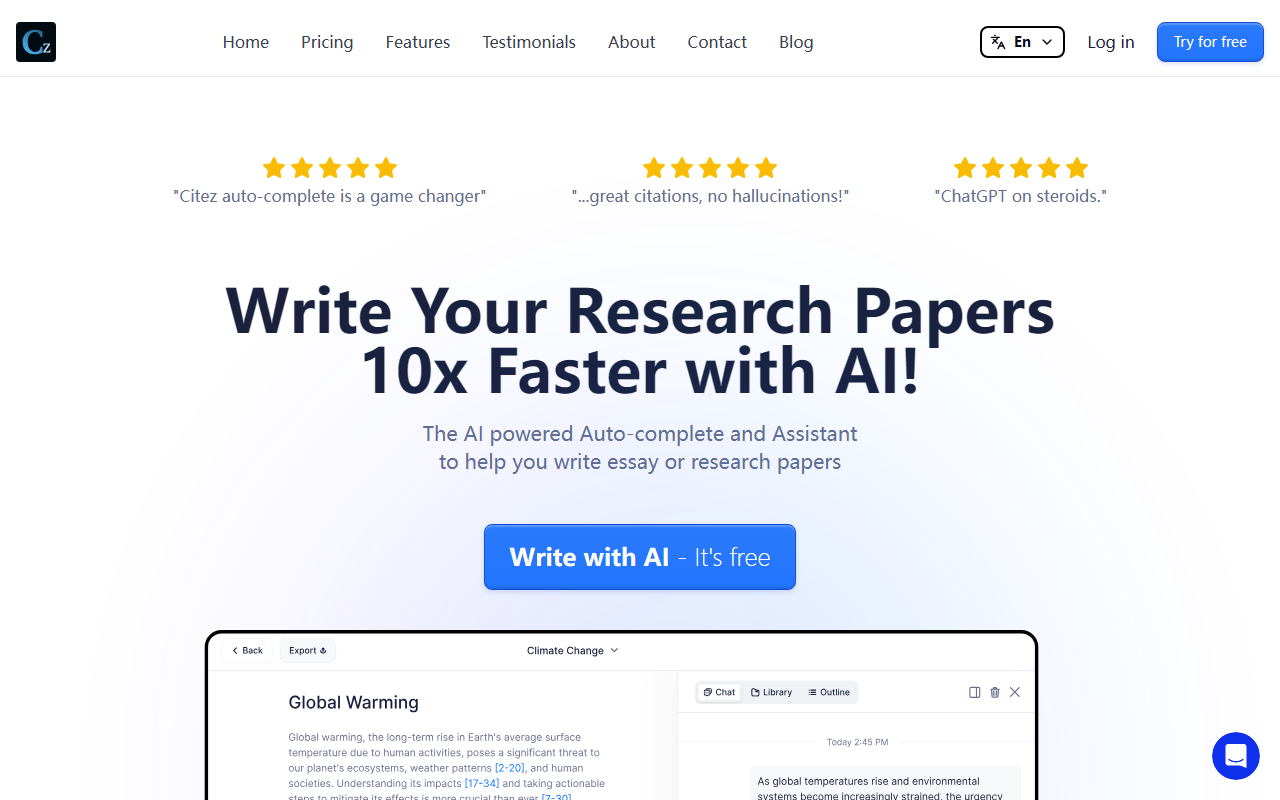
Upon visiting citez.ai, the homepage greets you with an energetic claim: “Write Your Research Papers 10x Faster with AI!” The layout is clean, with a headline, a list of use cases, and prominent testimonials from students and professionals. I noticed the phrase “ChatGPT on steroids” immediately, which sets high expectations. The call-to-action button invites you to “Write with AI — It's free.” Clicking it leads to a simple sign-up flow that only asks for an email and password. After logging in, the dashboard shows a text editor with a minimal toolbar and a sidebar for document management. The free tier starts a 14-day trial, giving you full access to the AI autocomplete and citation features. I tested the autocomplete by typing the start of an introduction for a history essay, and within seconds the AI suggested a coherent paragraph with natural citations. The response felt fluid and relevant, though I noticed it occasionally suggested sources that seemed plausible but needed verification. Overall, the onboarding was smooth and the interface is intuitive for anyone who has used a word processor.
Core Features and Technical Depth
Citez AI is designed specifically for academic writing. Its primary feature is the AI-powered autocomplete that suggests complete sentences and paragraphs as you type. There is also an AI chatbot for brainstorming or expanding notes, and a citation generator that pulls from journal and web sources. The tool claims to help with essays, literature reviews, research papers, personal statements, blog posts, and even speeches. The website states it has helped write over one billion words and is trusted by more than 5,000 students and top universities. From a technical standpoint, Citez AI does not explicitly state which large language model it uses, but the quality and style suggest it is built on a GPT variant. The autocomplete is context-aware and attempts to integrate citations directly into the text, which reduces the need for manual referencing. The citation feature supports both journal and web sources, and the interface allows you to search for sources within the editor. However, I found the citation database to be limited compared to dedicated reference managers like Zotero or Mendeley. There is no API listed for developers, and the tool currently does not integrate with Google Docs or Microsoft Word directly, which may be a drawback for some workflows.
Pricing, Competition, and Use Cases
Citez AI offers two pricing tiers: a Starter plan at $0 with a 14-day free trial (after which it likely requires payment), and an Unlimited plan at $6 per month billed monthly or annually. The Starter tier includes AI autocomplete, AI chatbot, and journal/web citations, but likely has a word limit or time restriction. The Unlimited tier removes all limits and costs a very affordable $6 per month, significantly cheaper than mainstream tools like ChatGPT Plus ($20/month) or Grammarly Premium ($12/month). In the competitive landscape, Citez AI positions itself as a specialized academic assistant rather than a general-purpose AI writer. Unlike ChatGPT, which can hallucinate citations, Citez AI attempts to generate real references, though I still recommend verifying each one. Compared to Copy.ai or Jasper, which focus on marketing copy, Citez is clearly aimed at students and researchers. The testimonials on the site highlight its use for research documents, SOPs, and study projects. The tool’s strengths are its affordability, focus on citation accuracy, and autocomplete that feels like a mind reader — as one user put it. On the flip side, the free trial is limited to 14 days, and the tool lacks advanced formatting features or plagiarism checks. It is best suited for undergraduate students and early-career researchers who need fast drafting and basic citation support. Professionals writing formal grant applications or complex literature reviews may find the citations insufficient and may prefer a dedicated reference manager alongside.
Strengths, Limitations, and Final Recommendation
The strongest aspect of Citez AI is its laser focus on academic writing with integrated citations, all at a price that undercuts most competitors. The autocomplete function genuinely speeds up the drafting process, and the chatbot can help overcome writer’s block. However, I must point out a real limitation: the citation engine does not always provide accurate or up-to-date sources, and the tool does not support real-time collaboration or LaTeX integration. Additionally, the website does not disclose the underlying AI model, which may raise concerns about data privacy for sensitive research. For a free-to-start tool with a $6/month unlimited option, Citez AI delivers good value for students who need to produce essays and research papers quickly. It is not a replacement for rigorous manual citation or critical thinking, but it serves as an excellent drafting assistant. I recommend that students and academics give the free trial a try, especially if you struggle with the initial blank page. Visit Citez AI at https://citez.ai/ to explore it yourself.










Comments