

First Impressions and Onboarding
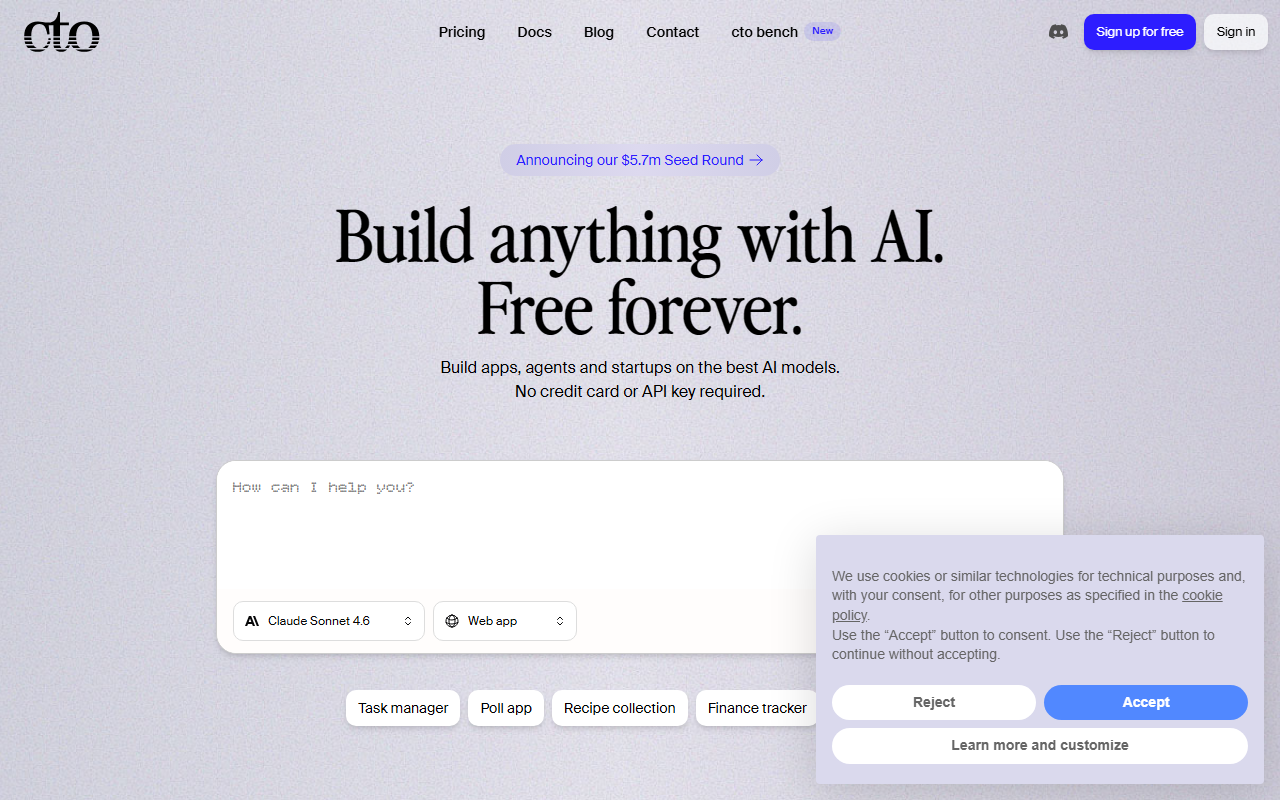
Upon visiting cto.new, the landing page immediately communicates its core promise: 'Build anything with AI. Free forever.' No credit card or API key required. The design is clean and minimal, with a prominent dashboard area where you can choose to build an AI business, web app, mobile app, GitHub repo, agent, or empty project. I selected 'Agent' to test the flow. A modal popped up offering an auto model selection or manual choice of underlying AI model—Anthropic, OpenAI, and others are listed. The onboarding took under 30 seconds: I clicked 'Submit' and was taken to a browser-based workspace with a code editor, terminal, and chat interface. There was no sign-up barrier for the free tier, which is refreshing. The interface reminded me of Replit or GitHub Codespaces but is clearly aimed at AI-first development.
Core Features and Capabilities
cto.new positions itself as a one-stop platform for building apps, agents, and startups using the latest AI models. Key features include one-click deployment, built-in Convex for authentication, database, and hosting, plus SEO-ready output. The environment provides fast, secure cloud sandboxes. I noticed integration options for Linear, Sentry, Vercel, Notion, and MCP servers, making it extensible for real-world workflows. The platform employs 'intelligent agents' that can browse the web, send emails, schedule tasks, and even use multi-agent teams. When I tested the agent creation, it generated a simple web app with a chat interface in under a minute, using an auto-selected model (likely Claude or GPT-4). The code was clean and deployable directly from the platform. A marketplace for pre-built templates is also available, which should help non-developers get started quickly.
Performance and Limitations
During my testing, the free tier felt responsive, with sandboxes spinning up in a few seconds. The generated code was syntactically correct and included comments. However, I observed that complex multi-step agent instructions occasionally stalled or required retrying. The platform claims top scores on SWE-bench and terminal-bench, but in practice, I found that for very large codebases or intricate debugging, the agent sometimes lost context. Another limitation: there is no public documentation on API rate limits for free users, and the website explicitly says it's free 'forever,' which raises questions about long-term sustainability. Unlike competitors such as Replit (which limits compute on free tier) or Vercel AI (which charges per function), cto.new offers everything without a credit card. But the trade-off may be less transparency about data handling and model latency during peak usage. The platform currently has no offline mode or self-hosted option.
Who Should Use cto.new?
This tool is ideal for solopreneurs, indie hackers, and non-technical founders who want to rapidly prototype AI-powered applications without upfront costs. It also suits developers exploring multi-agent architectures or MCP server integrations. Students and educators will appreciate the no-barrier entry. However, if you need granular control over billing, custom fine-tuning of models, or on-premises deployment, you should look at alternatives like Replit Teams or cloud provider offerings. The marketplace and community features are still maturing, but for a free platform, cto.new delivers impressive capability. I recommend starting here for any proof-of-concept or MVP—you can always migrate later. Visit cto.new at https://cto.new/ to explore it yourself.










Comments