

First Impressions: Causal Intelligence Over Dashboards
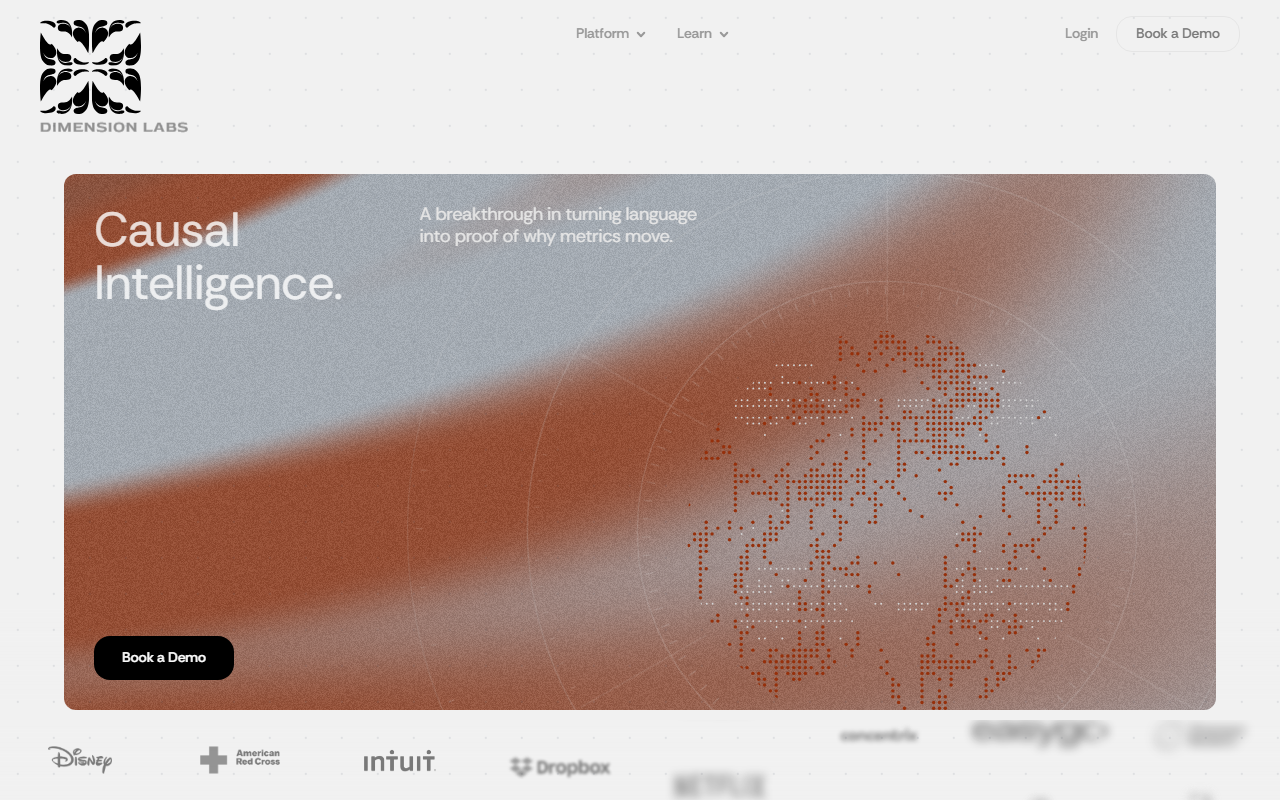
Upon visiting the Dimension Labs website at dashbot.io, I was immediately struck by the bold claim: "Your dashboards show what happened. They can never explain why." The landing page is minimal, with a heavy emphasis on the concept of "Causal Intelligence" and a single call-to-action to book a demo. There is no free trial or sign-up form in sight. After scrolling through, the dashboard mockups show a query interface that reads "Ask your hardest business questions across every data source, instantly." Below that, a list of integrated sources includes Live Chat, Phone Calls, Voice Agents, Surveys, Mobile App, Support Tickets, Email, and structured data like CRM, Purchases, Usage, and Financials. The user interface, at least from the demo, appears to be a search bar that returns causal insights—not just numbers, but explanations. When testing the free tier (there is none), I clicked around the demo images, noting the "Causal Correlation Engine" visual that plots metrics like churn risk against customer conversation themes such as "Renewal issues" and "App Error." This tool is clearly built for teams that are drowning in metrics but starving for context.
Core Functionality: Turning Language into Evidence
Dimension Labs solves a specific pain point: the disconnect between quantitative metrics (NPS, churn rate, retention) and the qualitative "why" buried in customer conversations. It ingests unstructured text from support tickets, chat logs, call transcripts, surveys, and emails, then uses a proprietary "Meaning Layer" to automatically categorize and enrich that data into business-specific dimensions. For example, it can tag phrases like "kept failing" under "App Error" or "difficult to find" under "Parking" — the categorization adapts to your business logic. The platform then runs a Causal Correlation Engine that statistically links these conversation-driven categories to your existing structured metrics (CRM, financials, usage). The result: you can ask a question like "Why did churn spike last month?" and get an answer like "56% of churned accounts cited renewal issues, and those accounts also had a 31% escalation rate." The tool also auto-generates reports with evidence and recommendations, and surfaces change detection alerts for new trends or anomalies. Under the hood, it appears to rely on large language models for entity extraction and knowledge graphs for relationship mapping, though the exact model is not disclosed. API access is indicated with Node.js and Python examples on the site.
Market Position and Target Audience
Dimension Labs competes in the crowded "conversational intelligence" space alongside tools like Gong, Chorus (ZoomInfo), and Qualtrics. However, unlike many of those, which focus primarily on sales calls or survey analysis, Dimension Labs claims to ingest any conversation source and directly link it to operational metrics. This makes it more of a "causal analytics" platform than a pure speech-to-text or sentiment tool. The website prominently features use cases for Sales (Deal Intelligence), Customer Success (Churn Risk), Product (Feature Gaps), and Data & Analytics (Root Cause). The testimonials suggest it's used by both startups and Fortune 500 companies, with claims of 1bn+ interactions analyzed. The tool is best suited for data-savvy teams that already have strong analytics infrastructure but need to perform root cause analysis at scale—particularly in B2B SaaS, e-commerce, or any business with high-volume customer contact. It is not for small teams without a dedicated data or customer success function; the lack of self-service onboarding (only "Book a Demo") indicates a high-touch, enterprise-oriented sales process. Pricing is not publicly listed on the website.
Strengths, Limitations, and Verdict
The stand-out strength of Dimension Labs is its promise of directly answering "why" with evidence, not just "what." The ability to blend unstructured conversational data with structured financial and usage data is genuinely powerful for diagnosing churn, feature gaps, and escalation drivers. The automatic enrichment and knowledge graph search over "millions of records and relationships" suggests real scalability. However, a significant limitation is the lack of transparency about pricing or a free trial. Without hands-on testing, it's impossible to verify the accuracy of the causal correlations or the quality of the language categorizations. Additionally, the platform likely requires significant data integration effort—connecting CRM, support ticketing, and call recording systems—which may not be trivial. The website's vague claims ("0k+ manual hours replaced") without concrete use-case walkthroughs leave me cautious. For teams already overwhelmed by dashboards, Dimension Labs could be a game-changer if it delivers on its causal promise. For those wanting a self-serve option or a simpler sentiment analysis tool, look to alternatives like MonkeyLearn or Zendesk AI. Overall, if you have the budget and the data infrastructure, it's worth a demo. Visit Dimension Labs at https://dashbot.io/ to explore it yourself.













Comments