

First Impressions and Onboarding
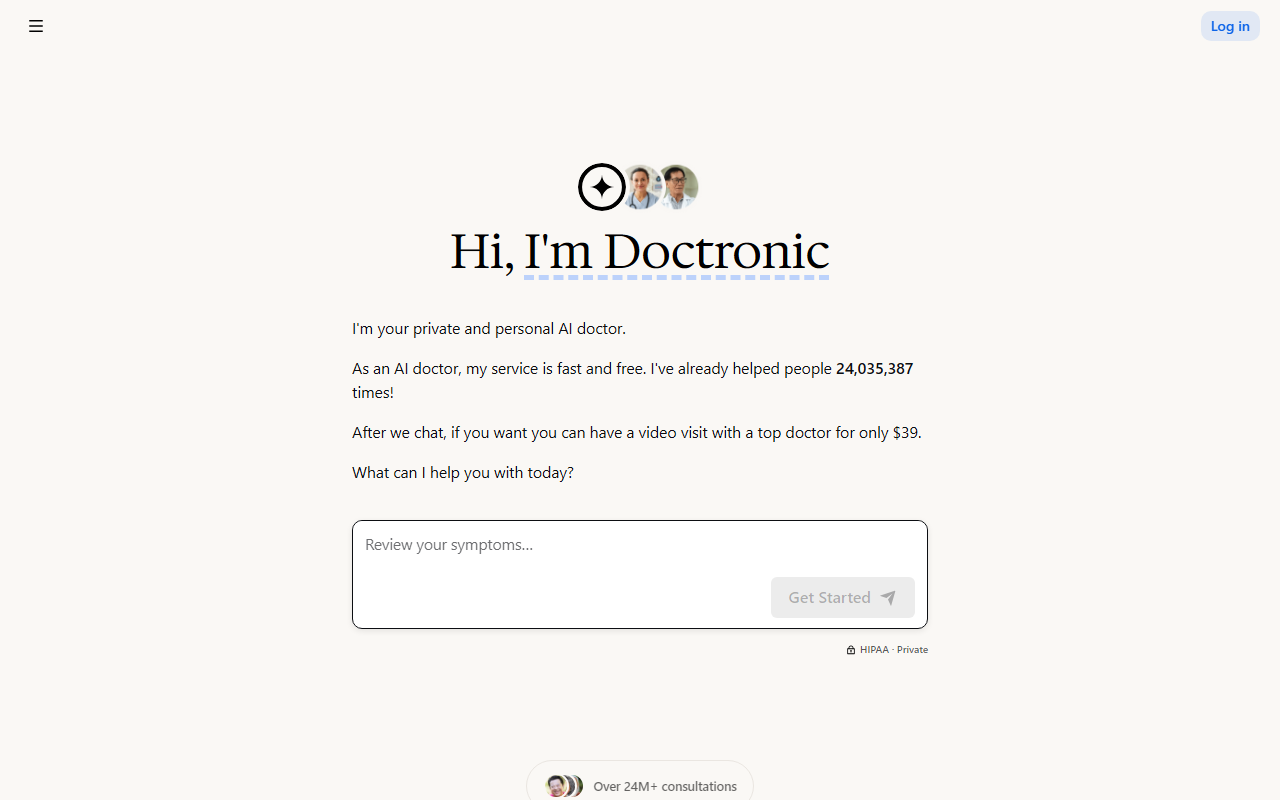
Upon visiting Doctronic.ai, the interface immediately presents a chat window with a friendly greeting: "Hi, I'm Doctronic." The layout is clean and minimal, with a clear disclaimer that the AI is not a licensed doctor and does not provide medical advice. The dashboard is essentially the chat screen; no clutter. The disclaimer appears both at the top and bottom of the page, reminding users to always discuss output with a doctor. The onboarding is exceptionally frictionless: no email or credit card required, just start typing symptoms. I tested the free tier by entering "persistent headache and fatigue," and within seconds the AI began asking follow-up questions about duration, location, and intensity. The experience feels like a more structured version of a symptom checker, but with conversational flow.
The homepage prominently displays a counter of 25.5 million consultations completed, lending credibility. The AI mentions being trained on peer-reviewed medical research and claims that board-certified clinicians agree with its treatment plans over 99% of the time. While I cannot independently verify this stat, it suggests rigorous testing. The tool is HIPAA compliant and promises not to use chat data for training—a strong privacy stance.
Core Features and AI Performance
Doctronic’s primary feature is the AI Doctor Chat, which aims to simulate a consultation. During my test, the AI asked about medication history, lifestyle factors, and previous diagnoses. It also inquired about allergies, which is a nice safety measure. It responded with a list of possible conditions and suggested next steps, including whether to see a human doctor. The AI appears to have a broad knowledge base, covering conditions like Type 2 Diabetes, heart conditions, STIs, and respiratory issues. There is also a dedicated Symptom Checker and a Urology Specialist module. I also tested the Symptom Checker, which provides a more structured step-by-step flow. The AI's knowledge seems current, referencing recent guidelines. However, for mental health queries, it defaulted to general advice without deep specificity. The 'Manage Conditions' section lists specific conditions, suggesting advanced modules for diabetes or heart conditions, but these appear to be chat prompts rather than dedicated sub-apps.
The AI’s responses are well-organized, using bullet points and disclaimers to emphasize that it cannot prescribe medication or give definitive diagnoses. It excels at providing educational context and triage guidance. However, the AI’s limitations become apparent with complex, multi-symptom cases; it defaulted to broad possibilities without deep personalization. The tool is clearly designed for initial screening, not comprehensive care. Notably, the AI remembers your health history across sessions, eliminating repetitive intake forms.
Pricing and Integration with Telehealth
Doctronic is free for the AI consultation—no hidden costs. The real value proposition is the seamless bridge to human doctors. If treatment is needed, the AI offers to connect you to a licensed U.S. physician for a flat $39 fee. This includes prescriptions, referrals, and treatment if appropriate. Appointments are available instantly, 24/7, and no insurance is required. This is significantly cheaper than typical urgent care copays. Compared to alternatives like Ada Health or Babylon Health, Doctronic’s focus on a direct telehealth handoff with a clear price point is a differentiator. Ada offers AI triage but then refers to local services without built-in telehealth. Doctronic keeps you within its ecosystem. However, the service is limited to U.S. residents, which excludes a global audience. Pricing for the human doctor is transparent, but there’s no subscription model for ongoing care.
The $39 flat fee is notably lower than many telehealth services like Teladoc or Amwell which charge $50-70 per visit. Doctronic’s business model relies on converting free users to paid consultations; the AI acts as a lead generation tool. Overall, the integration feels smooth: after the AI chat, a button appears to book a doctor. The entire experience is mobile-friendly.
Who Should Use Doctronic?
Doctronic is best suited for individuals seeking quick, free, and private initial medical information without committing to a platform. It’s ideal for curious patients who want to understand symptoms before seeing a doctor, or for those without insurance who need affordable access to a licensed physician for common issues like UTIs, respiratory infections, or prescription refills. The $39 doctor visit is a bargain.
Limitations include a lack of deep personalization for chronic conditions and the disclaimer that the AI is not a substitute for medical advice. Users with complex medical histories or emergencies should not rely on it. Additionally, the 99% clinician agreement stat is vague—it doesn’t specify which conditions or how many clinicians were polled. Overall, Doctronic is a well-designed triage tool with a practical monetization path. I recommend it for low-acuity health queries and as a bridge to affordable telehealth.
Visit Doctronic at https://doctronic.ai/ to explore it yourself.











Comments