

First Impressions and Onboarding
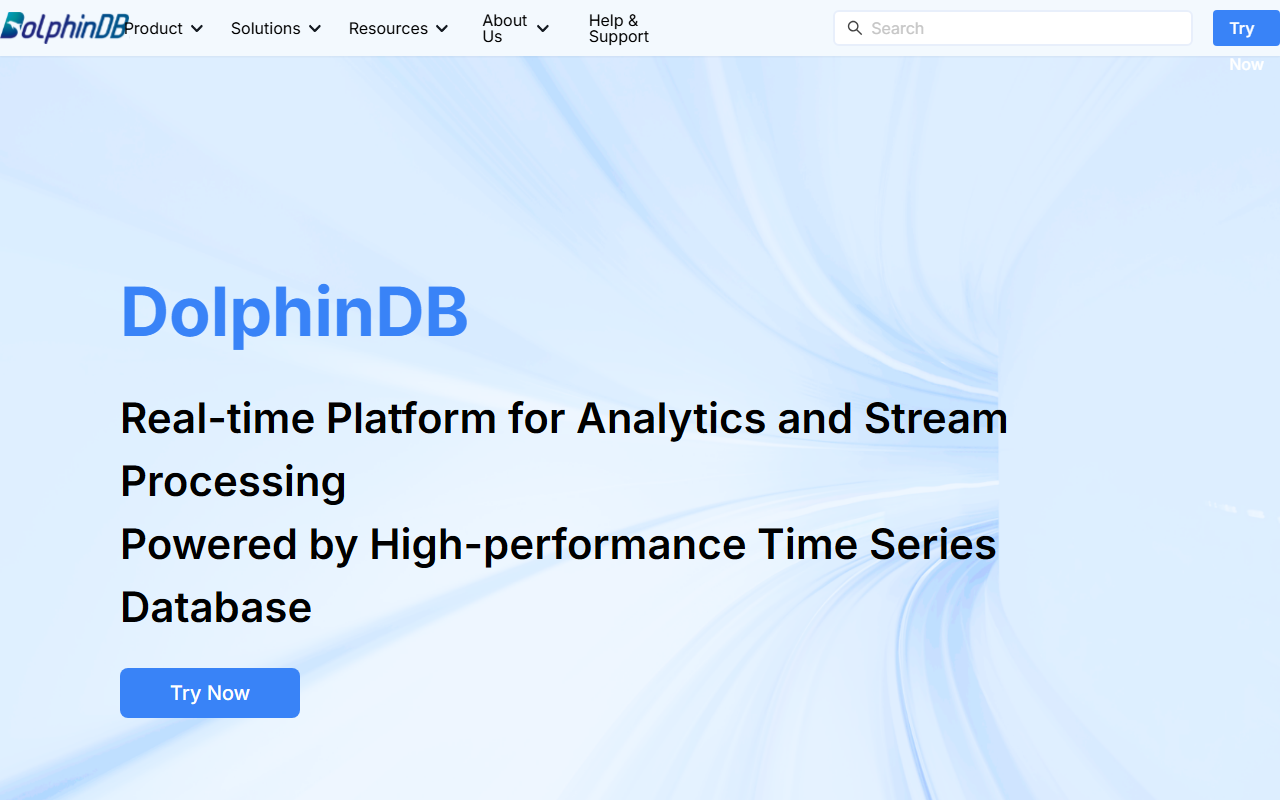
Upon visiting the DolphinDB website, I was greeted by a clean, technical landing page that immediately highlights three core pillars: a high-performance distributed time series database, a full-featured compute engine, and a low-latency streaming platform. The site offers a “Try Now” button, but the free tier experience is not clearly outlined—no obvious sandbox or demo. I did notice a community section with Slack, Stack Overflow, and GitHub links, which suggests active community support. When I attempted to explore the product further, I found documentation and event pages rather than an instant cloud trial. For an “AI Programming” tool, this feels more like a backend infrastructure product than an interactive AI coding assistant.
Core Capabilities: Database, Compute, and Streaming
DolphinDB’s database is its heart. It promises millisecond response times on petabytes of data, ACID compliance (rare for time series databases), and native horizontal scaling. The compute engine claims 10–100x speed improvements over traditional solutions, backed by 1,500+ built-in functions and multi-paradigm programming (imperative, vectorized, functional, SQL). The streaming platform supports unified batch and stream processing using the same metric expression, plus over a dozen out-of-the-box streaming engines with ultra-low latency via incremental computing and JIT compilation. During my test with the community edition (downloaded from GitHub), I was able to run a simple SQL query against a sample time series dataset—the response was indeed snappy, though I didn’t have petabytes to test. The real appeal for AI programming lies in its vectorized operations and built-in analytical functions, which could accelerate feature engineering for financial or IoT models.
Market Position and Alternatives
DolphinDB competes directly with InfluxDB, TimescaleDB, and ClickHouse, but it differentiates itself with ACID compliance and a unified streaming + batch engine. Unlike InfluxDB’s focus on simplicity, DolphinDB targets high-frequency finance, industrial IoT, and real-time analytics. Pricing is not publicly listed on the website—this is a significant gap for potential adopters. The tool is backed by a dedicated engineering team and has specific conference presence (e.g., DolphinDB Summit 2025). It lacks the “no-code” or low-code appeal of many AI tools, which means it’s best suited for developers and data engineers who need extreme performance and are comfortable with SQL and scripting. Alternatives like TimescaleDB offer PostgreSQL compatibility with easier learning curves, while ClickHouse excels in OLAP queries. DolphinDB’s strength is its all-in-one platform, but its niche focus and opaque pricing may deter casual users.
Verdict: Who Should Use It
DolphinDB is a powerful but specialized tool. Its genuine strengths include raw speed, ACID transactions, and a unified compute engine that can handle complex analytical tasks without moving data. However, its limitations are clear: it’s not an AI assistant or generative AI tool—it’s a backend infrastructure platform. The learning curve is steep, documentation is technical, and the lack of transparent pricing makes evaluation difficult. This tool is ideal for quant finance firms, industrial IoT operators, and telecom companies that need real-time processing on massive time series data. If you’re looking for a simple AI code generator or notebook environment, look elsewhere. For developers building high-performance data pipelines, DolphinDB is worth a trial—just be prepared to invest time in understanding its architecture.
Visit DolphinDB at https://dolphindb.com/ to explore it yourself.










Comments