

First Impressions and Platform Overview
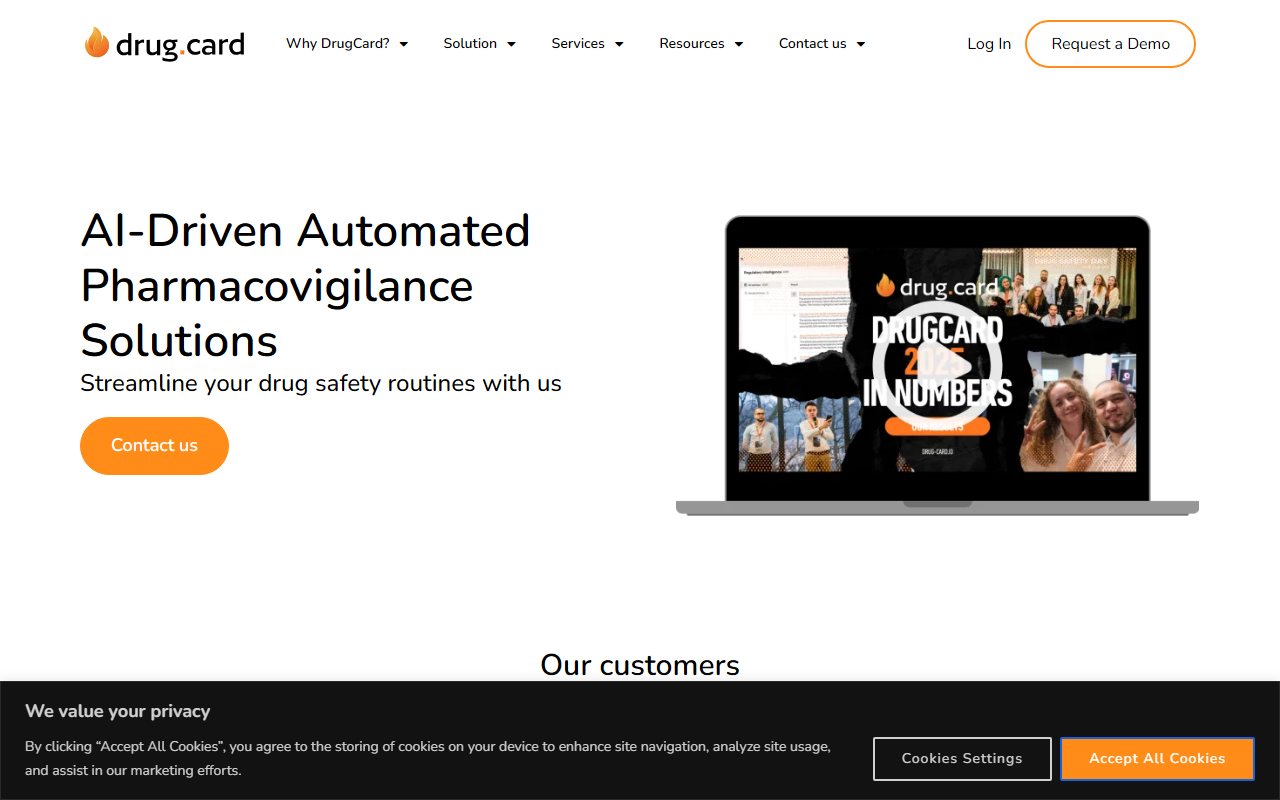
Upon visiting DrugCard's website, I was greeted by a clean, professional interface that immediately communicates its focus: streamlining drug safety routines. The landing page wastes no time addressing the pains of pharmacovigilance professionals—rising costs, audit pressure, and the struggle to keep up with local medical journals. This is not a general-purpose reading tool; it is a specialized solution for literature screening in pharmacovigilance (PV).
The platform positions itself as an AI-driven automated system that can handle continuous, traceable, and multi-language screening. I noted the claim of supporting over 100 languages and covering 121+ countries, with 2,200+ local journals continuously monitored. The website also highlights a 60% time savings compared to a human-only approach. While I could not test the actual tool without a demo, the emphasis on compliance, scalability, and cost-efficiency suggests a robust enterprise-grade offering.
Key Features and Technical Capabilities
DrugCard’s core strength lies in its ability to screen medical literature in local languages. According to the FAQ, users can add search keywords in Greek, Hindi, Arabic, or Japanese hieroglyphics. This is a game-changer for companies that must monitor adverse drug reactions across multiple regions. The platform also uses proprietary OCR technology to handle poorly scanned texts, claiming 99% accuracy on average-quality scans. This addresses a real-world problem: many local journals still distribute printed copies that are scanned unevenly.
Another standout feature is the reported time reduction. The FAQ states that a manual reading and recording task that takes about 35 minutes can be reduced to just 3 minutes with DrugCard—a nearly 10-fold improvement. For freelancers and CROs managing multiple projects, this could translate into significant cost savings and the ability to focus on higher-value tasks like signal detection and PSURs. The platform also promises weekly reports, though the exact report format is not detailed on the site.
From a technical perspective, DrugCard appears to leverage AI and natural language processing, but the site does not specify which underlying models or APIs are used. It is likely a proprietary system trained on medical literature. The management team includes a Chief Product Officer and a Chief Technology Officer, indicating serious investment in the platform’s development.
Pricing and Market Position
Pricing is not publicly listed on the website. This is common for enterprise B2B tools, but it means potential users need to request a demo to learn costs. The platform targets three segments: CROs (contract research organizations), MAHs (marketing authorization holders), and freelancers. For CROs, DrugCard claims to help manage more PV projects and improve screening results, reducing reliance on manual journal reading. For MAHs, it promotes in-house screening to avoid managing multiple CROs across countries. Freelancers can save up to 70% of time, according to testimonials.
Competitors in the AI reading and pharmacovigilance space include tools like MedDRA, Veeva Vault, and general literature monitoring platforms such as Quosa or Iris.ai. Unlike those, DrugCard is hyper-focused on the specific regulatory and compliance needs of drug safety. It does not try to be a general AI reading assistant; it is built from the ground up for PV professionals. This specialization is both a strength and a limitation: it deeply solves a niche problem but may not appeal to users outside pharmacovigilance.
Who Should Use DrugCard and Final Verdict
After reviewing the site and testimonials, I believe DrugCard is best suited for pharmacovigilance teams at CROs and MAHs that are overwhelmed by manual literature screening, especially in multi-language contexts. Freelancers offering PV services will also find value if they can justify the license cost. However, the lack of transparent pricing and the need for a demo might be a barrier for small teams or individual practitioners who want to quickly evaluate ROI.
A real limitation is the niche audience—this tool is not for general AI reading tasks. If you are not in pharmacovigilance, look elsewhere. Also, the website provides no details on API access, integration with existing PV systems (e.g., Oracle Argus, ARISg), or data security certifications, all of which are important for regulated industries. Strengths include the multi-language coverage, OCR capability, and the clear understanding of industry pain points shown in the content. The testimonials from PV leaders add credibility.
Overall, DrugCard appears to be a powerful, specialized tool that could deliver significant efficiency gains for its target users. I recommend scheduling a demo if you handle literature screening in a pharmacovigilance setting—the time savings might justify the investment.
Visit DrugCard at https://drug-card.io/ to explore it yourself.










Comments