

First Impressions and Onboarding
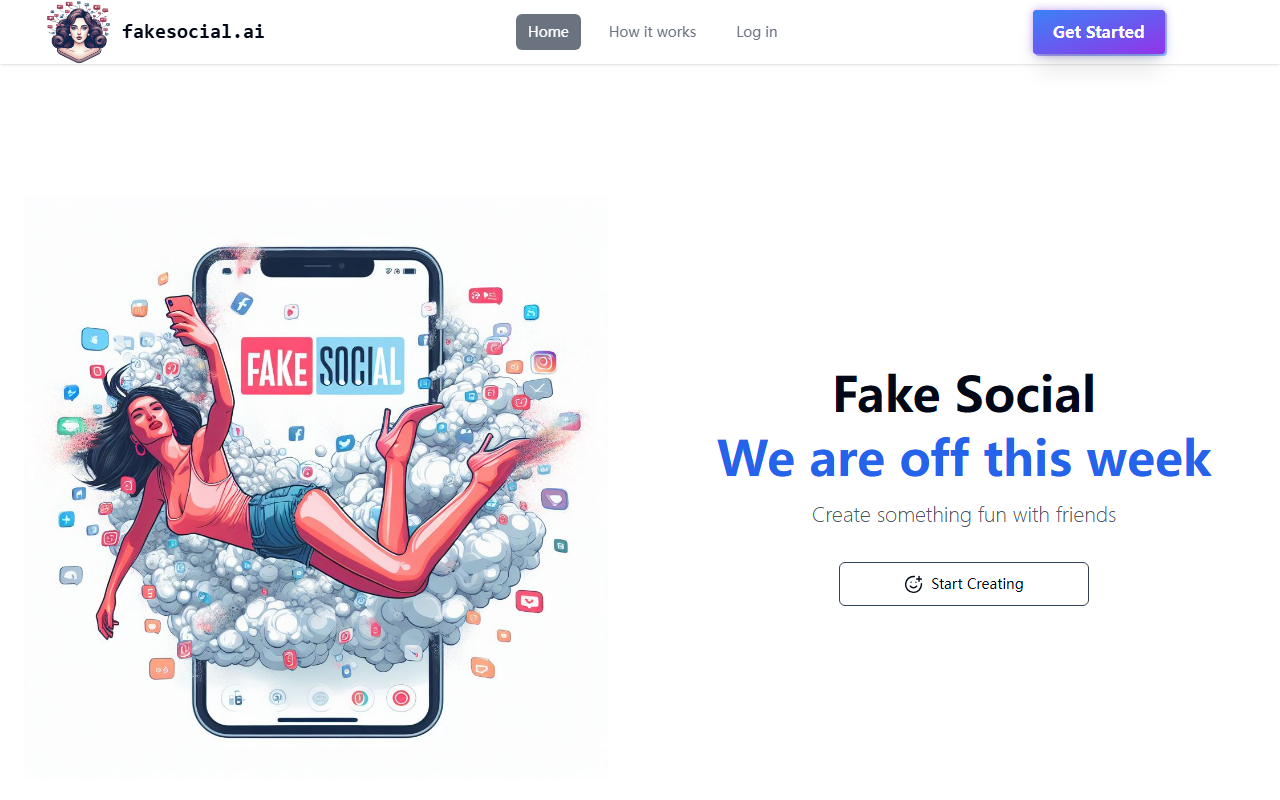
Upon visiting Fakesocial.ai, I was greeted by a clean, minimal homepage. The tagline "We are off this week" suggests the content follows a weekly theme, though the site doesn't elaborate on current themes. The call-to-action "Start Creating" is prominent. The onboarding is straightforward: you upload a single clear selfie, select a username and gender to create a unique profile page, then invite friends. During my test, I uploaded a neutral selfie and was prompted to generate content immediately. The dashboard is sparse — there are no complex menus or settings, which makes it easy for non-technical users to jump in.
How Fake Social Works
Fake Social positions itself as a daily entertainment tool. Each day, you can generate one piece of AI-generated content featuring yourself, based on a weekly theme that resets every Sunday at midnight Pacific Time. The content is automatically shared with friends who also have profiles — though the exact output format (images, text, etc.) isn't explicitly detailed on the site. Given the selfie requirement, I suspect the tool creates stylized avatars or photo manipulations rather than written text. That said, the category is listed as "AI Writing," which may be a mislabel. The technology behind the generation is not disclosed, but it likely uses a diffusion model fine-tuned for face swaps or style transfers. Unlike dedicated avatar apps like Lensa AI, Fakesocial focuses on social sharing and daily engagement rather than high-resolution portraits. The need to add friends to see their content creates a network effect, which is both a strength and a barrier — without friends on the platform, the experience is solitary.
Pricing and Accessibility
Fakesocial is entirely free to use. No pricing tiers are listed on the website, and there are no indications of a premium plan or subscription. This is refreshing, but it raises questions about data privacy and long-term sustainability. The tool asks for a selfie, which is sensitive data; the privacy policy (not visible on the homepage) should be reviewed before uploading personal images. In terms of technical access, there is no API or integration with other apps — it appears to be a standalone web service. Competitors like Remini offer more advanced face enhancement, while this tool emphasizes daily novelty with friends.
Who Should Use Fake Social?
Fake Social is best suited for casual users who enjoy creating lighthearted, daily visual content with a small group of friends. It's ideal for groups who want a low-commitment, fun way to generate shared memories — think of it as a digital inside joke generator. However, power users seeking high-resolution outputs, multiple daily generations, or serious creative tools should look elsewhere. The one-per-day limit and reliance on friends being active are real limitations. Additionally, the lack of transparency about the underlying model and data handling may concern privacy-conscious individuals. My recommendation: try it for a week if you have a willing friend group, but treat it as a novelty rather than a core AI tool.
Visit Fake Social at https://fakesocial.ai to explore it yourself.











Comments