

What Is FantasyGen?
FantasyGen is an AI-powered fantasy map generator designed specifically for tabletop RPG enthusiasts, fantasy authors, and game developers. It solves a common pain point: creating visually compelling maps without any artistic skills. Instead of spending hours drawing coastlines or mountains, you type a description—such as “a forest clearing with a stone bridge over a river”—and the AI renders a map in seconds. The tool covers a wide range of map types, including D&D battle maps, world maps, regional maps, city maps, and even sci-fi battlemaps.
Unlike traditional map-making software like Inkarnate or Wonderdraft—which require manual placement of assets and often demand a learning curve—FantasyGen operates like a text-to-image generator but with a focus on cartographic output. It uses an underlying AI model (likely based on diffusion architecture, though not explicitly named) that has been fine-tuned on map art styles. This makes it a specialized alternative to general AI image generators like Midjourney or DALL-E, which often struggle with consistent map elements like grid layouts or terrain labels.
First Impressions and Workflow
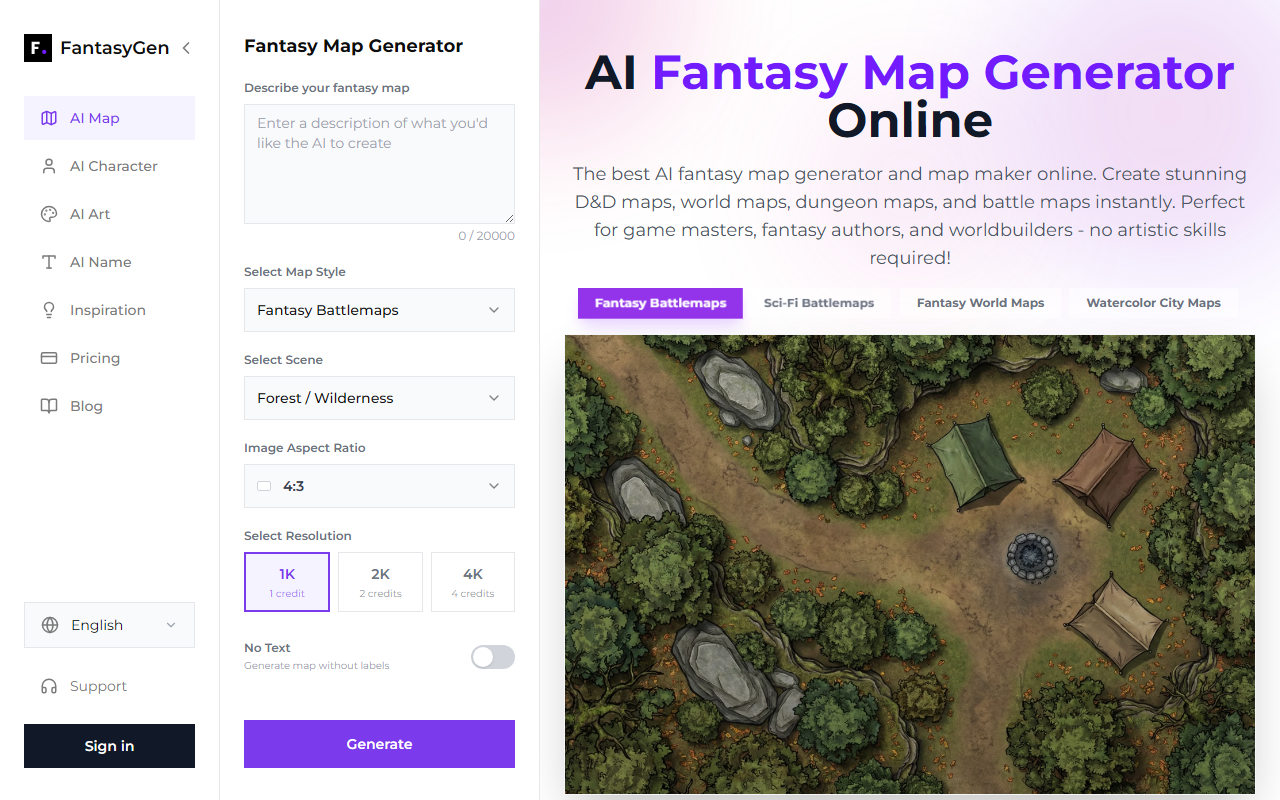
Upon visiting the site, I was greeted by a clean, single-page layout. The main input is a large text box with a 20,000-character limit—plenty for a detailed scene. Below that, you pick a map style from eight options: Fantasy Battlemaps, Watercolor Battlemaps, World HD, Vintage Parchment, Regional Detailed, Urban Watercolor, Sci-Fi, and Classic Retro. Each style has a preview image. I selected “World HD” and typed a prompt for a continent with two mountain ranges, a central desert, and coastal forests. The interface also offers aspect ratio selection and resolution: 1K, 2K, or 4K, each costing 1, 2, or 4 credits respectively.
After clicking “Generate,” the map appeared in about 10 seconds. The result was a high-resolution, color-coded map with biome transitions, mountain symbols, and ocean depth shading—impressively coherent for a first attempt. A “Refine” button lets you adjust details, though I didn’t test it extensively. You can also toggle “No Text” to generate maps without labels, which is useful if you want to add custom place names later. Export options include downloading at up to 4K, suitable for print or VTT platforms like Roll20.
The dashboard is sparse: a sign-in button in the top right, and navigation to “Inspiration,” “Pricing,” and a blog. Without an account, you cannot generate maps—the site pushes you to sign in. That means the free tier, if any, is not visible before login. This is a notable friction point.
Features and Pricing
FantasyGen’s core feature is its AI map generation from text, but it also offers specialized generators (World Map, Battle Map, D&D Map) accessible from the menu. The real differentiator is the variety of map styles tailored to different RPG aesthetics. For example, the “Vintage Antique” style mimics parchment with quill pen lines, while “Sci-Fi Futuristic” adds neon grids and metallic textures. The “No Text” option is a thoughtful addition for creators who want to overlay their own labels.
Regarding pricing: the site references a credit system but does not publicly list the cost of credits in dollars. The resolution tiers (1K = 1 credit, 2K = 2 credits, 4K = 4 credits) suggest a per-map cost, but you must sign in or visit the “Pricing” page (which redirects to the home page) to see actual prices. This lack of transparency is a limitation. For comparison, Inkarnate offers a free tier with limited assets and a Pro subscription at $5/month, while Wonderdraft is a one-time purchase (~$30). FantasyGen’s credit model could become expensive for frequent map makers.
There are no API or third-party integrations mentioned. The tool also lacks a grid overlay toggle (though you could add grids via external software) and doesn’t support collaborative editing. For game masters generating multiple maps per session, the lack of a subscription bundle or bulk credit discount is a missed opportunity.
Final Verdict
FantasyGen excels at one thing: generating attractive, style-consistent maps from a simple text prompt. It’s ideal for Dungeon Masters who need a quick battle map mid-session, authors visualizing a world, or game developers prototyping concept art. The interface is intuitive, the output quality is high, and the eight distinct styles cover most fantasy and sci-fi needs.
However, the tool has real limitations. The credit-based pricing without upfront transparency is a barrier. There is no free trial visible before sign-in, which reduces trust. It also lacks advanced features like layering, custom brush tools, or asset libraries that competitors offer. For serious worldbuilders who want granular control over geography, hand-drawn mapping tools remain superior.
I recommend FantasyGen for those who prioritize speed and require “good enough” maps without artistic effort, especially if you are a DM running a campaign on a virtual tabletop. But if you need detailed, editable maps or have a limited budget, consider Inkarnate’s free tier or Wonderdraft’s one-time purchase.
Visit FantasyGen at https://fantasygen.net/ to explore it yourself.










Comments