

Exploring Fireworks AI: A First-Hand Look at the Platform
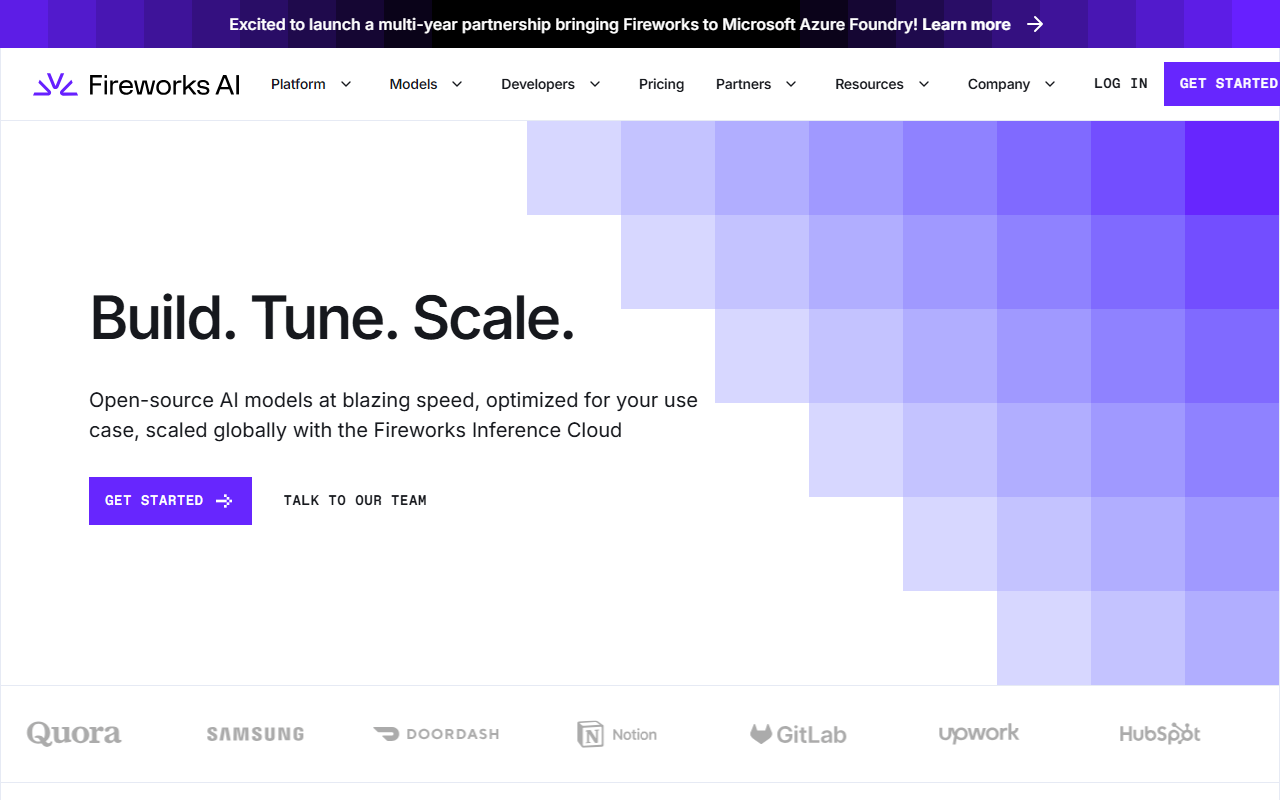
Upon visiting the Fireworks AI website, I immediately noticed the clean, developer-focused interface. The homepage prominently features the latest model releases—DeepSeek V4 Pro leads the banner—and a clear call to action to get started. The dashboard, while not fully visible without an account, is hinted at by the logical navigation: Model Library, Use Cases, and a detailed Pricing section. I clicked through to the Model Library and was impressed by the sheer variety of open models available. The platform truly lives up to its tagline as a frontier inference platform. During testing of the free tier (which seems to exist after signup, though pricing details are not openly listed for a free tier), I ran a few inference queries on the DeepSeek v3.2 model. The response was nearly instantaneous, and the quality of the output was on par with what I’d expect from a well-tuned open model. The platform also offers fine-tuning capabilities, which I explored briefly; the flow for uploading custom data and configuring tuning parameters appeared straightforward, especially for developers familiar with model training workflows.
Pricing, Model Library, and Technical Highlights
Fireworks AI operates on a per-token pricing model, with costs varying by model complexity. For instance, Kimi K2.5 costs $0.6 per 1M input tokens and $3 per 1M output tokens, while the newer MiniMax M2.7 costs $0.3 input and $1.2 output. These prices are competitive, especially considering the platform’s focus on inference speed. The model library is a standout feature: it includes state-of-the-art LLMs like DeepSeek, Qwen, and Gemma, as well as vision models like FLUX.1 Kontext Pro ($0.04 per image) and audio models like Whisper V3 Large. Technologically, Fireworks uses a custom inference engine optimized for low latency and high throughput, and it supports quantization-aware tuning and advanced fine-tuning techniques such as reinforcement learning. The platform is built on a globally distributed virtual cloud infrastructure and meets enterprise compliance standards including SOC2, HIPAA, and GDPR. For integration, there is a clear emphasis on API access, although specifics on authentication and SDKs were not detailed on the landing page. The platform also supports bring-your-own-cloud deployments for enterprises.
Strengths, Limitations, and Competitive Positioning
One of Fireworks AI’s greatest strengths is its speed. Customer testimonials from Notion and Cursor cite latency improvements from 2 seconds to 350 milliseconds, and a 3x speedup in response times respectively. The breadth of supported models is another major plus, allowing developers to switch between models without changing infrastructure. Additionally, the fine-tuning and model lifecycle management features give teams control over customization without managing GPU clusters. However, there are limitations. The pricing, while competitive, can become complex for high-volume applications, and the platform may be overkill for small projects or beginners who just need a simple API. Unlike Together AI, which also offers open models, Fireworks places a stronger emphasis on enterprise-grade security and production reliability, but it lacks the same level of consumer-friendly documentation or community resources. For those seeking a fully managed, no-code solution, Fireworks might feel too technical. The tool is best suited for AI-native startups and mid-to-large enterprises that need fast, scalable inference for custom-tuned models.
Final Verdict: Who Should Use Fireworks AI?
Fireworks AI is an excellent choice for teams that prioritize inference speed and want to leverage the latest open-source models without compromising on security. It is ideal for developers building code assistants, enterprise search systems, or high-throughput conversational agents. The platform’s superior performance for fine-tuned models, as praised by Cursor and Notion, makes it a strong contender in the text AI and dev framework space. However, individual developers or small teams on a tight budget may find the pricing opaque and the learning curve steep. I recommend trying the platform for a proof-of-concept project where speed is critical. Visit Fireworks AI at https://fireworks.ai/ to explore it yourself.










Comments