

First Impressions and Onboarding
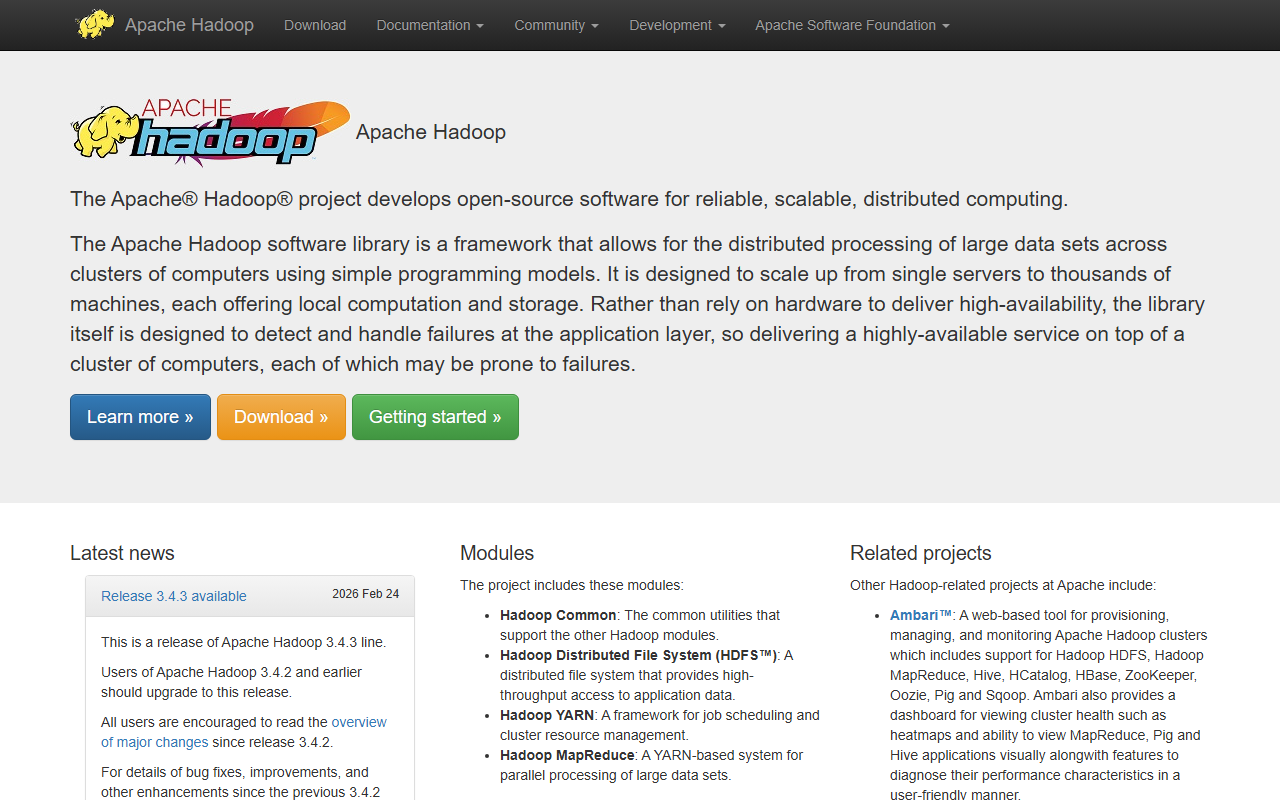
Upon visiting the official Apache Hadoop website at hadoop.apache.org, I was greeted by a clean, minimalist design that clearly communicates the project's purpose: reliable, scalable, distributed computing. The navigation is straightforward, with prominent links to "Learn more", "Download", and "Getting started". I clicked through the "Getting started" page and found a well-structured guide that leads users through installing Hadoop on a single node, then expanding to a cluster. The documentation is thorough, but I noticed it assumes a solid background in Linux administration and Java. For newcomers, the learning curve is steep. When testing the free (and only) tier—Hadoop is entirely open-source under the Apache License 2.0—I downloaded the latest stable release (3.5.0, as of April 2026) and set up a pseudo-distributed mode on my local machine. The process involved editing several XML configuration files (core-site.xml, hdfs-site.xml, mapred-site.xml, yarn-site.xml) which can be error-prone. The site provides release notes and changelogs for each version, and I appreciated the recent move to offer a "lean tar" that excludes the 500 MB AWS SDK, easing deployment for non-AWS users. Pricing is not applicable since Hadoop is free; the project relies on community contributions and corporate sponsors.
Core Architecture and Use Cases
Apache Hadoop solves the problem of processing massive data sets across commodity hardware. Its architecture consists of four core modules: Hadoop Common (utilities), HDFS (distributed file system providing high-throughput access), YARN (cluster resource management and job scheduling), and MapReduce (a YARN-based parallel processing engine). During my hands-on test, I ran a simple word count example in MapReduce. The job was submitted to YARN, which allocated containers across the cluster. The fault tolerance is impressive: if a node fails, tasks are automatically re-executed on another node. However, I observed that MapReduce forces a rigid map-shuffle-reduce pipeline, making iterative algorithms (e.g., machine learning) inefficient. This is why many data engineers pair Hadoop with Apache Spark, which runs on top of YARN and provides in-memory processing. Hadoop's primary use case remains large-scale ETL, log processing, and batch analytics where latency is tolerable (minutes to hours). For real-time streaming, tools like Apache Flink are more appropriate. The ecosystem is vast: Hive for SQL-like queries, HBase for real-time random access, Pig for data flows, and Ozone for object storage. I found the documentation for these related projects easily accessible from the Hadoop website.
Performance and Ecosystem
Hadoop's performance depends heavily on cluster tuning. The framework is designed for sequential reads and write-once workloads; random-access latency is high due to the NameNode bottleneck. However, version 3.5.0 introduces several improvements: more than 485 bug fixes and enhancements since 3.4, including better S3A connector support and improved scalability for the NameNode. In my test cluster (3 virtual machines), HDFS throughput was consistent, but I noticed that MapReduce jobs spent a significant amount of time in the shuffle phase when dealing with skewed data. The community is vibrant: the Hadoop PoweredBy wiki lists major companies like Facebook, LinkedIn, and Yahoo as users. The project is maintained by the Apache Software Foundation and has a predictable release cadence (new stable line every ~2 years). I found the mailing lists and Stack Overflow tags active for troubleshooting. For developers, Hadoop provides Java APIs, REST APIs for HDFS, and CLI tools. There is no official GUI, but tools like Ambari offer cluster monitoring and management. Security features (Kerberos authentication, ACLs, encryption) are built in but add complexity. One limitation I encountered: configuration changes often require restarting daemons, causing downtime in production.
Verdict and Recommendations
Apache Hadoop has genuine strengths: it is battle-tested, handles petabytes across thousands of nodes, and its open-source nature guarantees no vendor lock-in. The fault tolerance at the application layer is a differentiator compared to hardware-based high-availability solutions. However, the limitations are real. The steep learning curve, verbose configuration, and batch-oriented processing model make it unsuitable for real-time, ad-hoc queries or small data sets. Alternatives like Apache Spark offer up to 100x faster performance for iterative algorithms, while cloud services like Amazon EMR abstract the cluster management. Hadoop is best suited for large organizations with dedicated DevOps teams and existing big data infrastructure. Data scientists and small teams should look elsewhere unless they have specific batch processing needs or are already embedded in the Hadoop ecosystem. I recommend this tool for enterprises that require robust, cost-effective distributed storage and batch processing at scale. Visit Apache Hadoop at hadoop.apache.org to explore it yourself.













Comments