

First Impressions: What hippist AI Offers
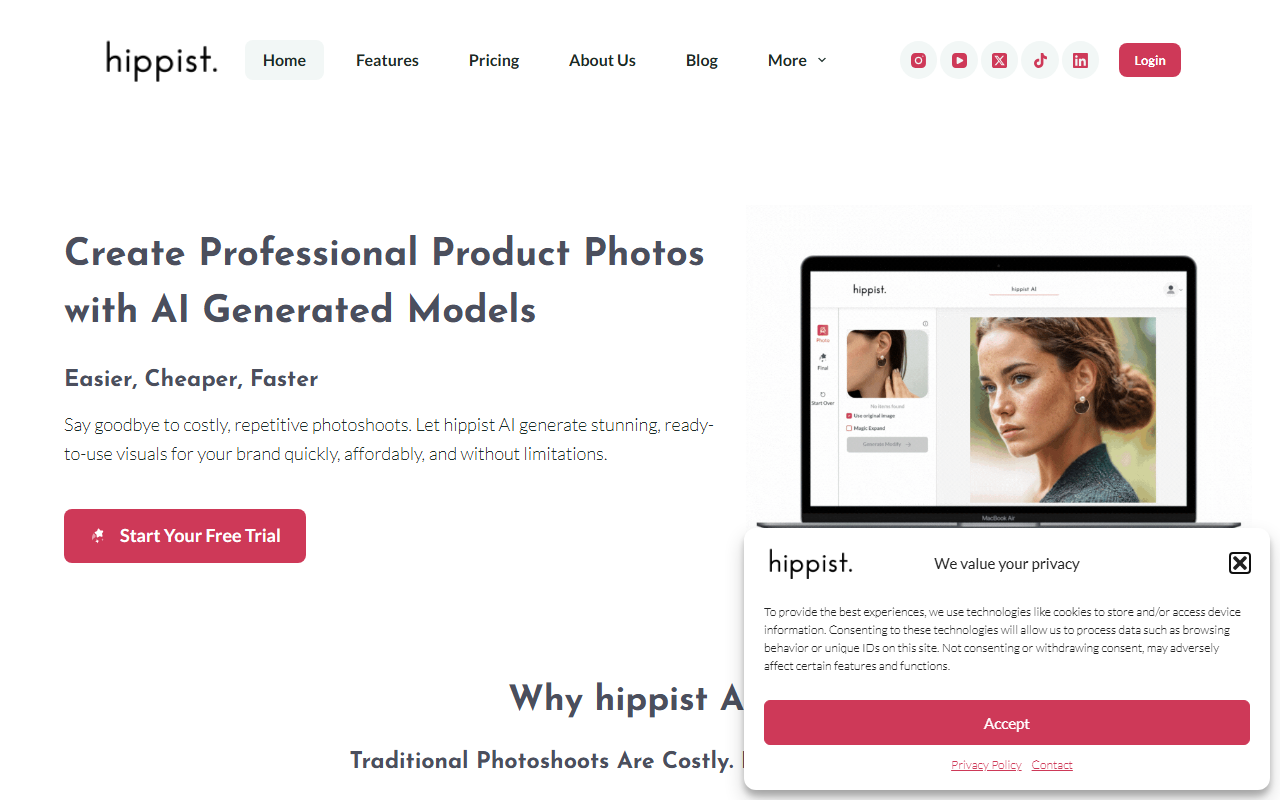
Upon visiting hippist.com, the landing page immediately presents a bold promise: “Create Professional Product Photos with AI Generated Models.” The design is clean and focused, with a prominent “Start Your Free Trial” button. I noticed that the site breaks down the value proposition into clear sections: it highlights the pain points of traditional photoshoots (cost, time, discomfort) and positions hippist as the solution. The headline “Easier, Cheaper, Faster” sets the tone for a tool aimed squarely at small-to-medium e-commerce businesses, marketplace sellers, and social media managers.
Scrolling further, I found a list of concrete use cases: websites, marketplaces like Etsy and Amazon, social media, ad creatives, newsletters, and A/B testing. The tool seems purpose-built to replace expensive studio shoots with AI-generated visuals. The free trial suggests a low-barrier entry, though no pricing details are visible on the site. This is a common tactic for AI tools that operate on a credit-based or subscription model, but it does leave potential users in the dark about long-term costs.
Key Features and Workflow
The website describes four main capabilities that I explored conceptually: Create a Model, Change the Scenes, Try New Stylings, and Magic Expand. Together, these features allow a user to generate a lifelike AI model, swap backgrounds for different settings (e.g., seasonal themes, holiday promotions), change outfits and accessories on the model, and even expand a close-up product photo into a full scene. The “Magic Expand” feature is particularly interesting—it suggests the AI can infer and generate realistic surroundings from a cropped image, which could save hours of manual editing.
Based on the copy, the workflow seems intuitive: upload a product photo (either from a previous studio shoot or a DIY shot), select or generate an AI model, then customize the background and styling. The tool also promises to “transform your face into an AI model,” which feels novel for brands that want to use a real person’s likeness without repeated sessions. However, the site does not show any sample outputs, model diversity, or resolution limits. I would have liked to see a demo gallery to assess image quality before committing to a trial.
Pricing, Positioning, and Limitations
Pricing is not publicly listed on the website. The only call to action is “Start Your Free Trial,” which implies a freemium or credit-based model, but without transparent tiers, businesses cannot easily evaluate cost-effectiveness. This is a notable limitation for a tool that competes with established players like PhotoRoom or Remini, which offer clear pricing for background removal and AI enhancement. That said, hippist differentiates itself by focusing on full-scene generation and model creation rather than simple background swaps—a more comprehensive solution for brands that need entire visuals.
Another limitation is the lack of user testimonials, case studies, or integration details. The site mentions “seasonal and event-specific photos” and geographic targeting, but without examples, it’s hard to gauge cultural sensitivity or regional accuracy. Additionally, no API or bulk processing features are mentioned, which may disappoint advanced users. On the strength side, the tool specifically addresses discomfort with self-photography and offers a creative alternative for brands that don’t want to hire models—a genuine pain point. The free trial is a good way to test quality before committing.
Final Verdict: Who Should Use hippist AI?
hippist AI is best suited for solo entrepreneurs, small e-commerce teams, and marketplace sellers who need a steady stream of product photos without the overhead of traditional photoshoots. Its focus on model generation, scene swapping, and styling variations makes it a compelling option for fashion, jewelry, and lifestyle brands that rely on visual appeal. However, the lack of transparent pricing and sample outputs means I would advise potential users to thoroughly test the free trial before scaling up. If you are a larger brand with specific quality and integration requirements, you may want to compare with more established tools first. Visit hippist at https://hippist.com/ to explore it yourself.










Comments