

First Impressions and Onboarding
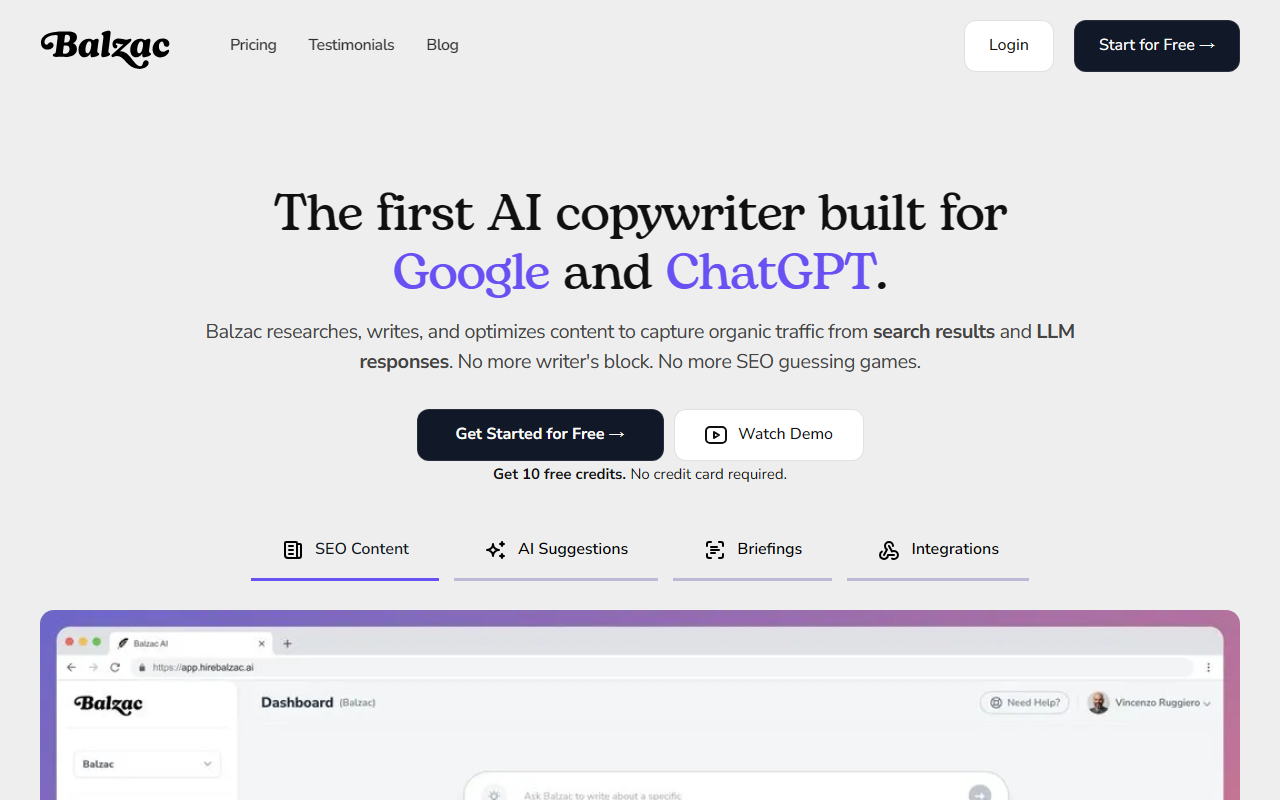
Upon visiting the Balzac website, the first thing that struck me was the distinctly developer-oriented messaging. The hero section bluntly calls it "The AI SEO writer your agents can hire" and immediately offers an npm install -g balzac-cli command. This is not a tool for casual bloggers—it's a skill for Claude Code, Cursor, or any MCP-compatible agent. The dashboard is minimal; most interaction happens through the CLI or API. I tested the free tier by running a quick keyword research command on my test site. The response was a clean JSON object with search volume, difficulty, and intent—exactly what a pipeline needs. The anti-slop engine is a standout: I generated a sample article and it avoided the dreaded "In today's digital landscape" filler, using natural sentence rhythm and specific examples. The initial experience makes one thing clear: Balzac is built for technical users who want automation, not a CMS dashboard.
Core Capabilities and Technical Depth
Balzac is a purpose-built SEO and GEO content engine delivered as a CLI, MCP server, and REST API. It solves a very specific problem: enabling AI agents to research keywords, write optimized articles (2,500–3,500 words), and publish them directly to a CMS—all without human intervention. The technology integrates with Google Search Console to read actual ranking data, targeting keywords where you're closest to page one (positions 5–20). It then structures content not only for Google but also for Gemini, ChatGPT, and Perplexity citations (GEO optimization). Under the hood, the anti-slop system uses a curated database of flagged patterns and runs output checks against AI detection heuristics. The API supports 50+ languages and can push to WordPress, Webflow, Shopify, and any platform via webhooks or Zapier. I tested the internal linking skill: it automatically maps existing pages and inserts relevant links, boosting crawlability. The image generation feature—AI cover images in 10+ styles—is a nice touch for full pipeline automation.
Pricing and Market Positioning
The website does not display exact pricing tiers on the landing page, but a prominent banner compares the "average monthly cost of a junior content marketer" ($5,200) against Balzac's flat rate of $79 per month. There is also a "Start for Free" button and a Product Hunt exclusive code for 50% off for 6 months. This suggests the paid plan begins around $79 monthly, which is competitive with tools like Frase ($44.99–$114.99/mo) or Surfer SEO ($69–$149/mo). However, Balzac's differentiator is its agent-first architecture: unlike Frase's web-based research and writing workflow, Balzac is designed to be consumed by AI agents, making it ideal for automated content pipelines. It competes indirectly with Content at Scale but targets a more technical audience. The tool is best suited for SEO teams and developers who want to script content operations, not for manual writers. Those who prefer a visual editor or drag-and-drop interface should look elsewhere.
Final Verdict and Recommendations
Balzac's genuine strengths lie in its anti-slop engine, deep Google Search Console integration, and full programmatic control via CLI/MCP/API. It genuinely produces content that sounds human and passes AI detectors. However, there are real limitations: the learning curve is steep for non-developers, and the lack of a robust web interface means you cannot quickly tweak articles without dropping into a terminal or API call. Additionally, the pricing transparency is poor—I had to infer the $79 figure from a banner. I recommend this tool to technical SEO specialists running AI agents like Claude Code or Cursor, especially those managing high-volume content pipelines. If you want a hands-off, data-driven content engine that ranks well and avoids AI detection, Balzac is a strong candidate. For manual writers or teams without developer support, traditional tools like Frase or Surfer SEO may be more accessible. Visit Balzac AI at https://hirebalzac.ai/ to explore it yourself.













Comments