

First Impressions and Onboarding
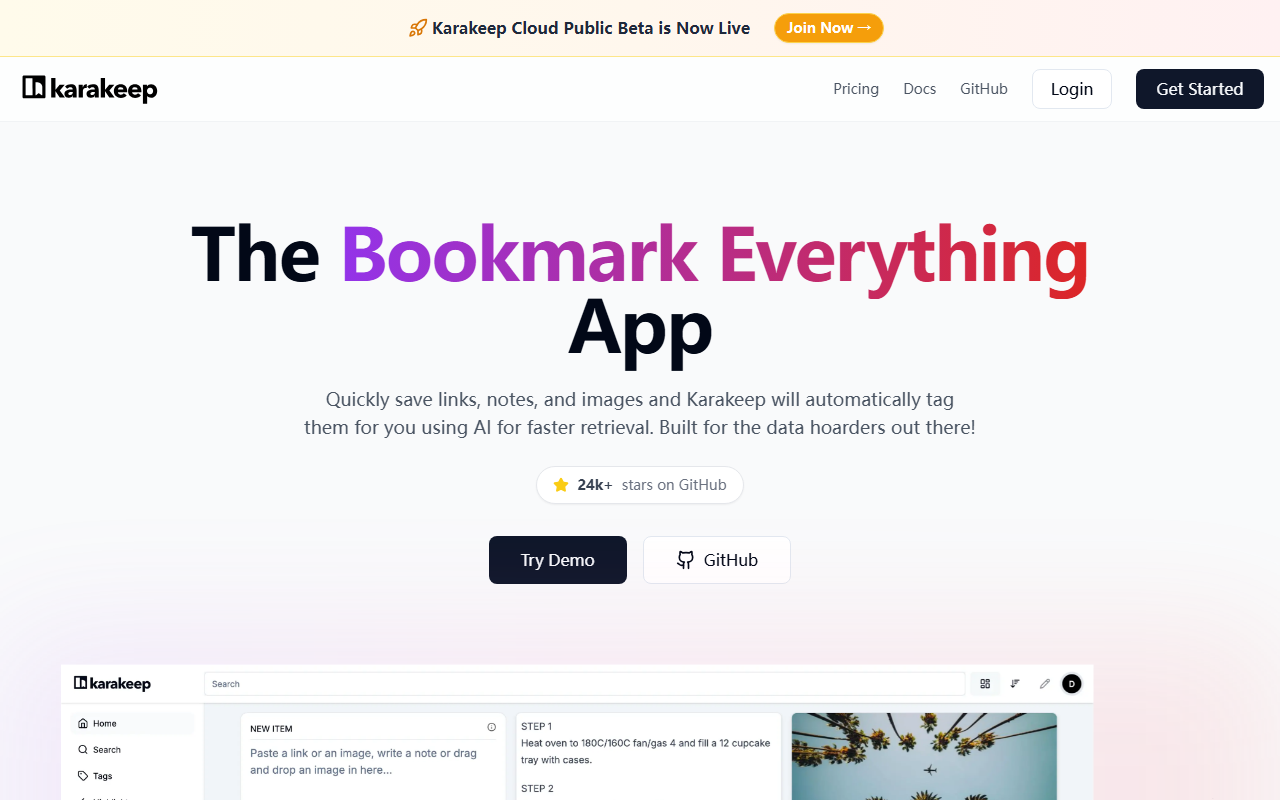
Upon visiting hoarder.app (now rebranded as Karakeep), I was greeted by a clean, modern landing page that immediately communicates the tool’s purpose: “The Bookmark Everything App.” The headline is backed by a prominent “Try Demo” button, which I clicked to explore the interface without committing to an account. The demo spins up a sandbox with a handful of sample bookmarks, showing how the dashboard organizes links, notes, and images into a card-based layout. The sidebar offers filters for tags, lists, and full‑text search. I was able to add a mock bookmark by pasting a URL; within seconds, the app automatically fetched the title, description, and a preview image. More impressively, it suggested tags like “technology” and “tutorial” based on the page content. The onboarding flow is minimal—intended for users who already know they want to hoard links efficiently. The site also highlights a new “Karakeep Cloud Public Beta,” which I joined using a form that required only an email address. The beta is free for now, and the team promises to announce pricing later.
Core Features and AI Capabilities
Karakeep distinguishes itself from traditional bookmarking tools like Raindrop.io or Pinboard by putting AI tagging front and center. The autotagging system, which appears to run a lightweight model locally in the self‑hosted version (or on the cloud in the beta), analyzes the text and metadata of each saved item and assigns relevant tags. In my demo test, the tags were accurate but not overly granular—think broad categories rather than niche specifics. You can also manually add or remove tags, and the rule engine lets you create custom automation: for instance, auto‑apply a “reading list” tag to any link from a certain domain. Beyond tags, the tool supports highlights: when viewing a saved page, you can select text and it stores the highlight alongside the bookmark for later reference. Collaborative lists work well for teams, allowing shared collections with per‑member permissions. The full‑text search indexed every word of the saved pages I tested, making retrieval instant. For power users, the REST API and webhooks open up endless integrations—I could, for example, pipe new bookmarks into a Notion database or trigger a Slack notification when a specific tag is added. The self‑hosting option via Docker is a major plus for privacy enthusiasts, as it keeps all data on your own server.
Pricing and Open‑Source Model
Pricing is not publicly listed on the website beyond the free cloud beta. The beta currently offers unlimited bookmarks and AI tagging, but the team has indicated a paid tier will launch once the beta ends. For self‑hosters, the software is completely free and open source (licensed under AGPL‑3.0), with over 24,000 GitHub stars and 150+ contributors—a strong community indicator. This open‑source foundation means you can inspect the code, contribute features, and run the service indefinitely without paying. The cloud option will likely monetize through subscription fees, similar to competitors like Raindrop.io’s Pro plan ($9/month). If you’re willing to manage your own server, Karakeep’s self‑hosted version offers essentially the same feature set without recurring costs. The Docker setup is straightforward; the documentation provides a one‑command deploy for Linux and Synology NAS. One limitation: there are no native mobile apps yet. Although the web app is responsive, you currently rely on browser extensions or the CLI for mobile saving. The team lists “Apps & Extensions” on the homepage, but only a web app, CLI, and browser extensions are available at launch.
Who Should Use Karakeep?
Karakeep is best suited for researchers, journalists, and developers who collect hundreds of links weekly and need intelligent, automated organization. The AI tagging saves time compared to manual tagging in Pinboard or Pocket, and the self‑hosting option appeals to those wary of cloud lock‑in. Collaborative lists also make it a solid choice for small teams curating shared reading materials. If you prefer a polished mobile experience or require offline access on your phone, you might want to wait for native apps—or stick with Raindrop.io for now. Likewise, if you only bookmark a few items per month, the AI features may be overkill. However, for anyone who identifies as a “data hoarder,” Karakeep delivers on its promise: an intelligent, open‑source bookmarking system that surfaces your saved content with minimal effort. Visit Karakeep at https://hoarder.app/ to explore it yourself.










Comments