

First Impressions: A Researcher’s Dashboard Built for Speed
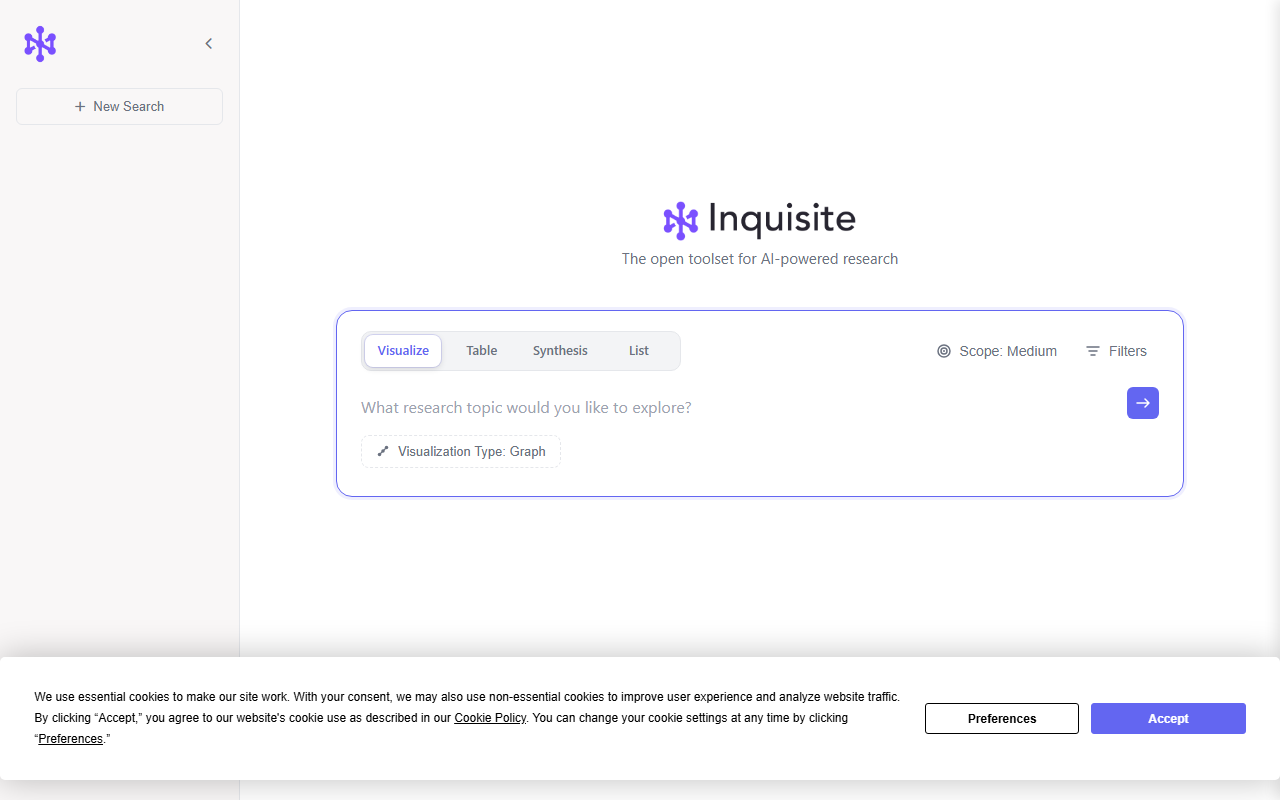
Upon visiting inquisite.ai, I was greeted with a clean, left-aligned sidebar offering New Search, Projects, Recent Searches, and profile options. The main panel immediately presents a search bar with scope toggles—Narrow, Medium, Wide—and a rich set of filters including publication year, minimum citations, and open-access only. The dashboard feels purpose-built for academics and deep readers who need precision, not just keyword matching. The onboarding is minimal; you sign up, then you’re prompted to enter an OpenAI API key. The tool lists models including GPT-4.1, GPT-4.1-Mini, and several GPT-5 variants (Medium and Minimal Thinking), which caught my attention—more on that later.
I started a new search for "transformer neural architecture search" using the Medium scope and the Graph visualization type. The results appeared quickly, each paper showing a summary, data, methodology, and other attributes that I could toggle on or off. The interface is responsive, and the ability to upload a PDF or import from URL for document analysis is a welcome addition for those working with their own papers.
Core Features: Semantic Search, Graphs, and Custom Attributes
Inquisite claims to search "100M+ research papers". While I cannot verify that exact number, the breadth of results was impressive for niche queries. The standout feature is the topic graph visualization: selecting Graph displays a network of related papers, with nodes sized by relevancy and edges indicating citation or semantic similarity. This makes it easy to spot clusters and influential works at a glance. You can switch between Graph, Table, Synthesis, and List views—Synthesis generates a brief AI-written overview of selected papers, while List offers a simple ranked output.
You can also define custom attributes for each paper. Beyond the default options (Summary, Data, Methodology, Population, Main Findings, Limitations, Future Work), you can add a custom attribute—for example, "Code Availability"—and Inquisite will attempt to extract that information from each paper. This level of flexibility is rare and powerful for systematic reviews or literature mapping. The project management feature lets you save papers into named projects, edit metadata, and upload full-text PDFs for deeper indexing. The "Similar Papers" generator, which runs after selecting a paper, is another time-saver.
Pricing and Technical Backend
Pricing is not publicly listed on the website. Inquisite appears to operate on a bring-your-own-key model: you supply an OpenAI API key, and the tool charges your own account for the GPT queries used during analysis and synthesis. This is transparent and cost-effective for users who already have API credits, but it may be a barrier for newcomers unfamiliar with API billing. The model selection includes GPT-5 variants, which are not yet widely released by OpenAI. It is unclear whether these are placeholder names, custom fine-tunes, or early-access models; I would recommend users verify compatibility before relying on them. The tool currently lacks a timeline view (marked as "Coming Soon") and does not appear to support other model providers like Anthropic or open-source LLMs, which limits flexibility.
Alternatives such as Elicit (focused on Q&A over papers) and Semantic Scholar (free, with API) offer comparable search but with less customizable extraction. Inquisite’s edge lies in its open, modular design and deep attribute-level control. For now, the tool is best suited for researchers comfortable configuring their own API keys and who need a highly customizable reading and synthesis pipeline. Casual users or those expecting a fully hosted free tier should look elsewhere.
Verdict: Strengths, Limitations, and Recommendation
Inquisite excels at empowering researchers to define exactly what information they want from each paper and visualize the landscape of a field. The graph visualization and custom attributes are genuine differentiators. The project management and PDF upload features streamline workflow integration. However, the reliance on a personal API key, the uncertainty around GPT-5 availability, and the lack of timeline view are real downsides. The interface, while functional, could benefit from more polish during multi-paper selection operations.
I recommend Inquisite for power users—graduate students, postdocs, and industry researchers—who regularly conduct literature reviews and want granular control over extraction. If you are okay with paying for your own API usage and enjoy tinkering with filters and attributes, this tool will likely become a staple. For quick searches or casual reading, simpler tools may be more accessible. Visit Inquisite at https://inquisite.ai/ to explore it yourself.













Comments