

First Impressions and Platform Overview
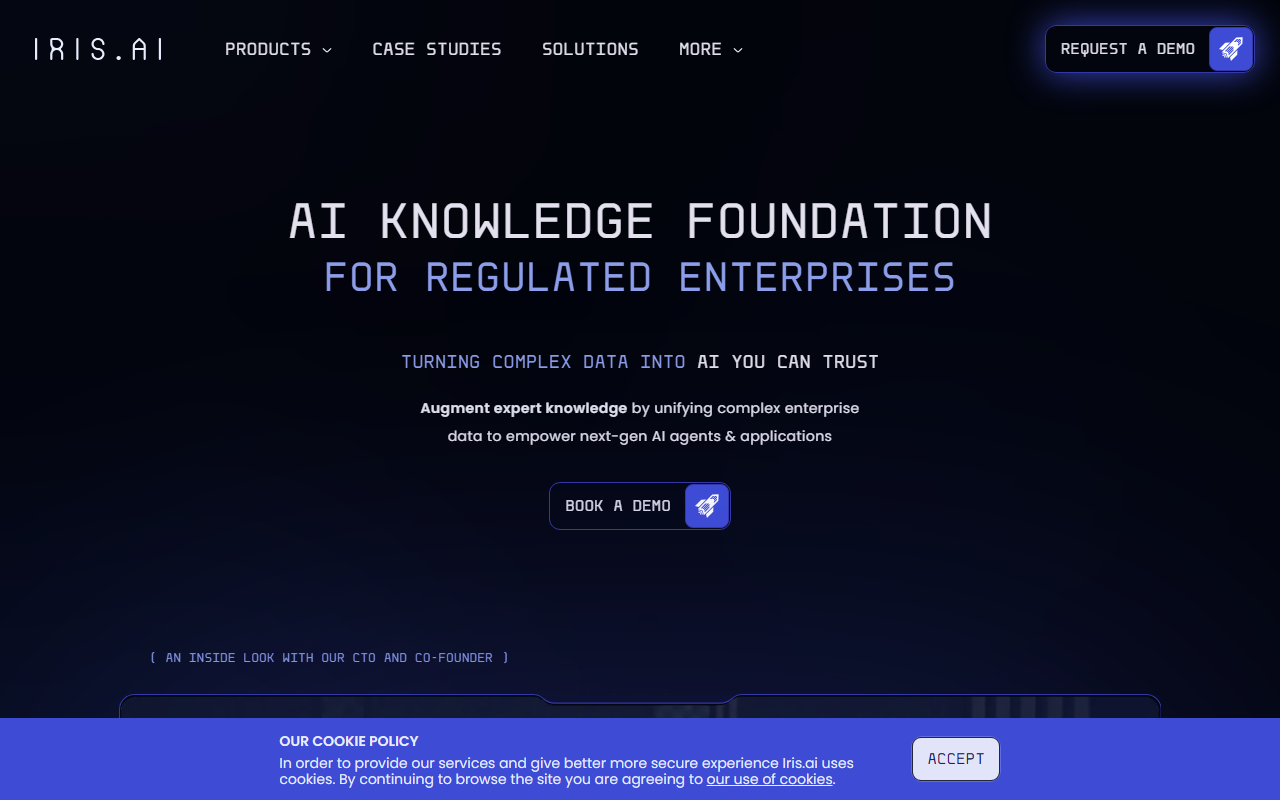
Upon visiting the Iris.ai website, I was immediately struck by its polished, enterprise-focused design. The homepage prominently displays the tagline “AI knowledge foundation for regulated enterprises,” and a large “Book a demo” button dominates the viewport. There’s no public pricing anywhere on the site—only a request form for white papers and demos. This immediately signals a high-touch, custom-priced offering aimed at organizations with serious compliance needs. The navigation menu lists three main products: Axion, Neuralith, and RSpace, each described with a short tagline. A video embed titled “An inside look with our CTO and co-founder” is present but did not play on my test browser—a minor technical friction. The dashboard concept isn’t explorable without a demo, but the site demonstrates a mature, methodical approach to knowledge management. I noted strong emphasis on “agentic RAG-as-a-service” and a three-phase onboarding process (Co-Create, Enable, Expand) that spans 30-180 days. This is clearly not a self-serve tool; it’s a partnership-oriented platform for large enterprises.
Core Products and Technical Capabilities
Iris.ai offers three intertwined products. Axion is described as “from data chaos to AI-ready intelligence,” implying a data ingestion and cleaning layer. Neuralith turns enterprise knowledge into an AI engine—likely a retrieval-augmented generation (RAG) system tailored to domain-specific data. RSpace provides precision intelligence for complex R&D, probably a search and discovery tool for researchers. The underlying technology leverages LLMs with a strong focus on accuracy and trust, evidenced by a white paper titled “A User-Friendly Approach to LLM Evaluation.” The platform supports agentic RAG, meaning AI agents that can autonomously retrieve and reason over enterprise data. Technical details such as which specific LLMs are used are not disclosed on the site, but the platform promises “35% savings on LLM usage costs” and “80% acceleration on AI go-to-market.” There’s no mention of a public API, but integrations are likely custom. The platform boasts secure ingestion of 160+ million documents and over 200,000 answers evaluated. These metrics suggest a mature, battle-tested system, but without independent verification, they should be taken as marketing claims.
Use Cases and Customer Evidence
The site includes three case study quotes from large organizations: ArcelorMittal (manufacturing), a public sector researcher (unnamed government body), and a leading global telecommunications company. The ArcelorMittal example is particularly compelling—their head of IP claims Axion “cut weeks and, in some cases, months out of our research and development timelines” and increased their ability to review patents. The public sector testimonial highlights speed in crisis situations, like reviewing papers on avian flu. The telecom company chose Iris.ai over 21 other vendors, praising its fast delivery of a working solution. These testimonials are detailed and specific, lending credibility. However, there are no generic “5-star user reviews” or G2 ratings visible—the target audience is clearly enterprise buyers who prefer case studies. The platform’s focus on regulated industries (manufacturing, telecom, public sector) suggests strong compliance capabilities. I see this tool excelling in scenarios where data privacy, audit trails, and accuracy are non-negotiable—such as pharmaceutical R&D or legal discovery. It would be overkill for a lone researcher or a small startup.
Market Position, Pricing, and Verdict
Iris.ai competes with other enterprise AI knowledge platforms like Glean (for workplace search) and Coveo (for e-commerce and service), but it differentiates by targeting strictly regulated verticals. Its emphasis on “AI you can trust” and “agentic RAG-as-a-service” positions it as a safer, more governed alternative to building custom LLM pipelines. Pricing is not publicly listed, which is typical for enterprise software. Expect costs in the tens of thousands annually, likely requiring a minimum contract. Strengths: robust data ingestion, proven ROI in large organizations, clear roadmap for scaling AI adoption. Limitations: no self-serve trial, high entry barrier for smaller teams, and the website’s lack of detailed technical specs may frustrate developers who want to validate under the hood. I recommend Iris.ai for regulated enterprises with complex data landscapes and a need for auditable AI agents. If you’re a team of five building a chatbot, look elsewhere—try simpler RAG frameworks or open-source tools. For a corporation with compliance officers and legal teams, Iris.ai is a strong contender. Visit Iris.ai at https://iris.ai/ to explore it yourself.










Comments