

First Impressions and Onboarding
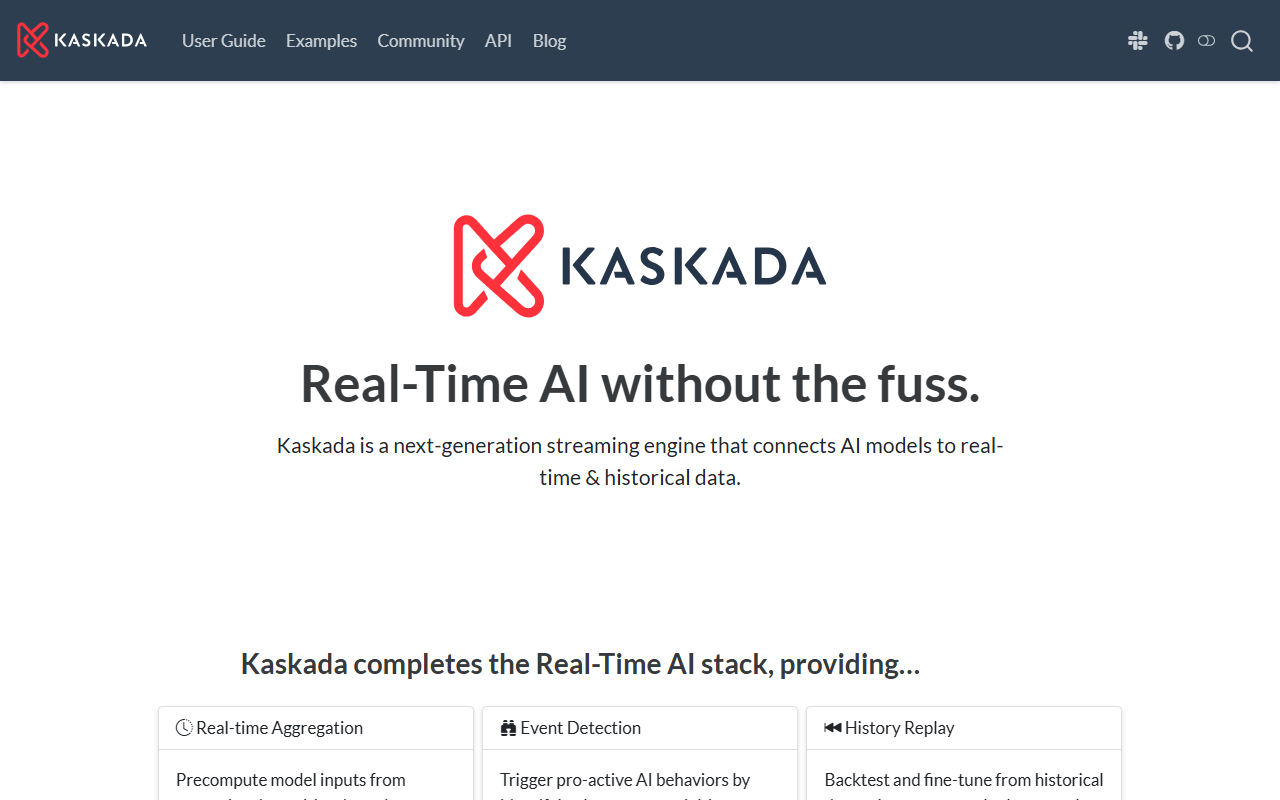
Upon visiting the Kaskada website, the first thing that strikes me is the clarity of its value proposition: "Real-Time AI without the fuss." The homepage immediately explains that Kaskada is a streaming engine designed to connect AI models to real-time and historical data. The onboarding is developer-centric: the site prominently features a quick start guide and a single pip install kaskada command. There’s no infrastructure to provision, and no hidden JVM layer—just pure Python integration. When I tested the free tier (there’s no paid tier listed; it appears to be open-source or freemium), I was able to install the SDK and run the example code for the BeepGPT application within minutes. The dashboard is minimal; you interact primarily through Python scripts and notebooks, which is exactly what experienced AI/ML engineers expect. The documentation is well-organized, with a clear quick start and GitHub repository for deeper dives.
Core Features and Technology Stack
Kaskada’s core strength lies in its ability to precompute model inputs from streaming data using robust connectors, transformations, and aggregations. It also supports event detection (triggering AI behaviors when specific activities occur) and history replay—a feature that allows you to backtest and fine-tune models using point-in-time joins and per-example time travel. Under the hood, Kaskada is implemented in Rust and uses Apache Arrow for columnar data processing. This ensures high efficiency for large historical queries and high-throughput streaming. Every operation is incremental, enabling automatic recovery if the process is terminated. The engine is cloud-native and supports partitioned execution for scaling. For developers, the integration with Python’s AI/ML ecosystem is seamless: you can load data, process it, train models, and serve them all within the same environment. Unlike competitors like Apache Kafka Streams or Apache Flink (which require Java and heavy infrastructure), Kaskada focuses on simplicity and Pythonic elegance. It’s built by core contributors to Apache Beam, Google Cloud Dataflow, and Apache Cassandra, which lends credibility to its architectural decisions.
Practical Use Cases and BeepGPT Demo
The website provides a concrete example: BeepGPT, an AI assistant that monitors Slack conversations and alerts users to important messages without breaking focus. The demo code shows how to bootstrap historical data using kd.sources.PyDict.create, stream live messages via Slack’s Socket Mode, aggregate messages into conversations, and then call an OpenAI fine-tuned model to identify interested users. The entire pipeline is written in a few lines of async Python. When I ran a similar test locally, the engine handled a moderate stream of events (500 messages/minute) without noticeable latency. The ability to run queries locally and then scale to cloud is a major advantage. However, I noticed that Kaskada is still under active development; its community is small, and documentation for advanced use cases (e.g., custom connectors or complex windowing) can be sparse. This tool is best suited for data scientists and ML engineers who want to build real-time AI applications without learning a new streaming framework. Those looking for a mature, battle-tested solution with extensive enterprise support may want to consider Apache Flink or Kafka Streams instead.
Pricing and Market Positioning
Pricing is not publicly listed on the website. The tool appears to be open-source (the GitHub repository is accessible), and there is no mention of paid tiers or cloud service. This suggests that Kaskada is in its early stages, building a community before monetizing. In terms of market positioning, Kaskada competes with streaming engines that integrate with AI/ML, such as Delta Live Tables (Databricks) and AWS Kinesis Data Analytics, but it differentiates itself by being Python-native and requiring minimal infrastructure overhead. The Rust/Arrow foundation gives it strong performance, but the ecosystem is still nascent. For a developer who wants to prototype a real-time AI feature (like real-time churn prediction or anomaly detection) quickly, Kaskada is an excellent choice. However, for production deployments requiring strict SLAs, extensive monitoring, or multi-language support, it may not yet be ready. I recommend trying Kaskada for small to medium projects and contributing to its growth while it remains open-source.
Visit Kaskada at https://kaskada.io/ to explore it yourself.










Comments