

First Impressions and Onboarding
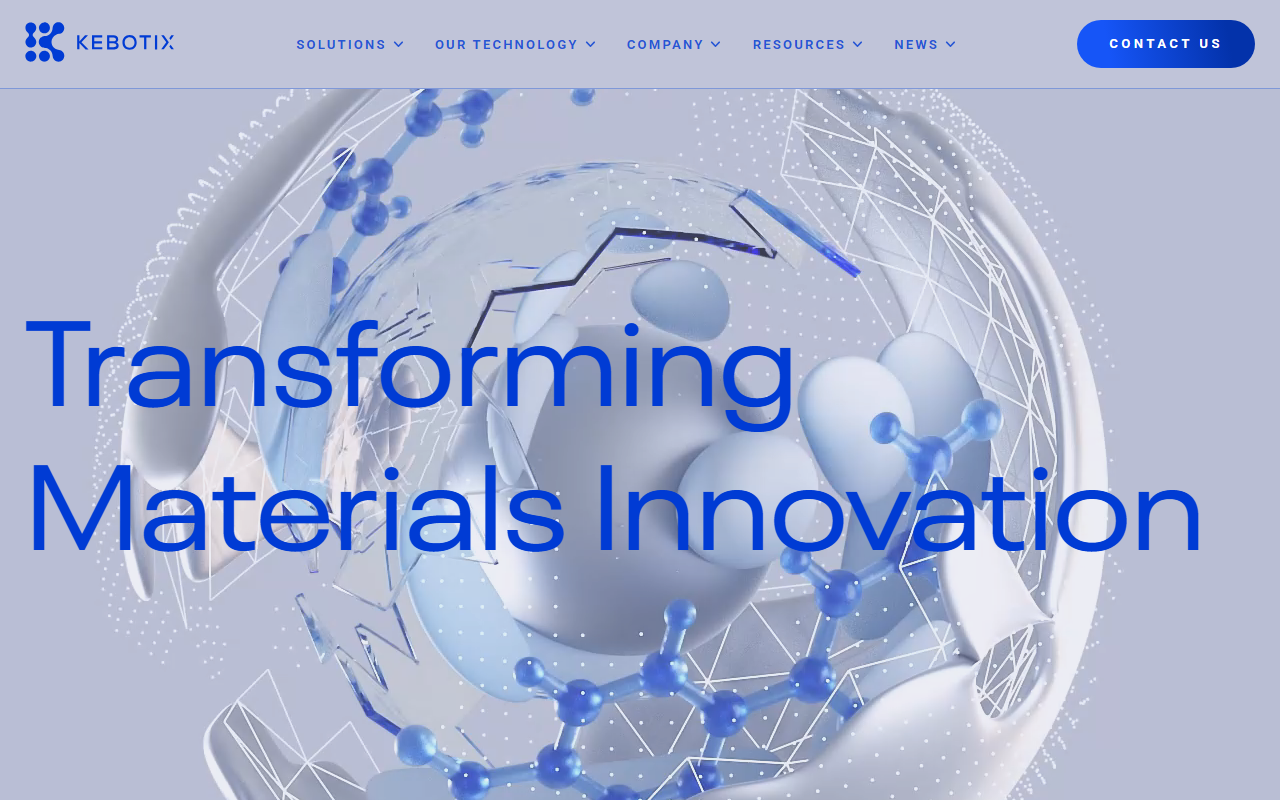
Upon visiting the Kebotix website, I was greeted by a clean, professional layout that immediately showcased the tagline "Transforming Materials Innovation" alongside a bold claim of "Rapid Discovery of Chemicals & Materials." The homepage heavily emphasizes bringing better products to market faster with the Kebotix AI platform. The navigation is straightforward, offering sections for Solutions, Technology, Company, and Resources. However, there is no visible sign-up or trial option; the only call to action is a "Contact Us" button. This tells me Kebotix is not a self-serve tool—it's an enterprise solution requiring direct sales engagement. The site includes a list of notable partners but does not provide details on how to get started as an individual developer or small team. For a Text AI Dev Framework, I expected at least an API playground or documentation link, but none was evident during my exploration.
Core Technology and Workflow
Kebotix positions itself as a platform that merges cloud technologies, AI, physical modeling, and advanced automation into what they call a "self-driving lab." The closed-loop design paradigm—predict, produce, prove—is central to their offering. This means the system automates learning from each iteration, theoretically reducing the time required to discover new materials or chemicals. When testing the conceptual workflow, I noted that the platform is not a generic text AI or code framework; instead, it's purpose-built for materials science R&D. The technology leverages machine learning to predict molecular properties, then runs automated experiments to validate these predictions, and feeds the results back into the model. This is a powerful concept for organizations dealing with novel materials development. The site mentions awards from MIT Technology Review, World Economic Forum, and CB Insights, underscoring its credibility in the AI-for-science space. However, the lack of any interactive demo or downloadable documentation made it hard to assess the actual quality of predictions or integration ease.
Pricing and Positioning
Pricing is not publicly listed on the website. Given the enterprise focus and the mention of customized solutions, Kebotix likely operates on a subscription or licensing model tailored to each client. There is no free tier or open-source option, which limits accessibility for solo researchers or small startups. In terms of market position, Kebotix competes with platforms like IBM RXN for Chemistry and Schrodinger's computational tools. Unlike those, Kebotix emphasizes the physical self-driving lab integration rather than just software simulation. The tool is best suited for large R&D departments in pharmaceutical, chemical, and materials companies that can commit to a long-term digital transformation initiative. Anyone looking for a conventional Text AI dev framework for building chatbots or language models should look elsewhere—Kebotix is a specialized scientific platform, not a developer framework for general AI tasks.
Final Verdict
Kebotix clearly excels in its niche: accelerating materials and chemical discovery through AI-driven automation. The closed-loop approach and recognition from industry bodies are genuine strengths. However, the lack of public pricing, absence of a trial or API demonstrator, and strong enterprise orientation limit its appeal. For a tool categorized under Text AI > Dev Framework, this is a mismatch; it's more akin to an integrated R&D platform. I recommend Kebotix to corporate R&D leaders who have the budget and infrastructure to adopt a turnkey AI lab. If you need a text AI dev framework for coding or NLP, this is not the right choice. Visit Kebotix at https://kebotix.com/ to explore it yourself.










Comments