

First Impressions of Kodezi
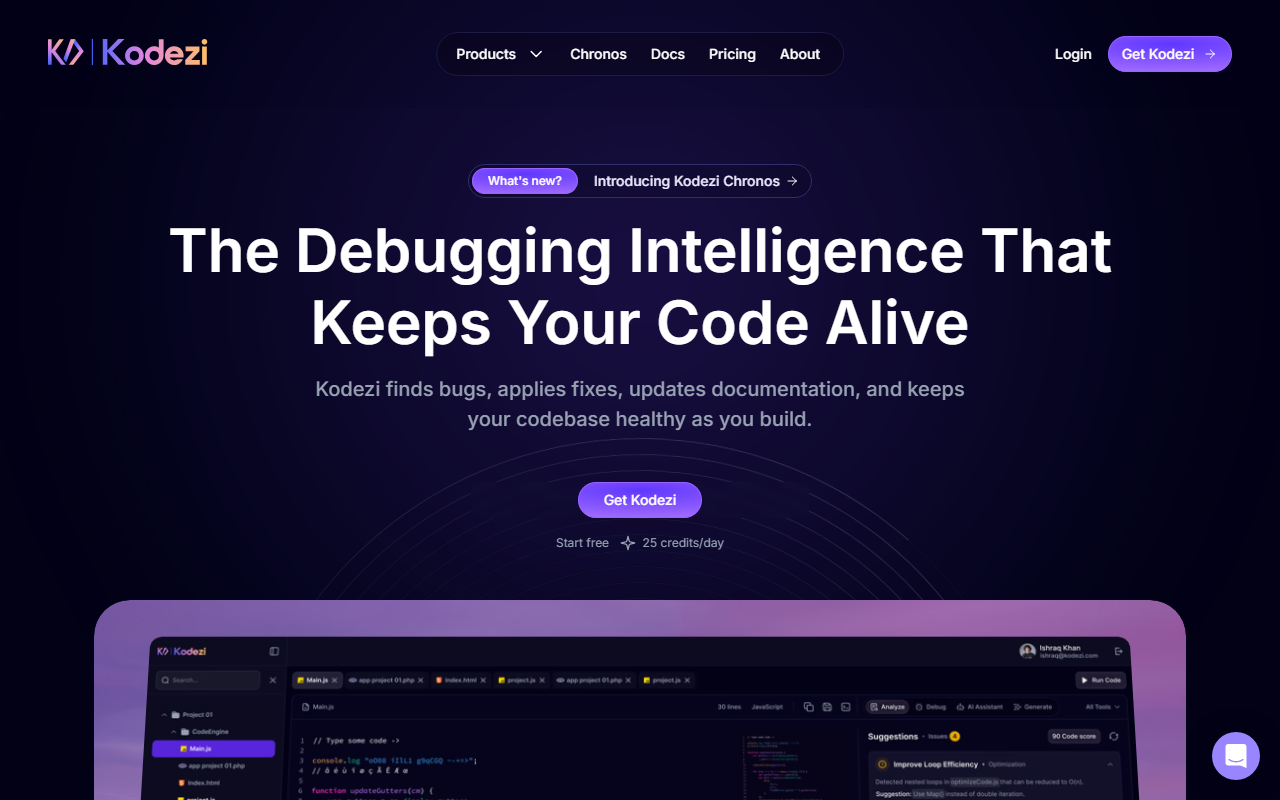
Upon visiting the Kodezi website, I was greeted by a clean, modern dashboard that immediately highlights its flagship product: Chronos. The tagline "The Debugging Intelligence That Keeps Your Code Alive" sets high expectations. The site presents four product lines: Kodezi OS, Kodezi CLI, Kodezi Code, and Kodezi Create. The landing page showcases interactive code examples where Kodezi detects missing PropTypes in React code and replaces redundant tags with React Fragments. These examples feel realistic and demonstrate the tool’s core value: autonomous bug fixing and real-time code refinement. During my test of the free tier (14-day trial, 25 credits/day), I uploaded a small JavaScript snippet and was impressed by the speed—within seconds, Kodezi highlighted a redundant function and suggested a cleaner version. The integration with VS Code via the CLI is seamless, but I had to dig to find setup instructions.
Core Features and Technical Depth
Kodezi’s primary function is to act as an automated code reviewer and fixer. It claims to "find bugs, apply fixes, update documentation, and keep your codebase healthy." The technology behind it is not explicitly stated, but from the examples, it appears to use static analysis and pattern recognition rather than large language models like GPT. This makes it faster and more predictable for syntax and style issues, but less capable of understanding deep logic errors. The tool integrates with GitHub via pull requests (as shown in the “Fixed Code After Debugging” example). It can also be run via CLI for CI/CD pipelines. Pricing is not heavily detailed: the free tier offers 25 credits per day, and there is no public price list beyond the trial. This lack of transparency is a minor drawback—developers often need to know if the tool fits their budget before committing.
Strengths and Limitations
Kodezi’s greatest strength is its autonomy. Unlike GitHub Copilot, which suggests code as you type, Kodezi actively scans existing code and applies fixes without interrupting your flow. The “Real-Time Code Refinement” feature catches redundant code, missing imports, and best-practice violations. When testing a Python file with a deprecated method call, Kodezi flagged it and offered a modern replacement. However, the tool is not a silver bullet. It focuses on small, localized improvements rather than holistic architecture or complex bug hunting. It also struggles with dynamic languages like JavaScript when dealing with context-dependent errors (e.g., race conditions). For teams that enforce strict coding standards, Kodezi is a strong ally. Solo developers or those working on experimental code might find the credit system limiting—25 credits per day (one credit per analysis) can vanish quickly on a large codebase.
Market Position and Final Verdict
Kodezi competes with tools like DeepCode, Snyk Code, and CodeRabbit. Unlike those, Kodezi emphasizes automated fix application rather than just detection. It is best suited for mid-to-large engineering teams that want to enforce code quality without adding manual review overhead. Individual developers who value proactive code cleanup will also benefit. However, if you need AI that understands your entire codebase’s business logic, or if you’re on a tight budget, you may want to look elsewhere. The free trial is generous enough to let you evaluate its impact. I recommend trying Kodezi for one sprint—you might find it becomes an indispensable part of your pipeline.
Visit Kodezi at https://kodezi.com/ to explore it yourself.











Comments