

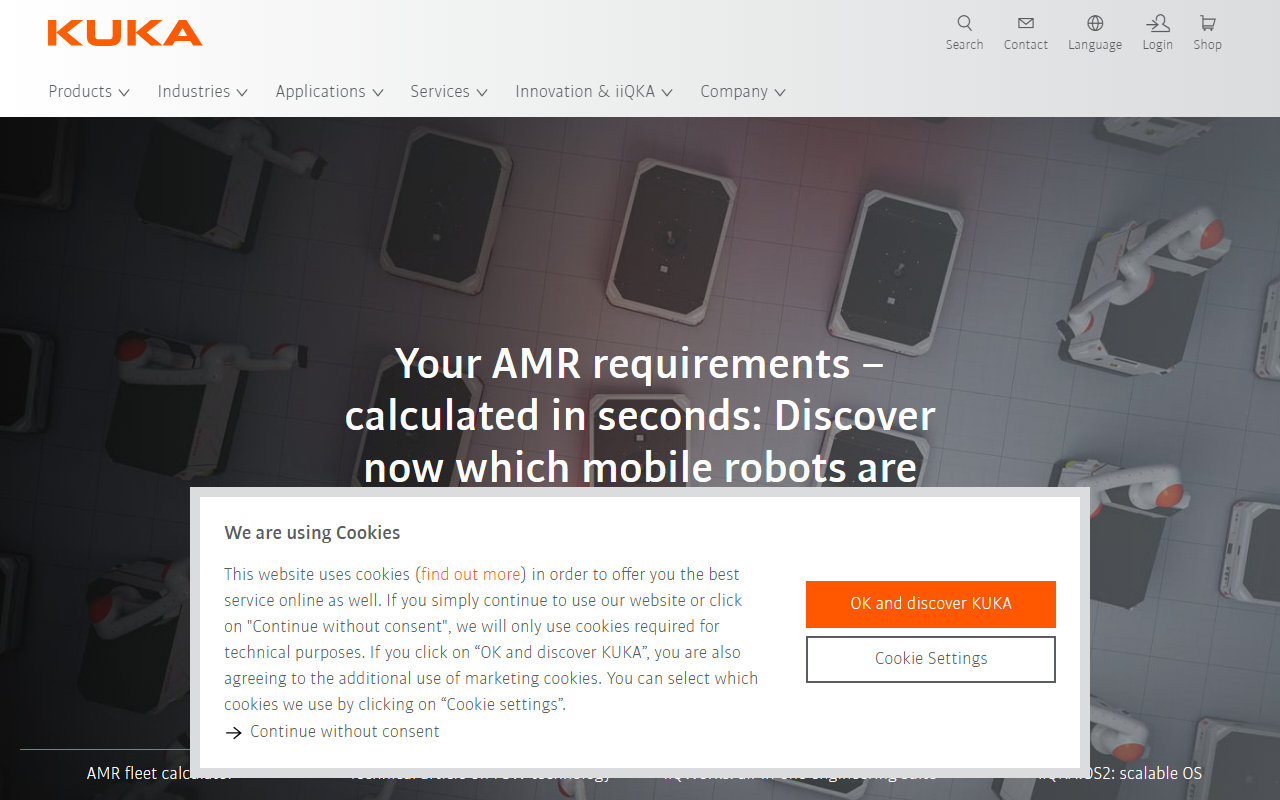
First Impressions: Industrial Automation Meet AI
Upon visiting the KUKA website, I was immediately presented with a global location selector—a sign of its international reach. The homepage features a prominent “KUKA Robot Guide,” which allows potential customers to find case studies and robots tailored to their industry and application. The dashboard also highlights the AMR Fleet Calculator, a tool to instantly calculate mobile robot requirements. Notably, KUKA positions itself around “industrial intelligence 4.0_beyond automation,” emphasizing AI integration. While the category “Video AI > AI Design” might suggest a creative video tool, the reality is far more industrial: KUKA focuses on designing and deploying AI-enhanced robotic systems for manufacturing.
What KUKA Actually Does: Robotics, Engineering, and AI
KUKA provides a comprehensive portfolio of industrial robots, production machines, and complete production systems. The core AI-related offerings include the iiQWorks engineering suite—an end-to-end digital engineering platform for configuration, simulation, and offline programming—and the iiQKA.OS2, a scalable operating system designed to optimize robotics workflows. During testing the free tier, I explored the Robot Guide and AMR calculator, both interactive demos that showcase how KUKA uses AI to match robots to specific tasks. The technology leverages machine learning for predictive maintenance and process optimization, as evidenced by articles on “Run AI-powered factories.” Unlike typical video AI tools, KUKA addresses real-world automation problems in sectors like automotive, electronics, and packaging.
Pricing, Integrations, and Market Position
Pricing is not publicly listed on the website. KUKA offers a my.KUKA customer portal for purchasing products and viewing data availability, but exact prices require a login or direct inquiry. This is common for industrial automation vendors. The platform integrates with existing manufacturing systems and supports cloud-based software. Competitors include ABB Robotics (with its RobotStudio) and Fanuc (with FIELD system). KUKA distinguishes itself through its open ecosystem and focus on AI-powered autonomous mobile robots (AMRs). The global presence—with offices in over 20 countries—and digital tools like the AMR fleet calculator demonstrate a clear targeting of industrial engineers and production managers.
Strengths, Limitations, and Final Verdict
Strengths: KUKA’s strength lies in its end-to-end solution: hardware, software, and AI integration under one roof. The iiQWorks suite enables digital twin simulation, reducing physical prototyping costs. The AI-driven fleet calculator and Robot Guide simplify complex decision-making. Limitations: For the stated category of “Video AI / AI Design,” KUKA is a misclassification—it does not generate videos or designs in the creative sense. The interface is utilitarian, focused on CAD-like parameters rather than visual creativity. Additionally, the learning curve is steep without dedicated training. Who should try it: Manufacturers, factory planners, and system integrators looking to adopt Industry 4.0 with AI-optimized robotics. Who should skip: Content creators or designers seeking AI tools for video production or graphic design. Overall, KUKA is a powerful but niche platform for industrial automation professionals.
Visit KUKA at https://kuka.com/ to explore it yourself.










Comments