

First Look: Kustomer’s Dual Approach to AI-Powered CX
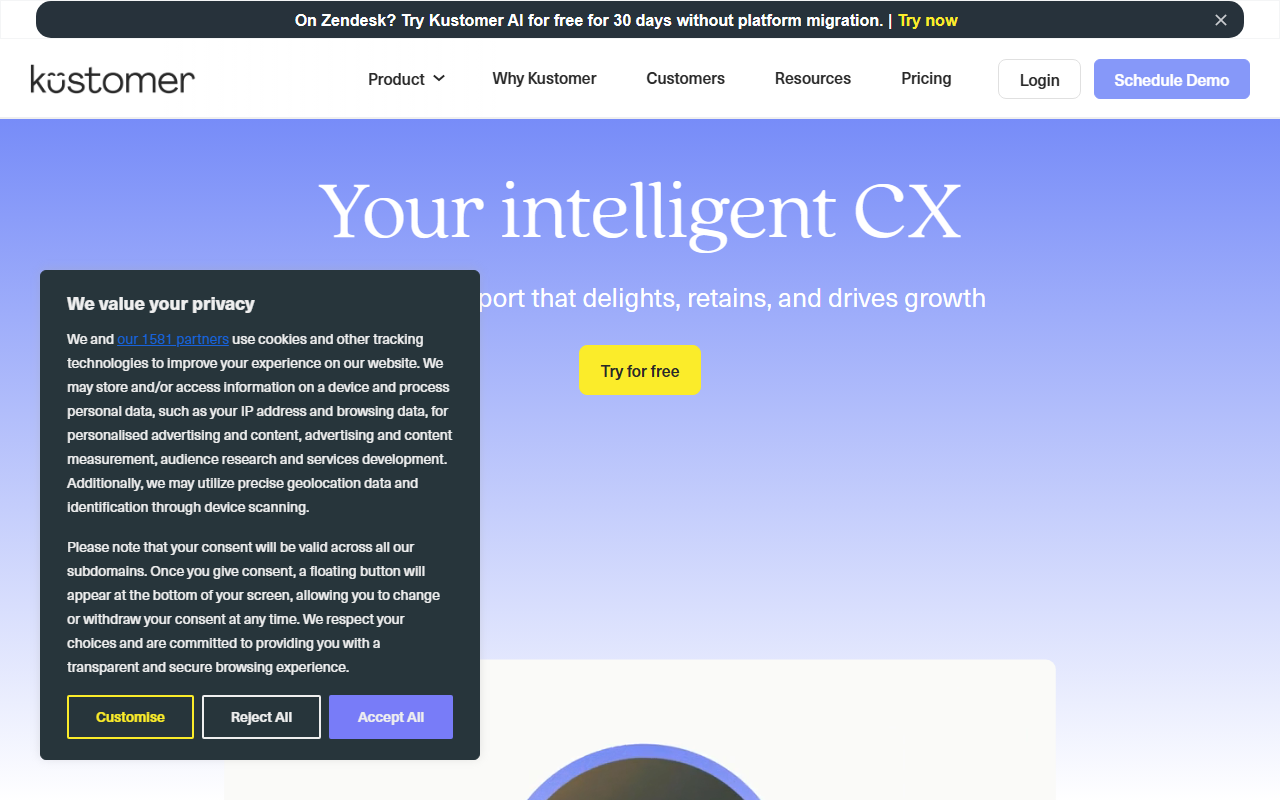
Upon visiting the Kustomer website, the first thing I noticed was the clear split between two product paths: “Kustomer AI” and “Kustomer AI + Platform.” This design immediately tells me the company understands that not every team wants to rip and replace their existing helpdesk. Kustomer AI is pitched as an intelligence layer that sits on top of your current stack, while Kustomer AI + Platform offers a full, connected CRM and helpdesk with AI built right in. The homepage uses a toggle to let visitors explore each option, which is a refreshingly transparent way to present a dual offering. Down the page, bold claims appear: “AI that reasons through complex workflows,” “80% improvement in first response times,” and a 15-point increase in CSAT scores. These stats are attributed to “500+ G2 reviews,” giving them some external credibility. The overall design is polished, with a strong emphasis on video demos and calls to schedule a meeting rather than a self-serve trial. There is no obvious free tier, which suggests Kustomer is targeting mid-market and enterprise teams looking for a serious investment.
Deep Dive: AI That Works With Your Team, Not Against It
Kustomer’s core value proposition is that its AI assists reps rather than replacing them. This is a crucial distinction in a time when many vendors push full automation. The platform claims to surface “proactive rep signals” – customer insights during conversations – and to use real-time intent detection for intelligent orchestration. From a technical perspective, the AI is built on a unified data foundation. This means all customer interactions, history, and context live in one place, powering both automated responses and human agent workflows. No specific models are named on the site, but the emphasis on “explainable AI decisions” and “human-in-the-loop” oversight suggests a focus on trust and compliance. The workflow integration appears deep, with no-code configuration and guided setup. When testing the description of “AI Agents built right in,” I appreciated that the wording focuses on helping teams “design, optimize, and scale experiences” rather than just deploying chatbots. The platform also promises orchestration that can handle complex, multi-step journeys. One concrete workflow I observed on the page: the AI adapts to customer intent on the fly and routes interactions to the best resource – a human, an automated response, or a combination. That kind of adaptive routing is what separates Kustomer from simpler rule-based systems.
Pricing, Market Position, and Competitors
Pricing is not publicly listed on the website. There is a “Pricing” link in the navigation, but clicking through requires starting a conversation with sales. This is typical for enterprise-oriented tools. Kustomer likely uses a per-agent or per-contact model, but without public figures, it’s hard to compare directly. In the CRM and CX space, competitors include Zendesk (with its AI add-ons like Zendesk Answer Bot) and Salesforce Service Cloud (with Einstein bots). Unlike Zendesk, which often feels like a generalist platform, Kustomer leans heavily into the “unified data” narrative, arguing that context is the key to better AI. Another competitor is Intercom, which also offers AI-powered customer support. Kustomer distinguishes itself by positioning its AI as a co‑pilot for reps rather than a replacement. The platform boasts “seamless orchestration at scale,” and the website highlights impressive results: 80% faster first response times, 25% agent hours saved, and 40% lower cost per contact. These are compelling numbers for any operations leader. However, I found limited information about integrations beyond the general “deep workflow integration” claim. For teams needing out-of-the-box connections to e‑commerce platforms or legacy systems, that may require further sales conversations.
Final Verdict: Who Should Try Kustomer?
Kustomer is best suited for mid-market to enterprise companies that want to augment their existing customer service operations with intelligent AI, without committing to a full platform rip‑and‑replace. The dual offering means you can start with Kustomer AI alone and later migrate to the full platform. Teams that prioritize a unified customer view and agent-coaching AI will find a lot to like. However, small businesses or startups without dedicated CX teams may find the lack of transparent pricing and self‑service onboarding a barrier. The absence of a free tier or trial also makes it harder to evaluate risk‑free. If your organization already uses a major CRM and you want an AI layer that understands context and intent, Kustomer is worth a demo. Strongest for companies that value explainability and human‑in‑the‑loop automation. Visit Kustomer at https://kustomer.com/ to explore it yourself.













Comments