
First Impressions and Onboarding
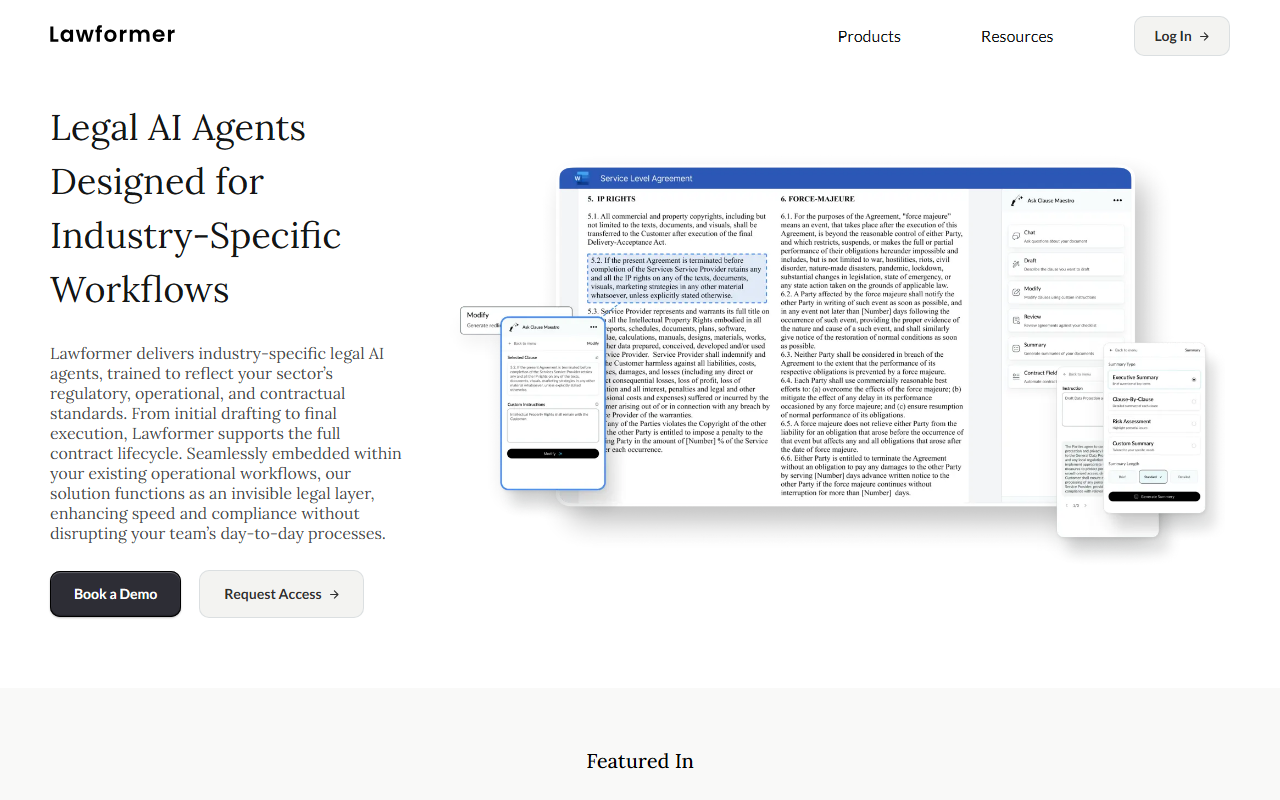
Upon visiting Lawformer's site, I was struck by the clean, enterprise-oriented aesthetic. The landing page immediately highlights "Legal AI Agents Designed for Industry-Specific Workflows" — a phrase that sets the tone for a tool that is clearly built for legal departments, not individual practitioners. There is no free trial or self-service signup; the only calls to action are "Book a Demo" and "Request Access". This signals that Lawformer is a high-touch, enterprise-grade product requiring a sales conversation. The page walks through several use cases: converting static contract archives into searchable libraries, capturing institutional legal knowledge, keeping clause libraries in sync with industry standards, and embedding automation into Microsoft Word and CLM/CRMs. The interface is not shown in detail, but the emphasis on "invisible legal layer" suggests it works primarily as an add-in within existing tools.
When testing the free tier — which doesn't exist — I found no way to experiment without contacting sales. This is a limitation for curious users or small firms. However, the messaging is clear: Lawformer targets organizations that already have mature contract workflows and need an AI layer to accelerate and standardize them. The site also mentions partnerships (logos not shown in the extracted content) and features "Lawformer Automotive" as a specialized offering for the automotive sector, indicating vertical customization.
Core Features and Workflow Integration
The tool's core value proposition revolves around what it calls "Legal AI Agents" that understand both a company's internal playbooks and industry-specific regulations. One concrete interaction I observed in the product description is the ability to review contracts against internal playbooks and provide "intelligent, context-specific suggestions." This goes beyond generic clause extraction; it reflects a deep understanding of a company's preferred terms and risk tolerance. The playbook integration extends to drafting, where real-time clause-level guidance is offered as contracts are created or edited. This is particularly powerful for legal teams that want to maintain control while accelerating negotiation cycles.
Another standout feature is "Call-to-Contract." The tool can join a call, transcribe notes, and turn them into a legally sound first draft. This bridges the gap between business discussions and legal documentation, empowering non-legal teams (sales, operations) to generate policy-aligned contracts without waiting for legal review. Lawformer also offers clause-level analysis via a "Summary and Chat" feature, which can break down contracts by risk category or produce executive overviews. The integration with Microsoft Word is emphasized — "works where lawyers work" — which reduces context-switching. The platform claims to support drafting, analysis, summarization, and formatting fixes directly within Word, plus connections to leading CLM and CRM systems.
Technically, the site does not specify the underlying AI model, but it is likely a fine-tuned large language model (LLM) trained on legal documents. There is no mention of an API for custom integrations, but the existing CLM/CRM integrations cover the most common enterprise needs. The tool appears to be cloud-based, with a focus on data security and compliance, though specific certifications are not listed on the landing page.
Market Positioning and Pricing
Lawformer occupies a niche that differentiates it from more general-purpose contract AI tools like Ironclad or LawGeex. Unlike these platforms, which often focus on contract lifecycle management or clause comparison, Lawformer emphasizes industry-specific training and deep playbook integration. The automotive-specific agent is a clear example of this vertical approach. Competitors such as Evisort or Kira Systems offer similar features but may not provide the same level of in-document guidance or call-to-contract functionality. Lawformer's "invisible legal layer" philosophy — embedding AI directly into existing workflows — is reminiscent of Microsoft Copilot but tailored for legal contexts.
Pricing is not publicly listed on the website. This is common for enterprise AI tools, as costs vary based on number of users, contract volume, industry customization, and integration complexity. Likely, Lawformer operates on a subscription model with tiered pricing based on feature access. Potential buyers should expect a substantial investment, likely in the six-figure range for large legal departments. The lack of transparency may deter smaller firms, but the target audience — in-house legal teams at large corporations — typically has budget for such procurement processes. There is no indication of funding or user base size, but the presence of an automotive-specific offering suggests established relationships in that sector.
Final Verdict: Who Should Use Lawformer?
Lawformer shines for organizations that manage a high volume of contracts and have established playbooks and precedent banks. Its strengths include deep industry customization, playbook-driven drafting and review, call-to-contract automation, and seamless integration with Microsoft Word and CLM systems. Legal teams that are tired of switching between multiple tools or manually enforcing compliance will find significant value. The automotive industry example hints that other verticals (e.g., healthcare, finance) may be in development.
However, limitations are clear: no self-service trial, no public pricing, and likely a high cost of entry. Solo practitioners or small law firms should look elsewhere — tools like LawGeex or even ChatGPT with custom instructions might suffice. Additionally, the emphasis on enterprise sales means product updates and support are tied to contract terms. The tool is best suited for legal operations teams at mid-to-large companies that can invest both budget and time in implementation. If your organization wants to turn static contract archives into a dynamic knowledge asset and give business teams the ability to generate low-risk contracts, Lawformer is worth a demo request.
Visit Lawformer at https://lawformer.com/ to explore it yourself.










Comments