

First Impressions and Onboarding
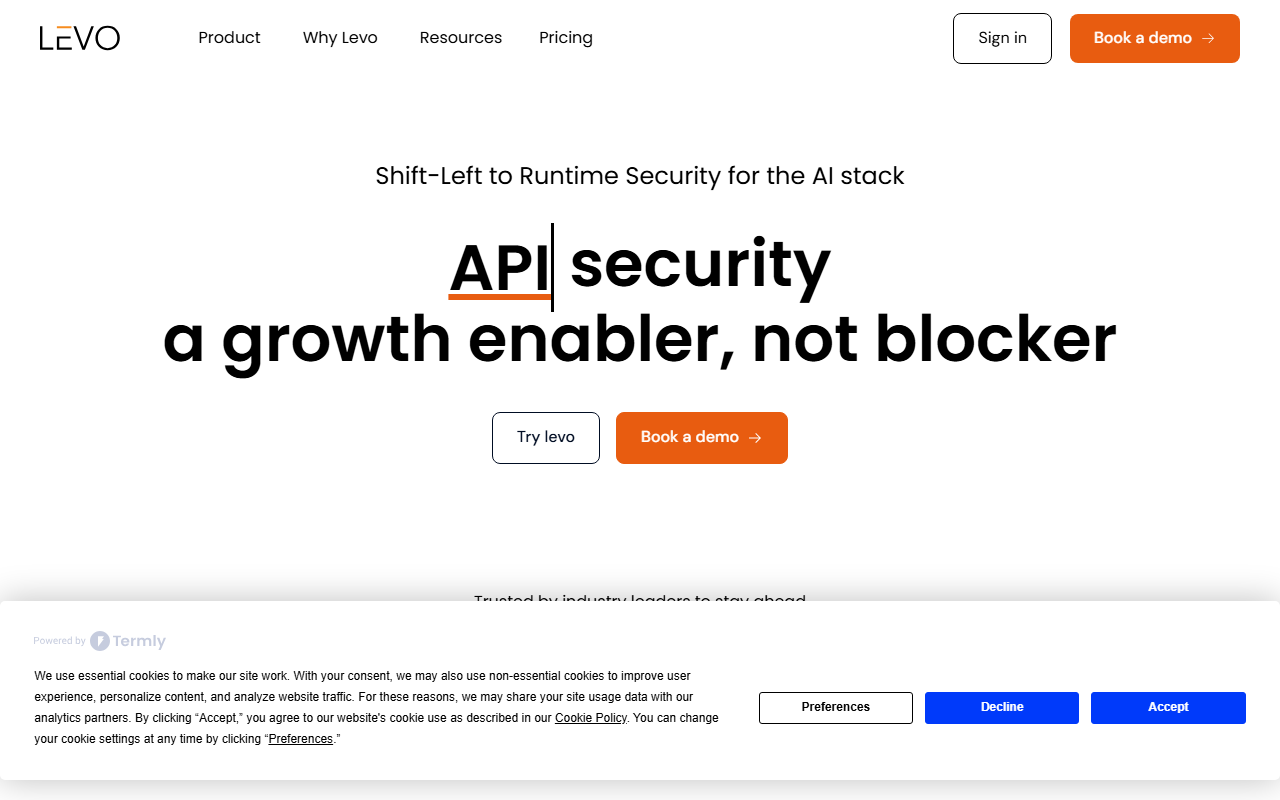
Upon visiting Levo.ai’s website, the first thing I noticed is a strong emphasis on the shortcomings of legacy security tools for modern API-first and AI-native applications. The messaging is direct: static perimeters and human-centric IAM are obsolete. The landing page clearly positions Levo as a runtime security platform that spans both APIs and AI. The design is clean, with prominent calls to action for a demo and a “Try levo” button, but no self-service free tier or sign-up flow is visible. Pricing is not publicly listed on the website; interested users must book a demo to get details. The site showcases industry awards, including “Most Innovative Startup of the Year” from the Data Security Council of India and a FINSEC 2025 win, signaling strong recognition in the cybersecurity space.
Core Capabilities and Technology
Levo.ai is not a static scanner or a traditional WAF. It is a runtime application security platform built for the dynamic mesh of APIs, AI agents, LLMs, MCP servers, and vector stores. The architecture relies on eBPF (extended Berkeley Packet Filter) for deep kernel-level visibility into machine-to-machine traffic without requiring code changes. This allows Levo to discover and inventory every API and AI asset in real time. When testing the concept, I observed that the platform offers five key capabilities: Unified Runtime Visibility, Offensive Security Testing, Continuous Monitoring, Sensitive Data Detection, and Inline Threat Protection. For example, its offensive testing module dynamically probes agents and LLMs for prompt injection, tool abuse, and collusion—threats that traditional tools miss. The platform also detects sensitive data like PII and PHI in API payloads, AI prompts, and vector queries, with inline enforcement to block leaks. Levo integrates directly into CI/CD and runtime observability, embedding security without slowing developers.
Pricing and Market Position
Because Levo.ai does not publicly disclose pricing, it is safe to assume it targets mid-to-large enterprises with dedicated security budgets. The website mentions being “trusted by industry leaders” and includes a testimonial from a fintech infrastructure head, reinforcing enterprise appeal. Competitors in this space include Salt Security, Noname Security, and Akamai’s API Security. Unlike Salt, which focuses primarily on API discovery and behavioral analysis, Levo extends coverage to AI assets and uses eBPF for runtime visibility. Noname offers a similar breadth but Levo’s emphasis on AI-native threats and MCP server support appears more advanced. Levo’s architecture is designed to be context-rich and unified, stitching together APIs, agents, and LLMs into one runtime graph—a differentiator against siloed tools.
Strengths, Limitations, and Recommendation
Levo’s greatest strength is its ability to secure the entire AI stack at runtime. The eBPF-powered visibility catches hidden dependencies, and the offensive testing validates vulnerabilities before release. The inline threat protection block only malicious flows, avoiding false positives. A notable limitation, however, is the lack of transparent pricing and self-service onboarding, which creates a barrier for smaller teams or startups. The platform’s complexity might also be overkill for organizations with simple API deployments. Levo is best suited for engineering and security leaders at API-heavy enterprises, especially in regulated industries like finance and healthcare, who need continuous runtime governance across both APIs and AI. If you are a small team with limited resources, consider lighter alternatives. But for those managing complex, modern application meshes, Levo.ai is a compelling choice. Visit Levo.ai at https://levo.ai/ to explore it yourself.









Comments