

First Impressions and Onboarding
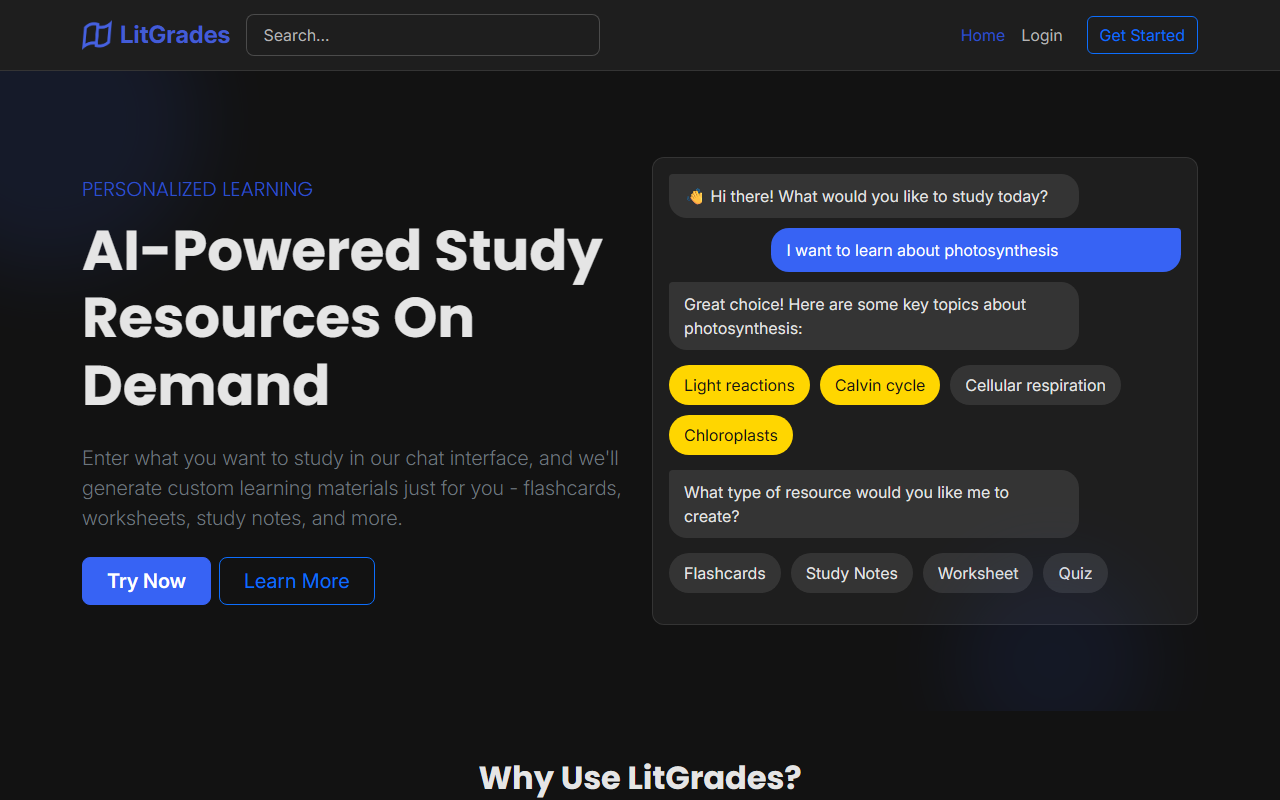
Upon visiting LitGrades, I was greeted by a clean, minimalist landing page with a prominent chat interface. The headline “Personalized AI Study Resources On Demand” sets clear expectations. I clicked “Try Now” and was immediately taken to the chat box, where a friendly prompt asked: “Hi there! What would you like to study today?” I entered “photosynthesis,” and within seconds the AI suggested four key topics: light reactions, Calvin cycle, cellular respiration, and chloroplasts. It then asked what type of resource I wanted—Flashcards, Study Notes, Worksheet, or Quiz. I selected Flashcards, and the tool generated a set of cards with terms and definitions almost instantly. The entire flow from topic entry to resource creation took less than a minute. The dashboard itself is sparse but functional; there is a sidebar for saved folders (I could create a new folder with a name and optional description), but no complex navigation. This simplicity makes onboarding nearly frictionless.
Core Functionality and Technology
LitGrades is a generative AI study assistant that creates custom learning materials on demand. After a user specifies a subject and confirms the subtopics, the AI produces resources in four formats: flashcards, study notes, worksheets, and quizzes. The underlying model is not explicitly disclosed, but the speed and relevance of the output suggest a large language model (likely GPT-based) fine-tuned for educational content. The free tier currently grants full access—I tested all four resource types without any paywall. Pricing is not publicly listed on the website, which may indicate a freemium model still in development. No API or third‑party integrations are mentioned, so the tool works as a standalone web app. The “How It Works” section breaks down the process into three steps: tell what you want, confirm topics, and choose a format. This linear workflow keeps cognitive load low, which is ideal for students who want quick, targeted study aids.
Target Audience and Market Position
LitGrades is built primarily for secondary school and undergraduate students who need to rapidly generate study materials for specific topics. It competes with established platforms like Quizlet (flashcard‑centered with user‑shared sets) and Chegg (broader tutoring and homework help), but differentiates itself by generating entirely fresh, personalized content on the fly rather than relying on pre‑existing user uploads. Unlike Khanmigo (which offers step‑by‑step tutoring), LitGrades focuses on creating static resources for self‑study. The tool’s claim of “thousands of students” suggests early traction, though it is not yet a household name. It is best suited for learners who prefer a no‑frills, prompt‑based generation experience over exploring large libraries of content. Advanced students or those requiring deep explanatory tutoring may find the resource formats too brief; the flashcards and notes I generated were accurate but lacked the rich context a full textbook or tutor would provide.
Strengths, Limitations, and Verdict
Strengths: Instant generation eliminates the time spent manually creating flashcards or outlines. The four resource types cover common study preferences, and the personalized topic selection ensures materials are not generic. The interface is extremely easy to navigate, making it accessible even for less tech‑savvy users.
Limitations: The absence of publicly listed pricing creates uncertainty about future access. The generated content, while accurate for basic subjects, can feel shallow—my photosynthesis quiz contained only multiple‑choice questions with no explanations. The tool also lacks features for tracking progress, collaborating with peers, or integrating with learning management systems. For advanced or niche topics, the AI may produce incomplete or oversimplified material.
Verdict: LitGrades is a promising, lightweight tool for students who need quick study aids on the go. I recommend trying it for revision purposes, especially if you are comfortable with AI‑generated content that may require occasional fact‑checking. However, users seeking comprehensive learning platforms or adaptive tutoring should look to more established alternatives.










Comments