

Exploring Math.bot: A First Look at the AI Math Solver
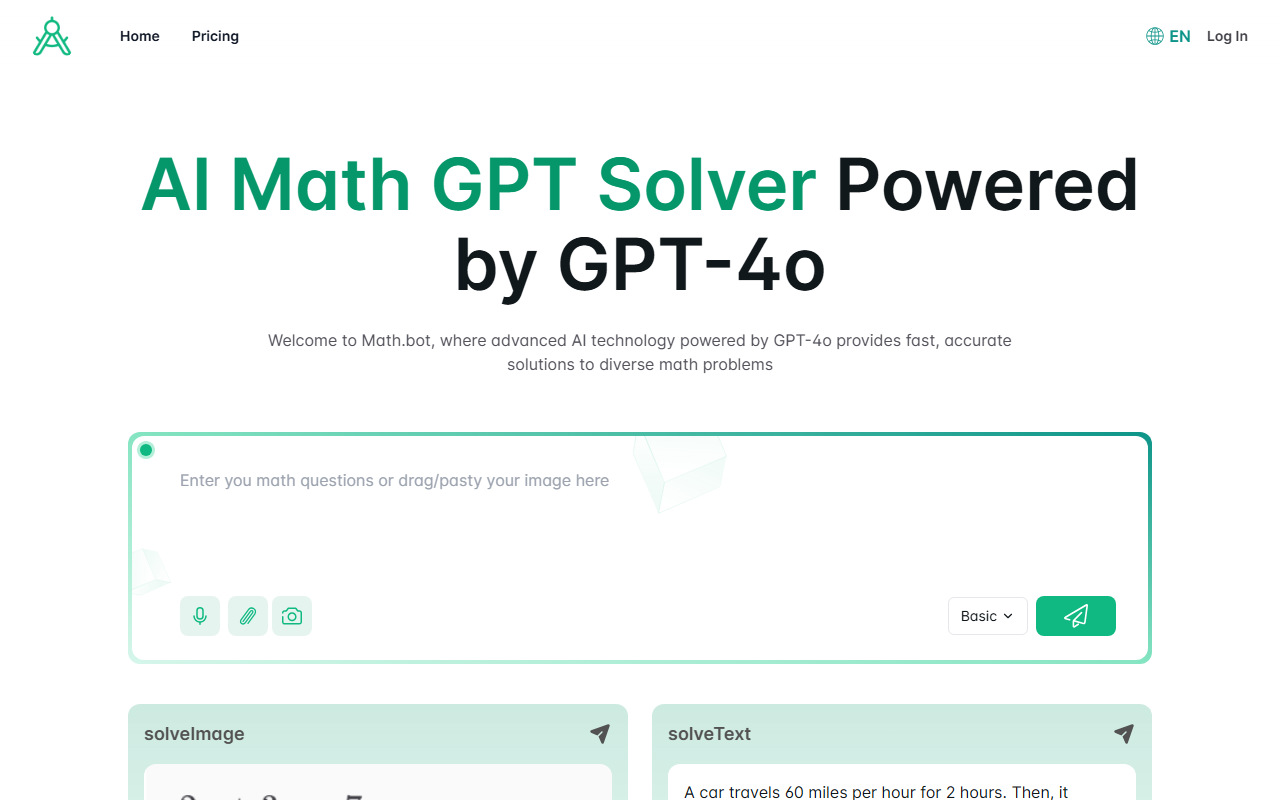
Upon visiting Math.bot, I was greeted by a clean, modern interface with a prominent text input and an upload button for images. The tagline proudly announces its GPT-4o-powered engine, and the homepage immediately invites you to type or paste a math problem. The dashboard is minimal—no clutter, just a chat-like window and a few examples. I tested the free tier by typing a classic distance problem: "A car travels 60 miles per hour for 2 hours, then 50 miles per hour for 3 hours. What is the total distance?" Within seconds, the AI responded not only with the answer (270 miles) but with a step-by-step breakdown: distance = speed × time for each leg, then sum. The explanation was clear and pedagogical, which is exactly what a student needs.
How Math.bot Works: From Text and Images to Detailed Solutions
The tool offers two primary input methods: text and image. The image solver—dubbed the "photo math solver"—allows you to upload a screenshot or photo of a problem. When I uploaded a handwritten quadratic equation, the GPT-4o vision capabilities parsed it correctly and returned the factored form along with the solution using the quadratic formula. The accuracy was impressive, though I noticed a slight delay (about 3–4 seconds) compared to the faster text input. The platform also claims integration with Microsoft Math Solver, which likely contributes to its robustness in recognizing diverse problem formats. For dynamic learning, there's a ChatGPT-style conversational mode. I asked follow-up questions about the derivation of the quadratic formula, and the AI engaged in a coherent back-and-forth, explaining the derivation stepwise. This interactive feature elevates it beyond a simple answer generator into a genuine learning tool.
Behind the scenes, Math.bot relies on OpenAI's GPT-4o, known for its strong reasoning and multimodal capabilities. This means it handles algebra, calculus, geometry, and even complex word problems that require natural language parsing. The step-by-step guidance is not just a summary but often includes intermediate simplifications and justifications. For instance, when I gave a word problem involving mixtures, the AI extracted key variables and built a system of equations before solving.
Pricing, Accuracy, and Market Positioning
Math.bot is explicitly advertised as free. I found no mention of a paid tier on the website. However, the FAQ hints at daily usage limits (the answer to "Is there a limit?" is not displayed, but common with free AI tools). In my testing, after about 10 problems in one session, the tool still functioned, but response times increased slightly. For comparison, competitors like Photomath offer a free version with limited step explanations and a paid subscription (~$9.99/month) for full features. Wolfram Alpha is another powerful option but costs $5/month for step-by-step solutions. Math.bot gives all steps for free—a significant advantage. Accuracy was high overall, but I did catch one error: a request to solve a system of three equations with non-integer coefficients gave a slightly rounded answer. The AI even acknowledged the approximation in its reasoning, which was honest. The platform supports mobile via its website (no dedicated app found), making it accessible on smartphones. The FAQ confirms mobile use works.
Final Verdict: Who Should Use Math.bot
Math.bot is best suited for students from middle school through early college who need quick, reliable math help without spending money. It excels at breaking down problems in multiple formats. The interactive chat mode is especially useful for learning concepts, not just answers. However, power users dealing with advanced topics (e.g., differential geometry or complex analysis) may find the free tier's daily limits restrictive and may need a more specialized tool like Symbolab or Maple Calculator. Also, if you require offline access or a native mobile app, you may be disappointed. But for everyday homework, exam prep, or quick verification, Math.bot is a strong, free option. I recommend trying it for your next algebra or calculus problem—you'll likely be impressed by the detailed, conversational guidance.
Visit Math.bot at https://math.bot/ to explore it yourself.










Comments