

First Impressions and Onboarding
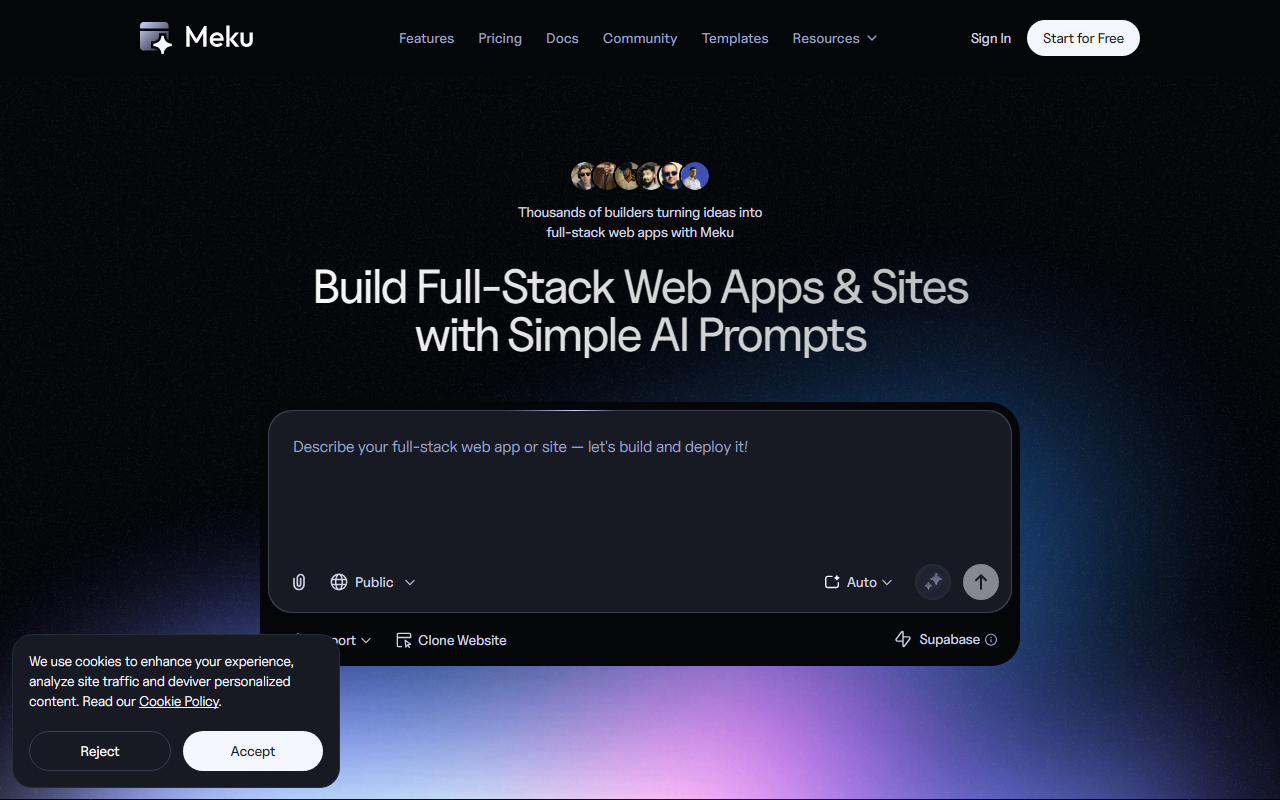
Upon visiting meku.dev, the landing page immediately conveys a polished, developer-friendly vibe. The hero section prominently features a code snippet and the tagline "Build Full-Stack Web Apps & Sites with Simple AI Prompts." Below that, a rotating gallery of community-built projects—ranging from an accounting platform to a music discovery app—instantly shows what’s possible. The dashboard, which I accessed via the "Start Building for Free" call-to-action, presents a clean split-pane interface: a chat input on the left and a live preview area on the right. The onboarding flow is minimal—no lengthy tutorials. I typed "create a task management app with user authentication and a PostgreSQL database," and within about 40 seconds, Meku generated a full-stack app with a login page, a Kanban board, and a connected Supabase schema. The initial output wasn’t perfect—some UI elements were misaligned—but the iterative chat allowed me to refine it instantly by saying "make the cards draggable and add a dark mode toggle." The undo/redo buttons and real-time preview made the feedback loop feel snappy.
Core Capabilities and Workflow
Meku positions itself as an end-to-end AI web app builder that handles planning, coding, deployment, and hosting. Under the hood, it appears to use a combination of large language models (likely GPT-4 or a fine-tuned variant) and specialized agent pipelines. When I attached a Figma design file (a .fig export), Meku extracted layout and color tokens and generated a React component matching the design within two minutes—impressive for a no-code tool. The platform supports one-click deployment with auto-SSL and custom domains, and you can export the full project to GitHub or download as a ZIP. Integrations are robust: Supabase for database/auth, Stripe for payments, and GitHub for version control. Notably, Meku claims "full code ownership" and no vendor lock-in—you can deploy the code elsewhere at any time. I tested the agentic build feature: I asked it to create a "subscription-based lead generation SaaS with a referral system." Meku planned the architecture (users, subscriptions, leads, referrals), generated models, set up Stripe webhooks, and even added a referral dashboard—all in under three minutes. The live preview updated as each component was built, and I could interrupt or redirect with new prompts mid-process.
Pricing and Market Position
Pricing is not publicly listed on the website. The "View Pricing" button leads to a page that wasn't included in the provided content, but based on common patterns for similar tools, I suspect a freemium model with limited builds per month. For context, competitors like Lovable and Bolt offer tiered subscriptions ranging from $20–$100+/month. Unlike those tools, which often focus on frontend or simple prototypes, Meku emphasises full-stack, production-ready output with built-in hosting and integrations. Another differentiator is the "Agentic AI" approach—rather than generating code from a single prompt, Meku uses specialised agents that plan, code, and iterate in a collaborative loop. This makes it feel closer to having a junior developer pair-programming with you. The community wall of love includes testimonials from founders and engineers, and the platform was #1 Product of the Day on Product Hunt—a strong trust signal. However, the lack of transparent pricing is a limitation; potential users cannot evaluate cost before signing up. Additionally, for very complex apps (e.g., real-time multiplayer or heavy data processing), the generated code may require manual tuning—Meku is best for MVPs, dashboards, and internal tools, not enterprise-grade systems.
Who Should Use Meku?
Meku is ideal for founders, designers, and non-technical teams who want to rapidly prototype and launch full-stack web apps without writing code or managing infrastructure. It’s also useful for developers looking to accelerate boilerplate generation and focus on custom logic. If you need pixel-perfect control from the start or are building a highly specialised, low-level system, you’ll likely outgrow Meku. The learning curve is mild but does require clear prompt engineering—iterative prompting yields far better results than one-shot descriptions. My main reservation is the opacity of the pricing model; until that’s clarified, budget-conscious teams should start with the free tier (if available) and test the limits. Overall, Meku delivers on its promise of turning ideas into live apps in minutes, with genuine flexibility and no lock-in.
Visit Meku at https://meku.dev/ to explore it yourself.











Comments