

First Impressions and Onboarding
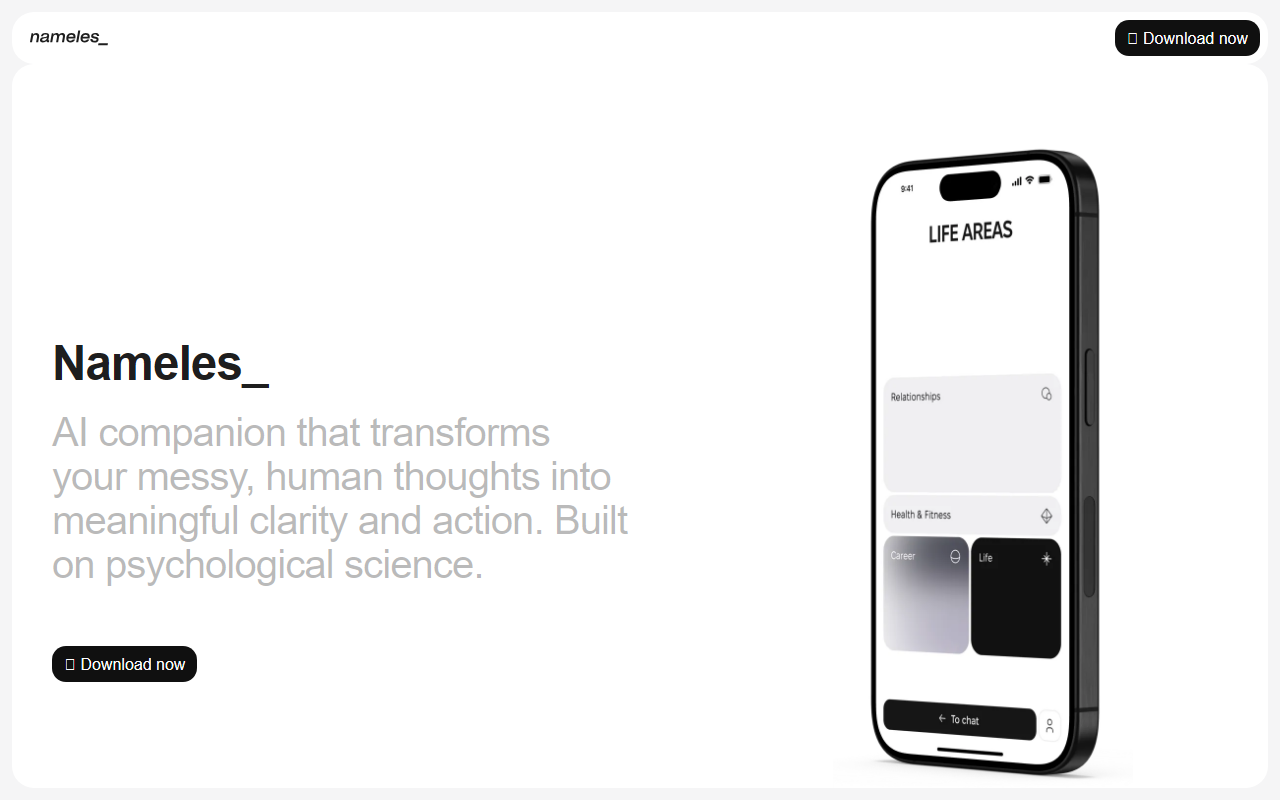
Upon visiting the Nameles website, you are greeted by a clean, minimalist design that immediately communicates the app's focus on emotional support. The tagline—“AI companion that transforms your messy, human thoughts into meaningful clarity and action”—sets clear expectations. The site highlights a varied user base: deep feelers, achievers, seekers, and everyone in between. A prominent Apple download button suggests the app is currently iOS only; no Android mention is present. I tested the waitlist sign-up flow, which is straightforward: enter your name and email, and you receive a confirmation that your spot is saved. The interface is sparse but inviting, with soft colors and typography that feels calming.
Core Features and Psychological Science
Nameles differentiates itself from novelty AI chatbots by grounding its design in what the site calls “psychological science.” The core functionality centers on natural conversation that remembers your story, your emotions, and the people in your life. It claims to recognize patterns, identify triggers, and help users see connections they might otherwise miss. Privacy is emphasized strongly: “Your conversations are completely private. We can't read them, and nobody else can.” This is a critical trust signal for a tool handling sensitive emotional data. The app also adapts as your life changes, building on past conversations to provide continuity. While I could not test the actual conversation flow without access, the testimonials from Alpha users are consistent and believable—for example, a user named Alex D. reports that the app helped resolve a friendship conflict, and Nick A. notes a calming effect that promotes self-reflection.
Pricing and Market Comparison
Pricing is not publicly listed on the website. There is no mention of a free tier, subscription fees, or in-app purchases. This lack of transparency may be a hurdle for some potential users. Competing tools like Replika offer a free tier with optional subscriptions ($7.99/month or $49.99/year), while Wysa uses a freemium model with a $49.99 annual plan for full access. Unlike Replika, which can be overly casual, and Wysa, which leans into CBT exercises, Nameles positions itself as a deeper, non-judgmental conversation partner focused on emotional clarity without “fake positivity.” If pricing is revealed at launch, it will need to be competitive to stand out in a crowded mental wellness AI space. For context, Nameles appears to target the same audience as apps like Jour (journaling AI) and Sanvello, but with a more personalized, memory-driven approach.
Strengths, Limitations, and Recommendation
Nameles’ greatest strength is its clear purpose: to help users move from emotional chaos to actionable clarity through a private, adaptive conversation partner. The focus on pattern recognition and psychological insight is a unique niche among AI companions. However, significant limitations exist. First, the lack of Android availability excludes a large user base. Second, no pricing information makes it difficult to assess value upfront. Third, while the site claims a foundation in psychological science, no citations or expert endorsements are provided, so users should treat this as a promising tool rather than a clinical one. Who should try it? Overthinkers, deep feelers, and anyone who struggles to organize their thoughts will likely find Nameles refreshing. Who should look elsewhere? Users needing immediate crisis support or a clinical mental health resource should consult professional therapists. Overall, Nameles shows strong potential as an AI companion that respects your emotional complexity—if it delivers on its promises when fully released.
Visit Nameles at https://nameles.app/ to explore it yourself.










Comments