

First Impressions and Setup Experience
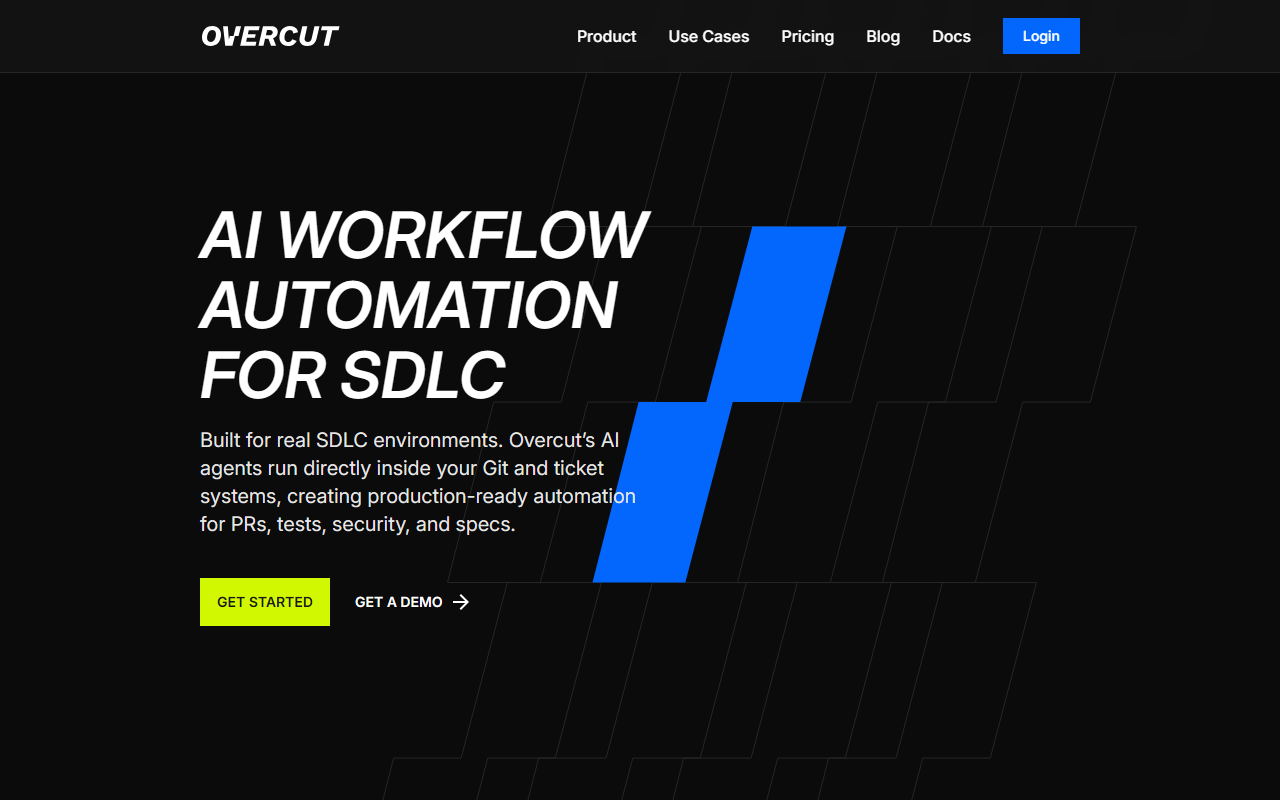
Upon visiting Overcut’s website, I was immediately struck by the focus on enterprise security and deep developer tool integration. The landing page leads with a clear promise: “Enterprise control plane for agentic SDLC.” A prominent “Get Started” button and “Get a Demo” call-to-action suggest that this is a platform requiring some hand-holding during onboarding—not surprising given its target audience. The site includes a demo video and multiple customer quotes from VP-level engineering leaders, which builds credibility. However, pricing is not publicly listed anywhere, which is typical for enterprise tools but might frustrate smaller teams looking for quick cost estimates.
When exploring the platform’s description, I noticed that Overcut claims teams can “spin up agents in minutes.” The setup involves connecting your Git providers, ticketing systems (Jira, Linear, ClickUp), and CI/CD pipelines. A drag-and-drop workflow editor is mentioned, which suggests a relatively low-code experience for launching automation. Still, the depth of configuration (e.g., defining boundaries, approval workflows) means that setup will likely require at least one engineer familiar with your SDLC ecosystem. The existing customers—like a VP Engineering at a fintech company—hint that the tool is battle-tested in regulated environments.
Core Features and Workflow Depth
Overcut differentiates itself by treating Git and tickets as first-class citizens. Unlike general-purpose workflow tools such as n8n (which the website explicitly compares itself to), Overcut is built specifically for software development lifecycle automation. Its pre-built engineering AI agents handle tasks like automated ticket triage, code review, fix review comments, root cause analysis, and CVE remediation. The platform also includes context-aware repository mapping, meaning agents can automatically link a ticket to the correct code repository based on project structure—a feature that generic automation tools struggle to deliver.
During my review, I found the list of use cases particularly telling: from “Auto PR Description” to “Test Coverage Gap Analysis,” each workflow is designed to reduce manual overhead for engineering teams. Overcut also monitors PRs across GitHub, GitLab, Azure DevOps, and Bitbucket, capturing signals to build “full organizational context.” This context enables agents to act intelligently—for example, when triaging a ticket, the agent knows which repositories and codeowners are relevant. For teams with complex multi-repo architectures, this depth of integration could be a game-changer.
Security and Enterprise Readiness
Security is clearly Overcut’s strongest pillar. The platform offers deployment in the managed cloud or fully on-premises, with the promise that “Overcut never transmits your code outside your environment.” Every agent run executes in ephemeral sandboxes with scoped tokens, and all actions are logged in audit trails. This level of data control is crucial for companies bound by compliance requirements like SOC 2, HIPAA, or internal data governance policies. Role-based access control and change tracking further enforce security. Compared to n8n, which requires additional self-hosted infrastructure and security hardening for similar compliance, Overcut provides it out of the box.
However, this enterprise focus comes with trade-offs. There is no obvious free tier or personal plan, and the lack of transparent pricing suggests a high per-seat or flat fee. Additionally, teams that do not need on-prem deployment or rigorous audit trails may find Overcut over-engineered for their needs. Smaller startups might be better served by simpler tools like GitHub Actions or Linear’s built-in automations, though these lack the cross-platform agentic intelligence Overcut offers.
Who Should Use Overcut?
Overcut is best suited for engineering organizations with 50+ developers who have complex SDLC workflows and strict security or compliance requirements. If your team struggles to enforce consistent code review, ticket triage, or changelog practices across multiple repos and tools, Overcut’s pre-built agents can standardize these processes with guardrails. The platform’s ability to run fully on-prem makes it ideal for fintech, healthcare, or defense sectors. Conversely, if you’re a small team looking for a quick automation fix, the lack of pricing transparency and likely high cost (plus the overhead of configuration) may not justify the investment. One real limitation I observed is that while the website lists many use cases, it does not provide concrete benchmarks or performance data for the AI agents, such as accuracy rates for code review or triage suggestions. This makes it hard to evaluate ROI without a hands-on trial.
In summary, Overcut is a sophisticated tool for enterprises ready to embed AI agents into their development lifecycle. Its deep integrations and security posture are unmatched by generalist workflow tools. I recommend requesting a demo to see if the agentic workflows align with your specific needs. Visit Overcut at https://overcut.ai/ to explore it yourself.













Comments