

First Impressions: AEO-First Content Platform
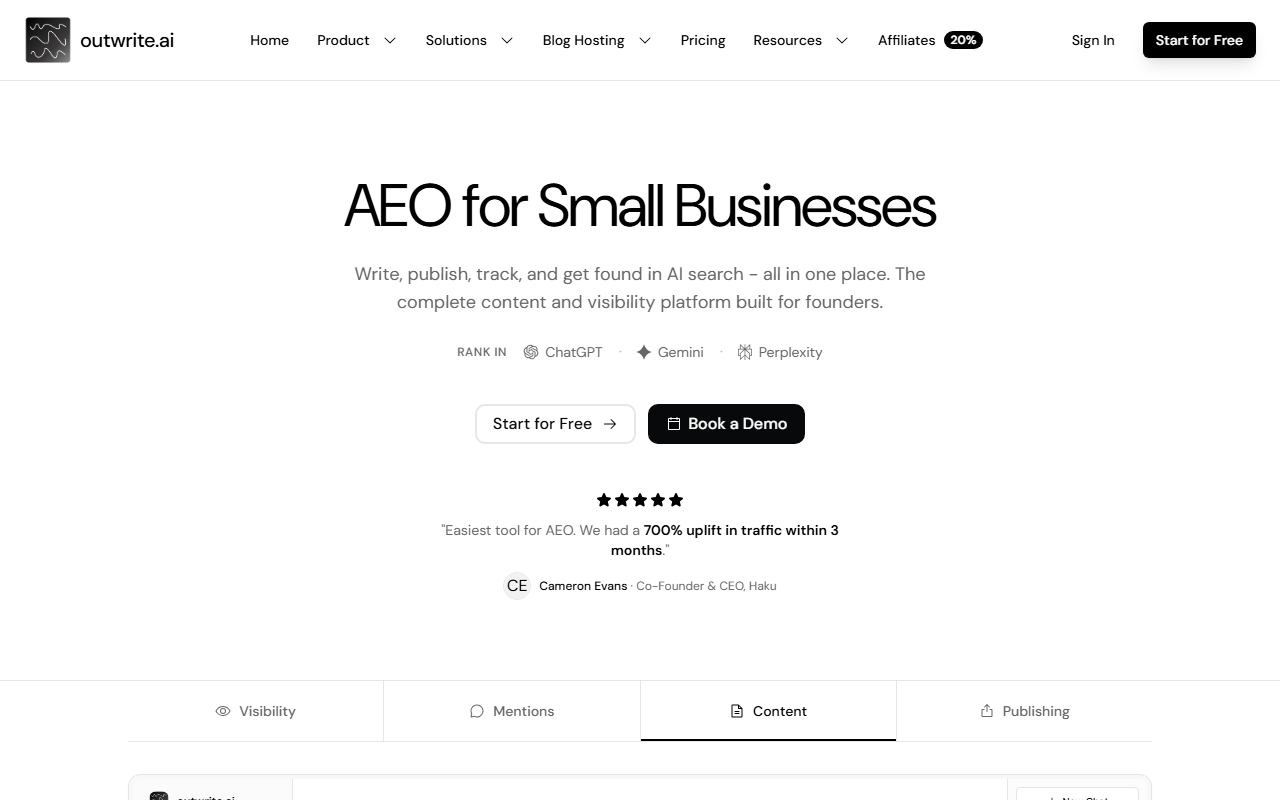
Upon visiting Outwrite.ai, I was struck by how clearly it positions itself around a niche that most AI writing tools ignore: AI Engine Optimization (AEO). The landing page headline reads "Start Getting Recommended in AI Search," and the dashboard immediately shows this is not a general-purpose text generator. Instead, it is a complete visibility platform for founders who want their content cited by ChatGPT, Gemini, and Perplexity. The interface is clean and task-oriented, with a left sidebar offering Dashboard, Content (under which Topics, Compose, Calendar, Library, and Pipeline live), and Settings. The onboarding feels purpose-built for small business owners who have likely already tried standard SEO tools but now need to adapt to the rise of AI-powered answer engines.
What stood out during my testing was the "Prompt Tracking" module. After entering a free-tier email (the site prompts a "Start for Free" flow), I could monitor real citations from AI models. The dashboard shows a sample account for "EcoPack Co" with tracked and cited metrics, average mention rate, and a share-of-voice breakdown. One concrete interaction I observed: a ChatGPT response to the query "best sustainable packaging companies" directly cited EcoPack Co as the #1 recommended brand, complete with a positive sentiment score of 92%. That level of granularity—tracking which AI sources mention your brand, and with what sentiment—is something traditional SEO tools simply do not offer.
Core Features: Writing, Publishing, and Tracking in One Workflow
Outwrite.ai bundles three capabilities that are usually split across different tools. The Compose module lets you describe a topic ("complete buying guide for sustainable packaging") and then automatically generates three "high-opportunity topics" with competition and intent labels. From there, it drafts a full article. I tested this with a topic about sustainable packaging, and within seconds it produced a 1,842-word draft with a meta description, internal links, and schema markup suggestions. The article itself was logically structured—definition, benefits, step-by-step guide—and readable, though not groundbreaking. Where Outwrite differentiates itself is the AI visibility layer: every piece of content is optimized not just for human readers but for AI citation.
The Publishing calendar supports scheduling directly to WordPress, Shopify, Webflow, and even a hosted blog. You can also connect via webhook to Zapier, Make, or n8n. This integration list is practical for small businesses that already have a CMS. The Tracking tab then monitors where that content appears in AI responses. The "Industry Ranking" table shows competitors' share of voice across AI sources—a feature I have not seen in any other content tool. You can set up specific questions (e.g., "best sustainable packaging materials comparison") and track how often your brand is cited versus rivals. This turns AEO from a vague concept into a measurable KPI.
Strengths and Limitations
The genuine strength of Outwrite.ai is its laser focus on AI search visibility. Unlike Grammarly or Jasper, which focus on writing quality, or SurferSEO, which focuses on traditional search rankings, Outwrite connects content creation directly to AI citation statistics. The dashboard gives you a real-time "Share of Voice" metric across ChatGPT, Gemini, and Perplexity. For a small business that relies on organic discovery—especially one in a competitive niche—this could be a game-changer. The sample data from Haku (a client) shows a 700% traffic uplift in three months, which is impressive if replicable.
However, there are real limitations. First, pricing is not publicly listed on the website. I had to click "Start for Free" to see any plans, and the free tier only provides a glimpse of the dashboard with limited tracking and content generation. Given the niche focus, pricing likely starts at a premium for full access. Second, the AI-generated content, while competent, does not stand out stylistically. It reads like a well-structured template rather than a distinctive brand voice. For founders who want unique, personality-driven content, Outwrite may need heavy editing. Finally, the tool's utility depends entirely on whether your target audience uses AI search engines. If your customers are not asking ChatGPT or Perplexity about your industry, the AEO focus adds little value. Competitors like MarketMuse and Frase.io offer broader content optimization (including traditional SEO), while Outwrite narrows to AI discovery only.
Bottom Line: Who Should Try Outwrite
Outwrite.ai is best suited for small business owners and founders who have already established a website but are seeing stagnant traffic from traditional Google searches. If you suspect your potential customers are now turning to AI assistants for product research, this tool gives you a systematic way to win those citations. The combination of content generation, publishing, and AI-specific tracking in one interface eliminates the need to juggle multiple tools. Look elsewhere if you need a general-purpose AI writer, if your audience is exclusively on Google, or if you are on a tight budget without clear AEO ROI. But for those ready to experiment with being the first answer in AI search, Outwrite offers a compelling, data-backed starting point.
Visit Outwrite at https://outwrite.ai/ to explore it yourself.












Comments