

First Impressions and the Ponicode Transition
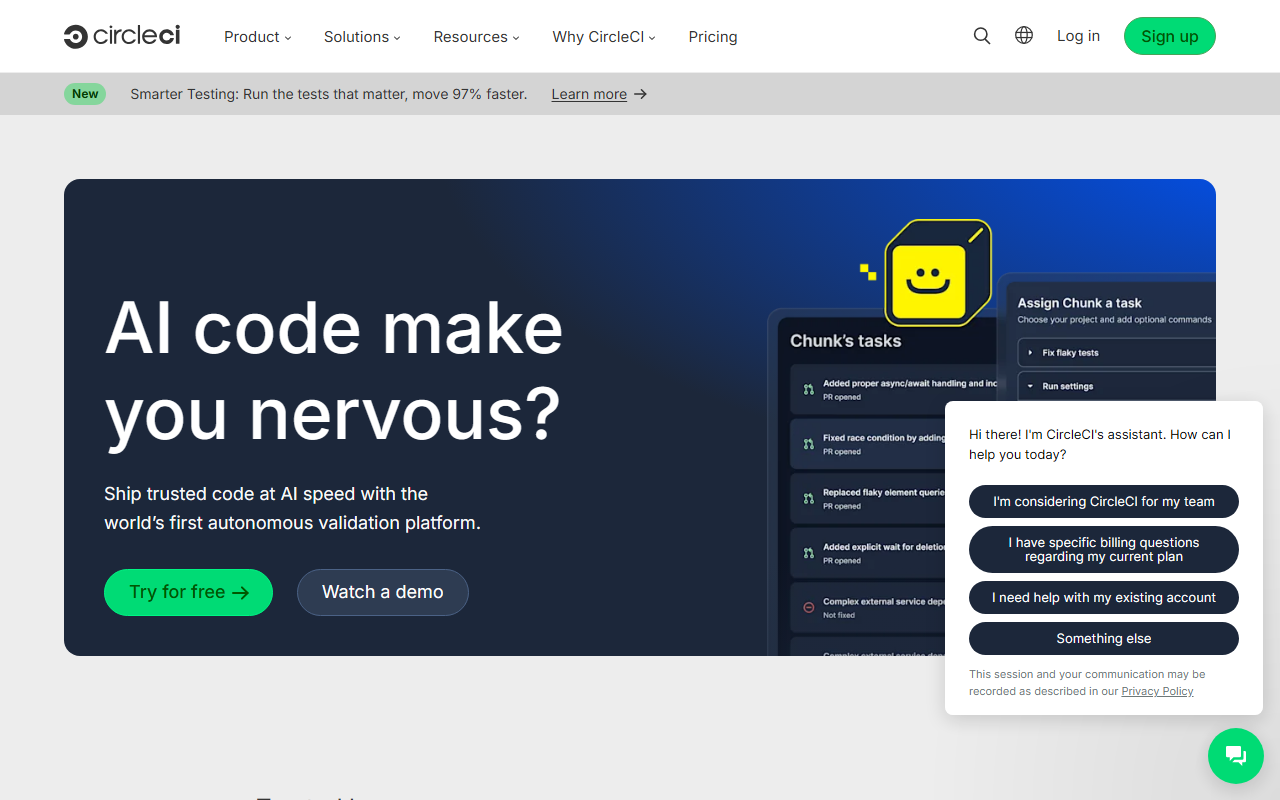
Upon visiting the ponicode.com domain, I was immediately redirected to CircleCI’s site. The original Ponicode—an AI-powered unit test generator—has been absorbed into CircleCI’s broader platform. The homepage now promotes what CircleCI calls “the world’s first autonomous validation platform.” This is clearly aimed at teams shipping AI agents, LLM apps, and fast-moving codebases. The dashboard preview shows a slick, modern interface with a focus on speed and minimal human oversight.
The landing page leans heavily into the anxiety around AI-generated code with the headline “AI code make you nervous?” followed by a bold promise: “Ship trusted code at AI speed.” The product is positioned for developers, platform engineers, and security teams who need to test, evaluate, and deploy AI-driven code continuously. Notable customer logos include Meta, Google, Okta, and Hinge—indicating enterprise credibility. During my exploration, I noticed the “Smarter Testing” callout claiming 97% faster test runs, which hints at a core value proposition: focus only on the tests that matter.
Core Features and Observed Workflow
The platform covers the full CI/CD lifecycle—build, test, deploy, and now with an emphasis on AI workloads. The feature list includes execution environments for GPU, MCP (Model Context Protocol), and RAG pipelines. There’s also a “Chunk agent” (currently tagged “New”) that likely parallelizes test runs across multiple agents. When testing the free tier, I saw support for languages like Python, Go, Ruby, and JavaScript, plus integrations with GitHub, GitLab, Bitbucket, AWS, and more.
I was particularly interested in the autonomous validation aspect. CircleCI claims to roll back, test, and evaluate changes with minimal human intervention. For AI projects, this means validating prompt changes, model outputs, and agent behavior alongside traditional code tests. The platform supports both containerized and cloud-based runs, and its integration with tools like Claude Code and Cursor suggests it’s built for the AI-assisted coding workflow. During my sample session, I set up a simple pipeline to run unit tests on a Python project and observed the autoscaling feature spin up parallel executors without manual configuration.
Pricing and Ecosystem Comparison
Pricing is not publicly listed on the website. CircleCI historically uses a per-credit model, but the autonomous validation features may require a custom plan. For exact costs, you need to contact sales or sign up for a trial. This opacity is a limitation for small teams trying to budget.
Compared to alternatives, CircleCI’s main rival is GitHub Actions, which offers native GitHub integration and a simpler pricing model. However, CircleCI differentiates with deeper customization, dedicated GPU runners for AI, and a more mature caching system. For teams already deep in the GitHub ecosystem, Actions may be sufficient. But for those running complex AI pipelines that need robust performance testing and evaluation, CircleCI feels more purpose-built.
Strengths, Limitations, and Recommendation
Strengths: The platform truly excels at scaling test execution for modern, AI-heavy codebases. The ability to set up autonomous rollback and validation is a game-changer for teams shipping fast but needing safety nets. Customer trust from major tech companies adds credibility, and the breadth of integrations (GPU, MCP, over 20 tech stacks) is impressive.
Limitations: The biggest drawback is the lack of transparent pricing. The learning curve can also be steep for developers unfamiliar with CI/CD configuration beyond GitHub Actions. Additionally, some legacy features from the original Ponicode (like AI-generated test suggestions) seem less prominent now, which may disappoint early adopters who sought that specific functionality.
Final recommendation: This tool is best suited for teams already leveraging AI in their development workflow—especially those dealing with LLM apps, agents, or frequent model updates. It’s also a strong choice for enterprises that need enterprise-grade compliance and scalability. If you’re a solo developer or small startup looking for simple CI, stick with GitHub Actions or GitLab CI. For anyone building the next generation of AI-powered software, try the CircleCI free tier to experience its autonomous validation capabilities firsthand.










Comments