

First Impressions: A Supply Chain Partner, Not an AI Tool
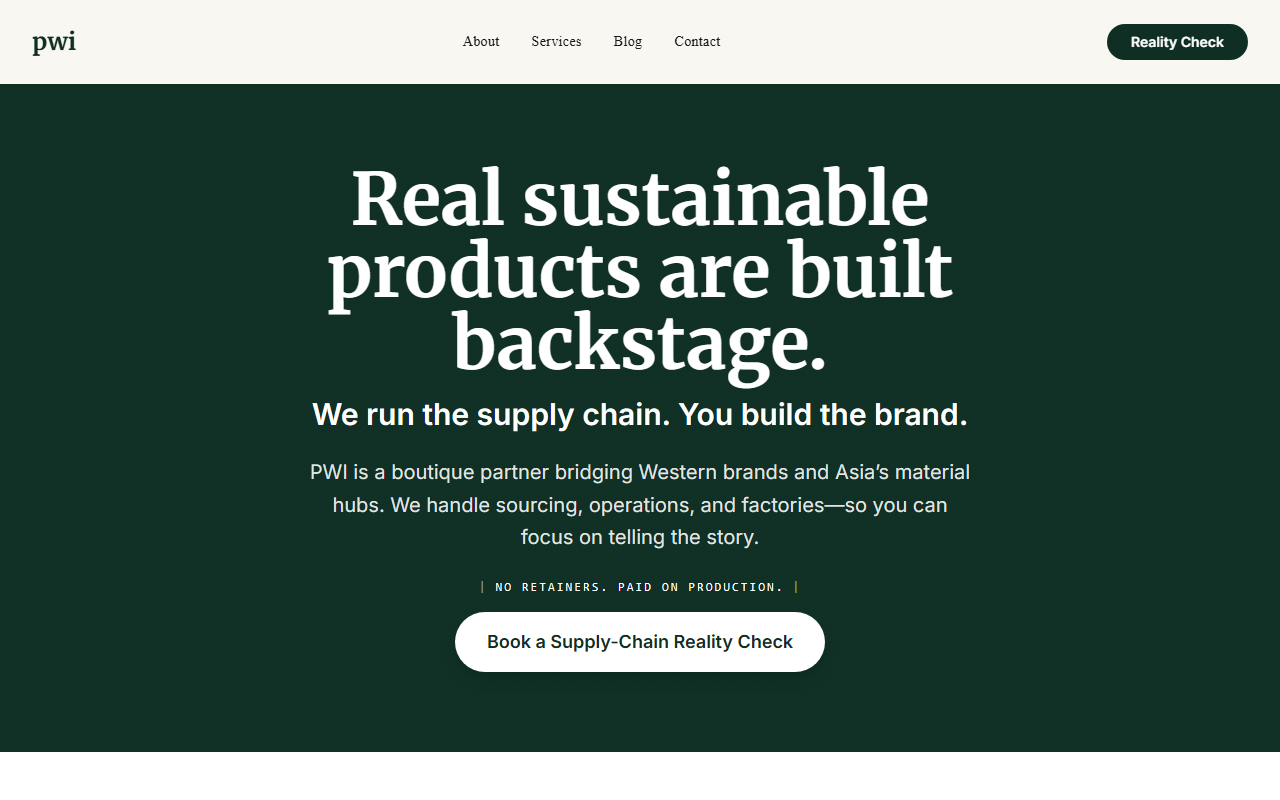
Upon visiting pwi.co, I was struck by the clean, minimalist design that immediately communicates a consultancy ethos rather than a software product. The homepage headline reads, “Real sustainable products are built backstage,” and the tagline makes its position clear: “We run the supply chain. You build the brand.” There is no chatbot, no dashboard with analytics, no API documentation. Instead, I found a call-to-action to book a “Supply-Chain Reality Check.” This is not a text-generation AI nor a cross-border translation tool in the traditional sense. PWI positions itself as a boutique partner bridging Western brands and Asia’s material hubs, handling sourcing, operations, and factory management. If you came looking for a tool that automates supplier discovery or translates product specs, you will be disappointed. PWI is a human-driven service that promises to remove “Build a Supply Chain” from your personal job description.
What PWI Actually Does and How It Works
PWI solves a specific problem: the immense friction Western entrepreneurs face when trying to manufacture sustainable physical products in Asia. The site outlines three core service lines: Translation (turning sustainability goals into factory-friendly technical briefs), Sourcing (finding aligned suppliers, often smaller, practice-led workshops in material clusters), and Operations (managing sampling, pricing, timelines, quality control, and shipping). The workflow is presented as a three-step process: a Reality Check (honest assessment of feasibility), Build and Test (designing the supply chain with client approval), and Produce and Grow (billing only once orders are moving). This is a full-stack operational service, not a self-serve platform. The technical details are deliberately vague—no mention of underlying technology, AI models, or software integrations. This is by design: PWI’s expertise is tacit, built on 20 years of experience (since 2006) working with names like Tonino Lamborghini, Muhammad Ali, and Ekster. It is a relationship-based service, not a tool you can sign up for with a credit card.
Pricing, Positioning, and Who It’s For
PWI’s pricing model is refreshingly straightforward: no retainers; they charge a pre-agreed percentage on top of the factory invoice once orders are actually moving. If zero orders are placed, no invoice is sent. This aligns incentives—PWI only gets paid when production happens. The website explicitly states who is a fit: first or second sustainable physical product businesses without an in-house Asia supply-chain team, who care about genuine sustainability and are willing to hear “not yet.” It is explicitly not for companies with full internal sourcing offices just looking to squeeze margin, or those wanting a catalogue product with a leaf icon. Competitors include services like CocoFas (for fashion) or Sourceful (for independent brands), but PWI differentiates by focusing on sustainability as a core principle rather than a marketing add-on. The limitations are clear: it is not a scalable software alternative; it is a high-touch, low-volume studio. The technology layer is minimal—if you need automated supplier matching or real-time logistics tracking, look elsewhere.
Strengths, Limitations, and Final Verdict
The genuine strength is PWI’s deep, hands-on experience and commitment to honesty. They will tell you if your product idea is not realistic, saving you costly mistakes. The sustainability focus is not greenwashing—they demand 100% natural materials, endlessly recyclable inputs, or repairable designs. However, the limitation is equally significant: this is not a tool you can access immediately. The Reality Check is a 30-minute call, and they work with a small number of clients at a time. There is no self-service dashboard, no API, no AI-generated insights. For busy founders accustomed to instant SaaS onboarding, this may feel slow and opaque. The website also lacks detailed case studies with quantified results (e.g., cost reductions, lead times), which would strengthen credibility. In comparison to cross-border AI tools like Smartling (for localization) or Google Translate’s API, PWI does not compete—it operates in an entirely different space: physical supply chain, not digital text.
Who should try this tool? If you are a founder launching a sustainable physical product and feel overwhelmed by Asia sourcing, PWI is worth the 30-minute call. You will receive a honest assessment, and if you fit, you get a co-pilot who actually handles operations. If you are looking for an automated, scalable AI solution for cross-border sourcing, this is not for you. PWI is a boutique service, not a piece of technology. For those ready to outsource the hardest part of manufacturing while retaining creative control, it’s a compelling option. Visit PWI at https://pwi.co/ to explore it yourself.













Comments