

First Impressions and Onboarding
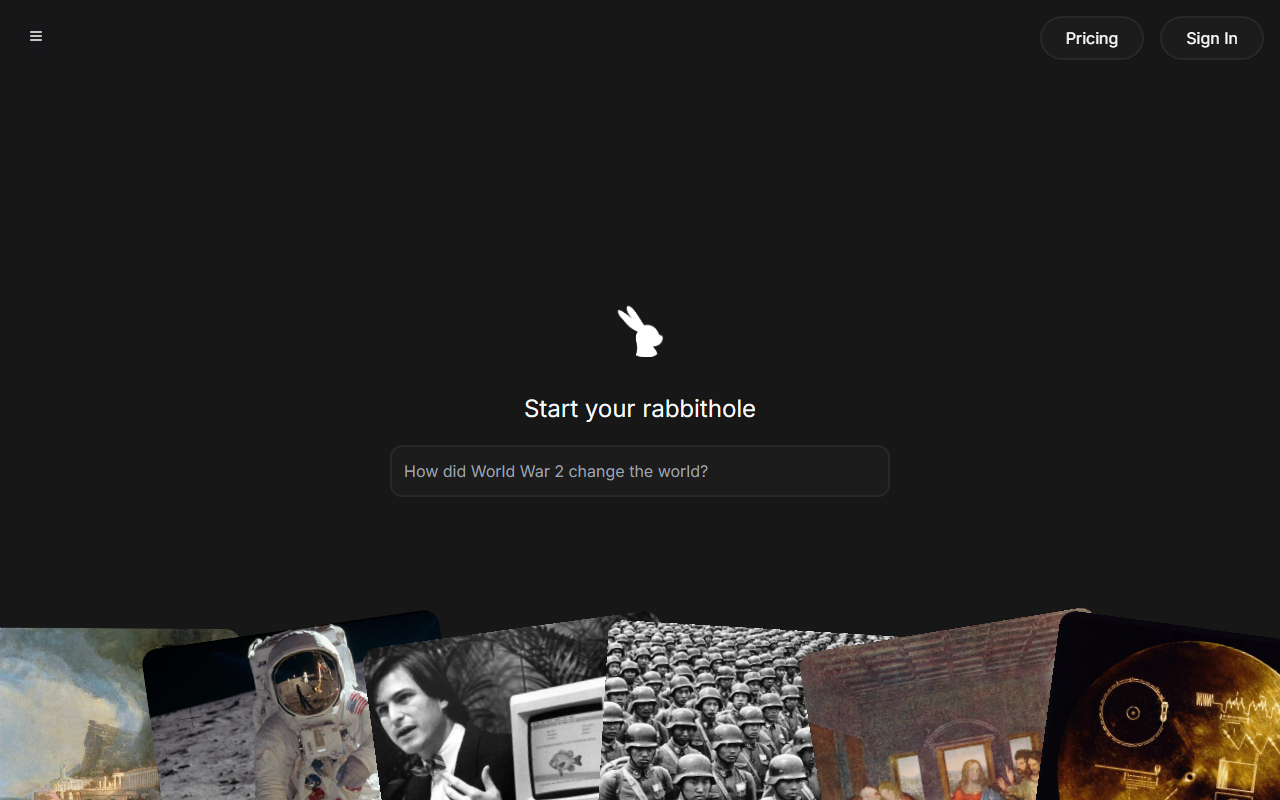
Upon visiting Rabbithole, I was greeted by a minimalist landing page with a short list of example questions like “What happened to the Library of Alexandria?” and “How did humans first land on the moon?” There was no splashy demo or tutorial — just a prompt to sign in via Google. After authenticating, the dashboard shows a clean, two-column layout: on the left, a persistent chat history panel; on the right, the active conversation area. The onboarding is frictionless — you simply pick a question from the preset list or type your own. I selected “What happened to the Library of Alexandria?” to test the tool’s depth.
The platform’s core premise is to guide users down “rabbit holes” of knowledge, offering follow-up questions and contextual links within the conversation. Unlike a generic chatbot, Rabbithole seems designed for sustained, topic‑driven exploration — it doesn’t just answer; it suggests related avenues. For instance, after explaining the Library’s destruction, it asked if I wanted to learn about the ancient scholars who worked there. This conversational curating is refreshing for learners who want structure without losing curiosity.
Core Features and Technology
Rabbithole positions itself as a learning platform rather than a multifunctional AI assistant. The technology powering the responses appears to be a large language model (likely GPT‑based, though not explicitly stated on the site). Each answer is concise, factual, and bibliography‑friendly — it often cites sources inline or provides references in the reply. A key differentiator is the history feature: every conversation is saved and can be revisited, renamed, or continued later. This is ideal for students or researchers who need to build knowledge over time.
During my test, I asked about the Voyager Golden Record. The AI gave a detailed response covering its contents, purpose, and cultural significance, then suggested I explore the work of Carl Sagan or the science of interstellar communication. The flow felt natural, not formulaic. However, I noticed the tool does not support file uploads, image generation, or code execution — it’s strictly text Q&A with a learning focus. There is no visible API or plugin ecosystem, limiting integration possibilities.
Pricing and Positioning
Pricing is not publicly listed on the website. The sign‑in screen only shows a Google login button, with no mention of free trials or paid tiers. This opacity is a drawback for potential power users who want to assess cost before committing. In comparison, tools like Perplexity (which also offers pro features) clearly display their subscription plans. Rabbithole may be entirely free at this stage, or it might be in an invite‑only beta with hidden pricing — the site does not clarify.
Competitors in the learning AI space include ChatGPT (with its custom GPTs for deep dives) and Wolfram Alpha (for computational knowledge). Rabbithole differentiates itself by emphasizing guided discovery and a clean, distraction‑free interface. It’s best suited for curious learners, students, or hobbyists who enjoy exploring topics without being overwhelmed by features. Researchers or professionals who need advanced analysis, data visualization, or real‑time web searching should look elsewhere — at least until Rabbithole adds more capabilities.
Strengths and Limitations
A genuine strength is the conversational continuity. The AI remembers the context of the entire chat, so you can dig deeper without repeating yourself. The history sidebar is another win — it keeps all your explorations organized by date and topic. The example questions are well‑chosen to spark curiosity. However, the tool has clear limitations: no web search integration (answers rely solely on the underlying model’s training data), no support for non‑English languages, and a narrow topic range (primarily history and science). Additionally, the inability to share or export conversations is annoying for collaborative work.
On the trustworthiness front, the site states no data collection practices beyond signing in with Google, and there’s a link to Terms of Service and Privacy Policy. But without a FAQ or about page, users have little insight into the company behind the tool or its long‑term viability. The experience is polished, but the lack of transparency around pricing and roadmap dampens enthusiasm for heavy reliance on the platform.
My recommendation: If you’re a lifelong learner who enjoys one‑on‑one guided Q&A on historical and scientific topics, try Rabbithole. It’s a delightful, distraction‑free way to explore knowledge. For anyone needing broader capabilities (e.g., up‑to‑date news, programming help, or multimedia output), stick with established tools and wait for Rabbithole to mature.
Visit Rabbithole at https://rabbithole.chat/ to explore it yourself.










Comments