
First Impressions and Onboarding
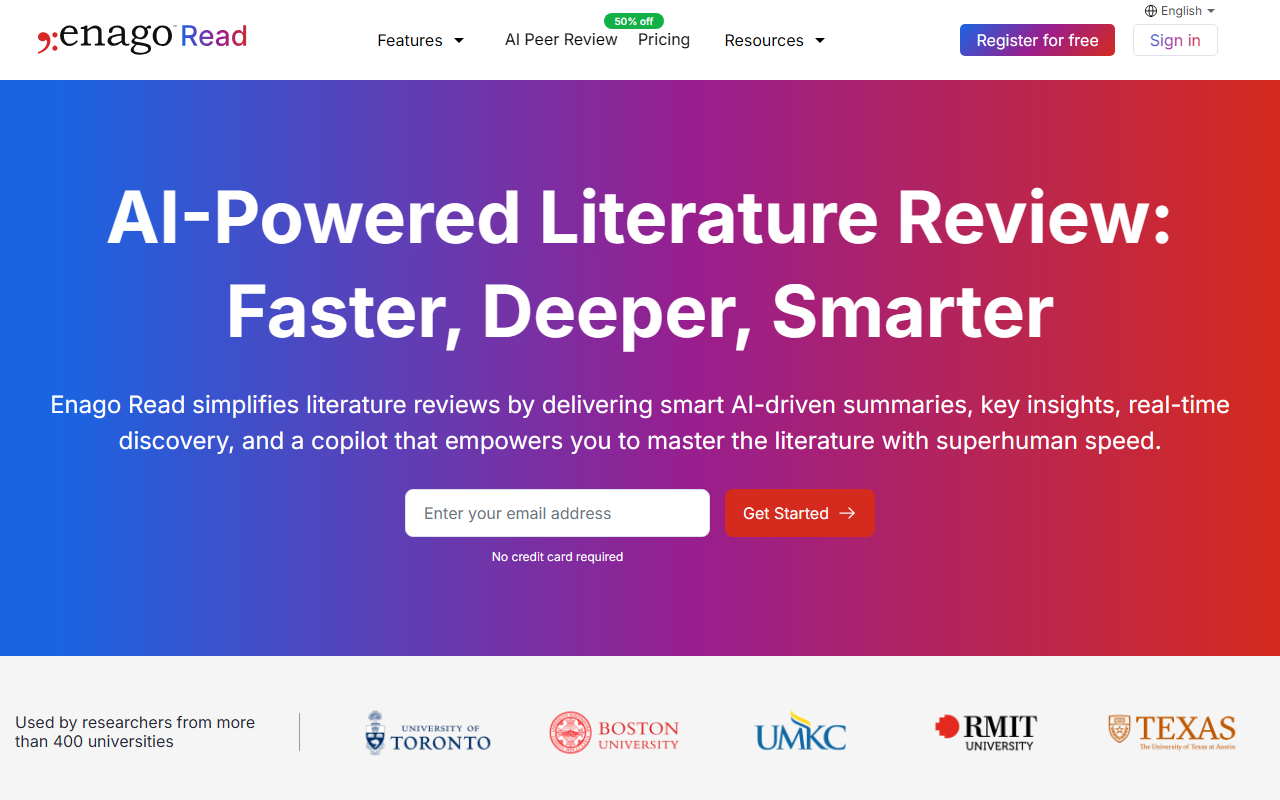
Upon visiting the Enago Read website, I was greeted by a clean, modern interface that clearly positions the tool as a solution for overwhelmed researchers. The landing page emphasizes speed and depth, with a prominent call-to-action to get started—no credit card required. I signed up using my academic email and was instantly taken to the dashboard. The onboarding flow is minimal: a brief tutorial highlighting the three main pillars—High-Impact Summaries, Discover the Unseen (related literature), and Real-Time AI Copilot. I appreciated that I could immediately upload a PDF or search for papers using the integrated database of over 200 million references. The tool previously operated under the name RAxter, and existing users seamlessly transitioned to the new Enago Read branding without disruption.
Core Features and Performance
I tested the free tier by uploading a dense research paper on transformer architectures. The AI copilot allows you to ask questions and receive real-time answers about the document. When I asked, "What are the key limitations of this model?" the tool provided a concise, accurate summary within seconds, drawing from the paper's discussion section. The summaries feature does exactly what it promises: it reduces information overload by extracting high-level insights, enabling me to decide whether to read the full paper. The Discover module is particularly impressive—it scans a database of over 200 million papers from repositories like PubMed, ArXiv, and Crossref, then recommends related literature. I found its suggestions relevant and not merely keyword-driven. The Key Insights view breaks down core ideas into bullet points, which I could export or annotate. The copilot also supports follow-up questions, which helped me clarify technical jargon without leaving the platform. Overall, response quality is high, though it occasionally struggles with highly niche terminology or non-English sources.
Pricing and Positioning
Enago Read offers a free tier with limited features and a $12 credit when you refer others. Exact pricing tiers are not publicly listed on the website, but the mention of credits suggests a pay-as-you-go or subscription model for advanced usage. The tool is backed by Enago, a well-known brand in academic editing and publishing services, which adds credibility. In the market, it competes with tools like Semantic Scholar and Scite, but Enago Read differentiates itself by acting as a comprehensive reading assistant rather than just a discovery engine. It is best suited for PhD students, postdocs, and researchers who need to quickly digest large volumes of literature. For those who prefer a more manual, annotation-heavy workflow, tools like Zotero or Mendeley may be better. However, Enago Read excels for users who want AI to accelerate their critical reading process.
Final Verdict
Enago Read genuinely simplifies literature review tasks. Its strengths lie in the real-time copilot, high-quality summaries, and the vast discovery database. A real limitation is the lack of transparent pricing and the occasional inaccuracies when interpreting extremely complex datasets. Additionally, the tool is browser-based, so offline use is not possible. I recommend Enago Read to any academic researcher, especially graduate students in STEM fields, who struggle with information overload and need a smart, time-efficient reading companion. It is not a replacement for deep critical thinking but a powerful accelerator. Visit Enago Read at https://read.enago.com/ to explore it yourself.







Comments