
First Impressions and Onboarding
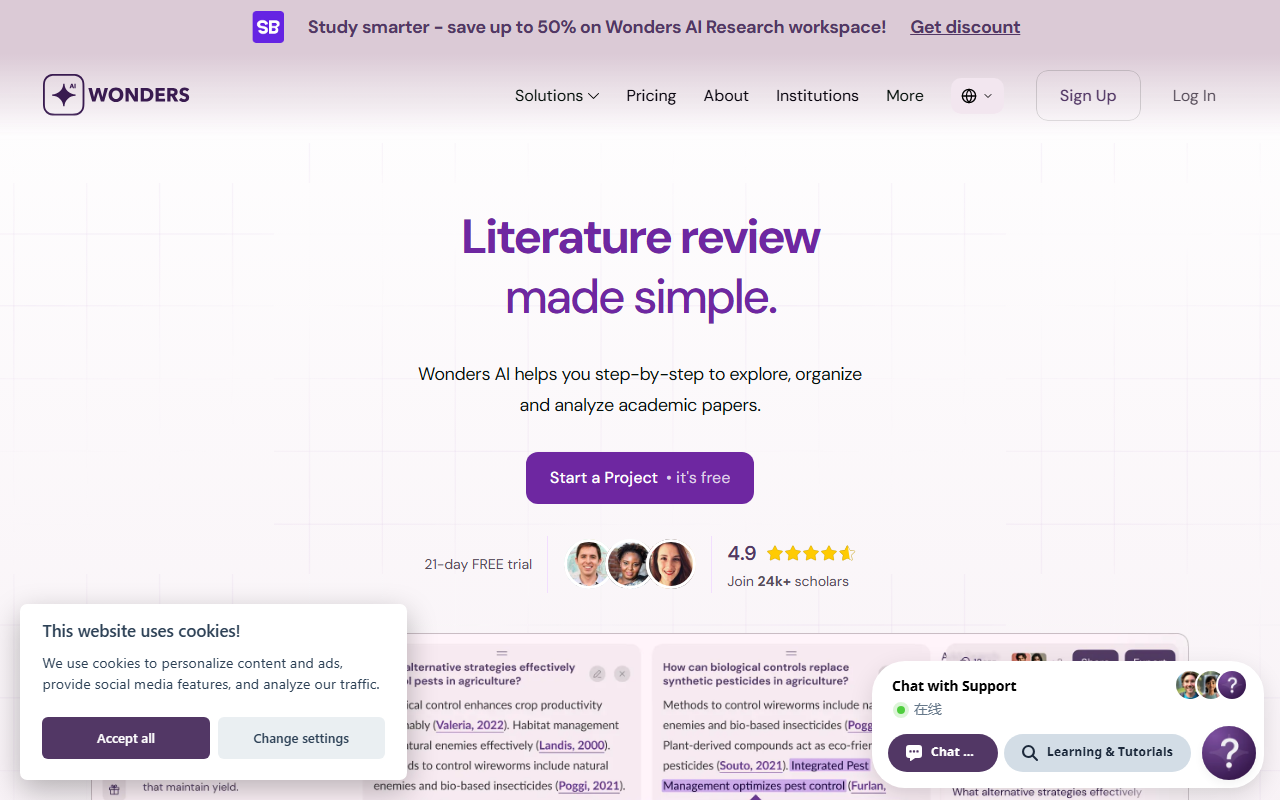
Upon visiting Wonders AI at readwonders.com, I was greeted by a clean, academic-focused landing page that immediately signaled its purpose: literature review assistance. The call-to-action – “Start a Project” – promised a free start, and after a quick signup, I was taken to a dashboard that felt purpose-built for research rather than generic chat. The interface features a project-centric layout with boards for side-by-side search, AI-suggested keywords, and bibliographic export tools. I tested the free trial by creating a new project. The onboarding flow walked me through setting up a research question, then used its AI to generate Boolean search strings and suggest alternative keywords. It felt less like a chatbot and more like a guided reference manager. The system claims access to over 550 million sources across 88,000 journals, including dissertations and patents, which is a significant claim. During my test search on “large language models in education,” the tool returned structured results with relevance scores, quick summaries, and the ability to save papers into folders. The auto-generated citations in APA and MLA worked without extra clicking. The entire process felt streamlined, replacing the typical multi-tab chaos of Google Scholar, PDFs, and messy notes.
Core Functionality and Technical Details
Wonders AI addresses a very specific pain point: the nonlinear, often overwhelming process of conducting a literature review. It breaks this down into three phases – explore, analyze, and write. The search board lets you run multiple queries simultaneously, which is a boon for comparative research. The AI does not just list articles; it surfaces under-explored angles and research gaps, a feature that sets it apart from plain search engines. The tool also offers integrated term lookups, saved search history, and in-platform PDF reading with color-coded highlights. While the website does not specify the underlying models or API availability, the AI response quality for summarization and keyword suggestion was sharp in my testing – concise, accurate, and properly cited back to source papers. On the pricing side, Wonders AI does not list explicit tiers on its public pages. I saw “21-day FREE trial” and banners offering “save up to 50%,” but no detailed breakdown of monthly or annual plans for individual vs. institutional users. This lack of transparent pricing is a notable gap. There is no mention of an API for programmatic access, which confirms it is a closed end‑user tool aimed at academics and students.
Market Position and Competitive Context
Wonders AI competes in the niche of AI-assisted academic research. It differs from general-purpose tools like ChatGPT by focusing on credible, traceable sources and structured workflows. Compared to Semantic Scholar or Google Scholar, it adds an organizing layer: saved projects, automatic citation generation in multiple formats (APA, MLA, Chicago, Harvard), and guided search refinement. It also has a community element – testimonial quotes from PhD candidates and professors suggest it is trusted within academia. The tool claims 24,000+ scholars as users, which is a respectable early adoption figure. However, it is not a replacement for reference managers like Zotero or Endnote; Wonders AI focuses more on the discovery and synthesis stage than on metadata management. For researchers who need to keep every citation properly formatted and shareable, a dedicated reference manager is still necessary. The platform is best suited for graduate students, early-career researchers, and faculty who conduct regular systematic reviews. It may be less useful for undergraduates working on a single, narrower assignment or for professionals doing light fact‑checking.
Strengths, Limitations, and Final Verdict
Wonders AI’s primary strength is its guided, end‑to‑end literature review process that teaches research methodology while doing it – a point echoed by multiple user testimonials. The ability to run parallel searches, generate Boolean queries, and export citations from within one dashboard saves significant time. The inclusion of 550 million sources across journals, patents, and dissertations provides a breadth unmatched by standard free academic search engines. On the downside, the lack of publicly listed pricing and any free tier beyond the 21-day trial raises a barrier for budget‑conscious students. Additionally, the tool seems to require a moderate investment in learning its workflow – several users noted a “takes a bit to fit into an existing research workflow” – so it may not suit those who prefer a quick, friction‑free start. There is also no mobile app mentioned. In summary, Wonders AI is a powerful, focused research assistant for anyone serious about literature review. It is not a generalist AI, but for its target audience it delivers real productivity gains. I would recommend it to any graduate student or researcher who frequently wrestles with source overload and wants a more structured approach.
Visit Wonders AI at https://readwonders.com/ to explore it yourself.










Comments