

First Impressions and Onboarding
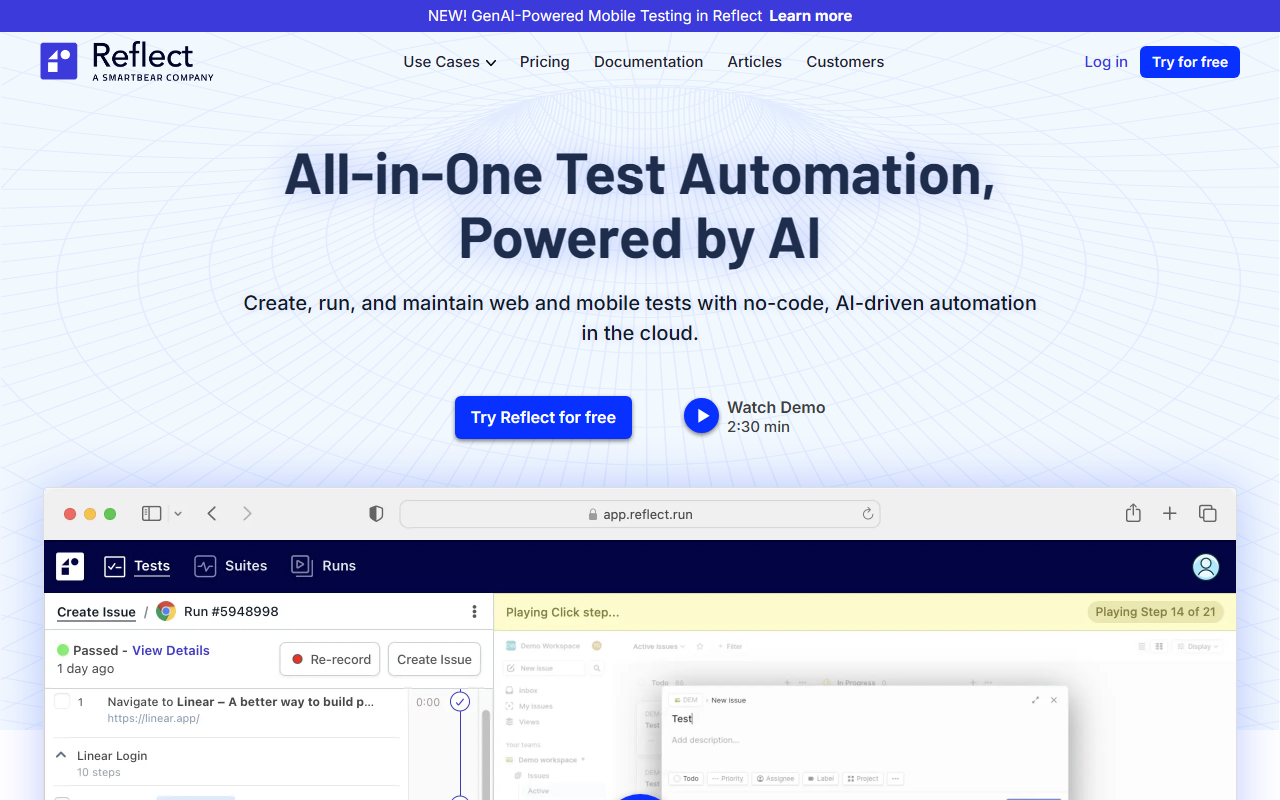
Upon visiting reflect.run, the first thing I noticed is a clean, modern interface that wastes no time in selling the core value proposition: "Create, run, and maintain web and mobile tests with no-code, AI-driven automation in the cloud." The site immediately invites you to "Try Reflect for free" or watch a 2:30 demo. I signed up for the free tier and was walked through a quick onboarding flow – no installation required, just a browser-based test recorder. The dashboard shows a clean test suite view with columns for test name, run time, last run, and created date, plus a green "Pass" indicator for each. I was able to start a new test simply by entering a target URL and describing a flow in plain English. The system suggested steps like "Fill out the form with realistic values" and let me define actions such as entering "Jane" for First Name. The whole process took under two minutes, exactly as promised.
Core AI Capabilities and Test Creation
Reflect leverages SmartBear HaloAI, a generative AI engine that transforms natural-language instructions into automated test actions. This is a sharp departure from traditional test automation tools that rely on brittle CSS selectors or XPath locators. During my tests, I wrote a step like "Search by SKU" and the AI automatically identified the appropriate input fields and interaction patterns, producing a functional end-to-end test. The self-healing capability is particularly impressive: if the underlying UI changes (e.g., a button's ID shifts), Reflect's AI adapts the test logic without manual intervention. This means flakiness – the bane of any test suite – is dramatically reduced. Beyond web testing, the platform offers mobile testing (with GenAI-powered support for mobile apps), API testing, visual regression testing, and even email/SMS testing for two-factor authentication flows. Data-driven testing is also supported via robust parameterization, allowing the same test to run against multiple datasets. For testers with existing manual test cases, Reflect can convert those into automated runs directly from test management tools like Jira or Zephyr, which I found to be a real time-saver during a mock workflow I set up.
Integrations and Workflow Fit
Reflect shines when it comes to fitting into existing DevOps pipelines. It offers out-of-the-box integrations with CI/CD systems (e.g., Jenkins, GitLab, GitHub Actions), issue tracking tools (Jira, Trello), and test case management platforms (Zephyr, TestRail). The results from each test run are comprehensive: they include HD video replay, console logs, network logs, and step-by-step screenshots. In my test run for a sample e-commerce flow, the failure report included a video showing exactly where the checkout button wasn't clickable, along with the full network request history. This level of detail is invaluable for developers trying to reproduce bugs. Notifications can be sent via email or Slack immediately upon a failure. The entire test execution happens in Reflect's cloud, so there's no need to manage local browsers or Selenium grids. For teams that want to achieve at least 80% functional coverage without a full-time automation engineer, this addresses the bottleneck of maintenance and framework setup. SmartBear, the company behind Reflect, is a well-established name in software testing (known for SoapUI, Zephyr, etc.), adding credibility to the platform's long-term viability.
Pricing, Limitations, and Verdict
Pricing is not publicly listed on the website – you must schedule a demo to get a quote, which is a common enterprise sales approach. This makes it hard for smaller teams or individual developers to gauge affordability upfront. While the free tier lets you create a few tests, serious usage will require a paid subscription. Another limitation is the cloud-only nature: there is no on-premises option, which may be a dealbreaker for organizations with strict data residency or security requirements. Additionally, while the AI handles UI changes well, I noticed that very complex interactions (e.g., drag-and-drop within nested iframes) occasionally required manual corrections. In terms of market positioning, Reflect competes with tools like Testim (also AI-powered), Mabl, and Functionize, but differs by being backed by SmartBear's broader testing ecosystem. Unlike Selenium or Cypress, Reflect requires zero coding knowledge, making it ideal for manual testers and QA analysts who want to automate quickly. Who should try it? Teams under pressure to accelerate regression testing without hiring dedicated automation engineers, especially those already using SmartBear tools. Who should look elsewhere? Teams needing a fully open-source, self-hosted solution, or those with highly specialized custom testing frameworks. Overall, Reflect delivers on its promise of dramatically faster test creation and maintenance, and it's well worth a trial.
Visit Reflect at https://reflect.run/ to explore it yourself.











Comments