

First Impressions and Onboarding
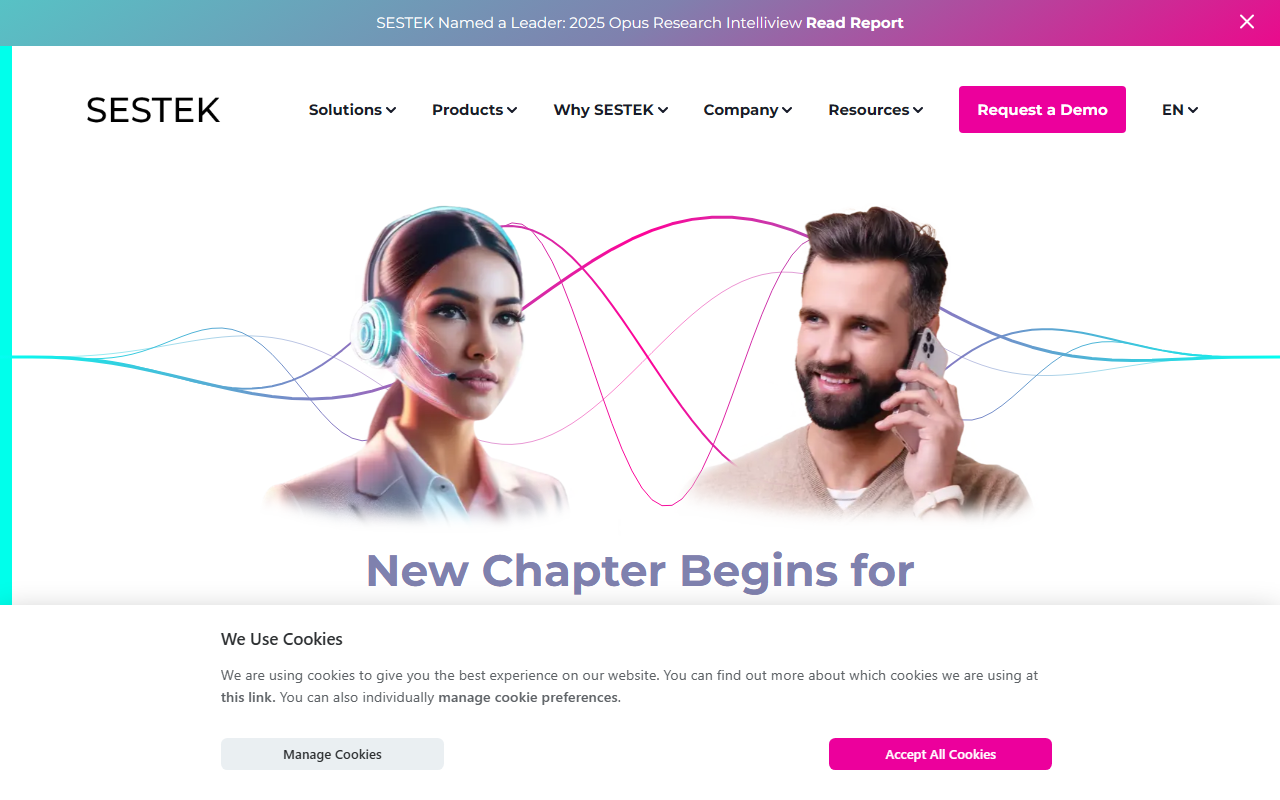
Upon visiting SESTEK’s website, I was met with a clean, corporate design that immediately communicates enterprise credibility. The hero section touts a 2025 Opus Research leadership mention and Gartner Peer Insights badges, suggesting strong industry recognition. Navigating the top menu reveals a clear structure: Solutions, Why SESTEK, Newsroom, and Contact. The site does not offer a direct trial or demo sign-up without filling out a contact form, which tells me this is a sales-led product aimed at large organizations rather than self-serve developers. I tested the contact flow by clicking “Contact Us”—the form asks for name, company email, and a message, but there is no immediate sandbox or API key generation. For a developer assessing this as a “Dev Framework,” the lack of public documentation or onboarding walkthrough is a notable gap. Despite that, the site does provide case studies and blog posts that hint at integration patterns, such as Conversational IVR deployment for a retail client.
Core Capabilities and Technology
SESTEK positions itself as a conversational AI platform for contact centers, but the “Dev Framework” category here reflects its underlying API-first architecture. The platform is built on in‑house technologies including speech recognition with a claimed accuracy of over 97% (up to 100% with fine‑tuning), text‑to‑speech supporting 40+ languages, and a hybrid NLP + LLM engine for its AI agents. I was especially interested in the “hybrid NLP + LLM architecture” – it combines deterministic intent recognition with generative flexibility, which should give developers more control than pure LLM approaches. The platform also offers voice biometrics, real‑time agent assist, and automated quality management with script adherence scoring. Importantly, SESTEK is cloud‑agnostic: it can be deployed on‑premise, public cloud, or private cloud. For a dev framework, this matters because you can integrate it without being locked into a specific cloud vendor. The website lists 60% of employees as R&D engineers and 100% in‑house technology ownership, which builds confidence in the stack’s stability and long‑term support. However, I did not find specific API endpoints, SDKs, or code samples on the public site – those are likely provided after a sales evaluation.
Pricing and Market Positioning
Pricing is not publicly listed on the website, which is typical for enterprise contact center solutions. SESTEK asks interested teams to contact sales for a quote. This suggests a custom pricing model based on usage volume (e.g., minutes of speech processed, number of agent seats, or deployed channels). Competitors in this space include Genesys Cloud CX, NICE CXone, and more developer‑friendly frameworks like Cognigy.AI or Kore.ai. Unlike those, SESTEK emphasizes its 100% in‑house ownership and 20+ years of speech research, which could appeal to organizations needing deep customization and on‑premise deployment. The company is part of UNIFONIC, which adds financial backing. For smaller teams or individual developers, the lack of a free tier or transparent pricing may be a barrier. The platform is clearly designed for mid‑large contact centers handling high volumes of voice and digital interactions, not for quick prototyping. That said, the promise of multimodel deployment (voice, chat, SMS, WhatsApp) and real‑time analytics makes it a strong contender for enterprises already running legacy IVR systems.
Who Should Use SESTEK?
SESTEK is best suited for enterprise contact centers that need a reliable, high‑accuracy conversational AI platform with robust on‑premise options. Its strengths lie in speech recognition accuracy, language coverage, and a hybrid architecture that reduces hallucination risks compared to pure LLM solutions. The platform’s real‑time alerting and automated quality management are valuable for compliance‑heavy industries like finance and insurance. On the downside, the absence of public documentation, sandbox environment, or clear pricing makes it less accessible for indie developers or small teams evaluating it as a “Dev Framework.” If you need a quick API to add voice or chatbot capabilities to an app, look at simpler options like Google Cloud Speech-to-Text or Twilio Autopilot. But if you are a large organization with dedicated R&D and need a fully integrated, cloud‑agnostic suite, SESTEK warrants a serious conversation. For an in‑depth technical review, I would need access to their API documentation and a live sandbox – something the sales team can likely provide.
Visit SESTEK at https://sestek.com/ to explore it yourself.













Comments